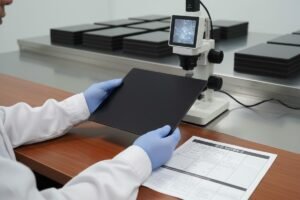

Every year, our production team fields hundreds of inquiries from European distributors who share the same frustration: they invested in solar shingles that looked great in a catalog but failed under real European weather IEC 61215 and IEC 61730 1. Rain seeped through joints during a Belgian storm. Hail cracked tiles on a German rooftop. Color mismatches turned a French client’s elegant slate-style roof into a patchwork embarrassment IEC 61215 hail impact test 2. These are not rare complaints—they are the norm when sourcing decisions skip critical climate-specific due diligence.
To choose the best solar roof shingles for Europe, verify dual CE and TUV certifications for both electrical and building compliance, confirm hail resistance to at least 35mm, demand batch-matched color samples, and prioritize interlocking waterproof designs that reduce labor-intensive installation time on site.
This guide breaks down the four most critical questions European buyers must answer before placing an order EN 1991-1-4 for wind loads 3. Each section draws on two decades of BIPV manufacturing experience and real sourcing scenarios. Let’s walk through them one by one.
What certifications must I verify to ensure my solar shingles comply with both European electrical and building safety standards?
A few years ago, one of our French distribution partners had a full container held at customs in Le Havre. The product had IEC certification but lacked the Construction Products Regulation documentation 4. That single oversight cost weeks of delay and thousands in storage fees.
You must verify IEC 61215 and IEC 61730 for photovoltaic performance and safety, CE marking under the EU Low Voltage Directive, and CPR compliance for fire rating and structural load. TUV certification adds an extra layer of trust that European building inspectors specifically look for.
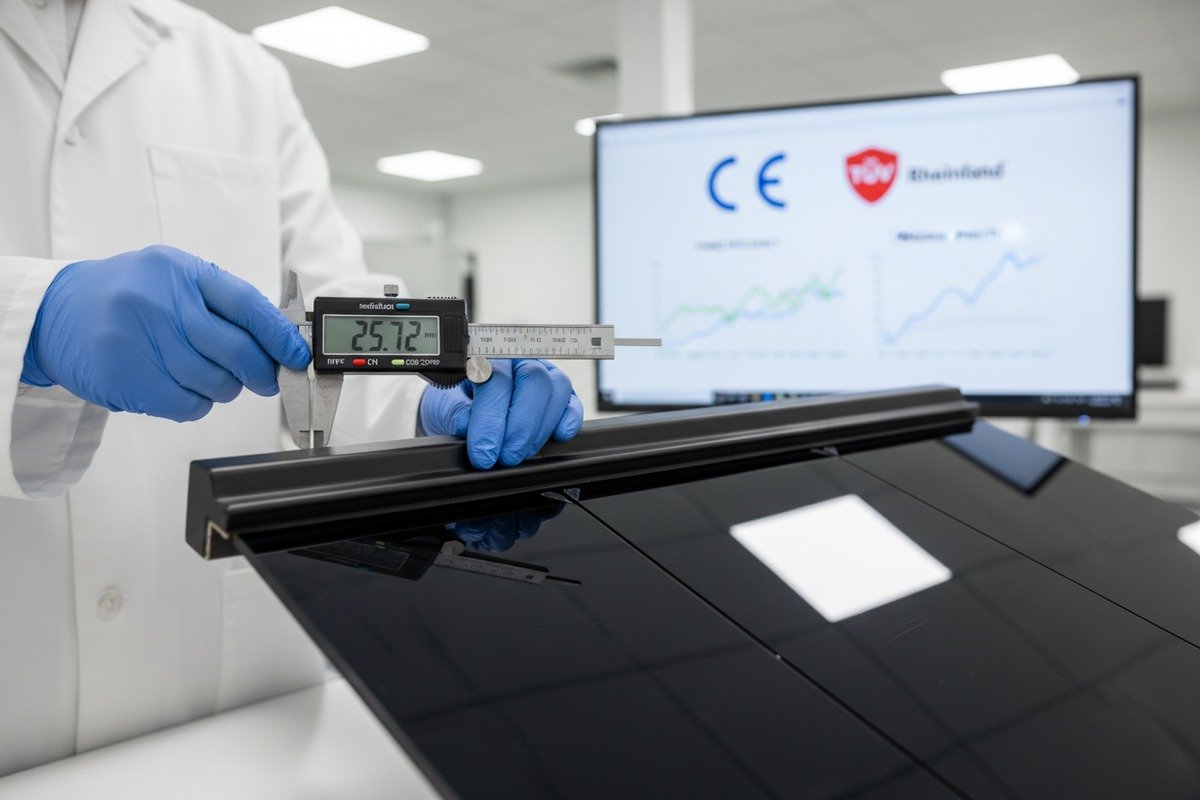
Why "Dual Certification" Matters
Solar roof shingles sit at the intersection of two regulatory worlds. They are electrical devices. They are also building materials. In Europe, you cannot treat them as just one or the other.
On the electrical side, IEC 61215 tests durability under thermal cycling, damp heat, and UV exposure. IEC 61730 covers electrical safety—insulation, grounding, and fire risk from the PV components. CE marking under the Low Voltage Directive (LVD) and Electromagnetic Compatibility (EMC) Directive 5 is legally required to sell in the EU. EU Low Voltage Directive 6
On the building side, the Construction Products Regulation (CPR) governs fire classification, wind uplift resistance, water penetration, and mechanical load capacity. EN 50583 7, the European standard specifically for Building-Integrated Photovoltaics, bridges these two worlds. It defines how BIPV products must meet both energy and construction requirements simultaneously.
The Certification Checklist
| Certification | What It Covers | Why It Matters for Europe |
|---|---|---|
| IEC 61215 | PV module performance and durability | Validates power output under thermal cycling, humidity, and UV stress |
| IEC 61730 | PV module electrical safety | Ensures safe insulation, grounding, and fire resistance of PV components |
| CE (LVD + EMC) | EU electrical market access | Legally mandatory for selling any electrical product in the EU |
| CPR (EU 305/2011) | Construction product fire, load, and waterproofing | Required for products permanently integrated into building envelopes |
| EN 50583 | BIPV-specific standard | Combines PV performance with building element requirements |
| TUV Mark | Independent third-party testing | Highly trusted by European inspectors, architects, and insurers |
Common Mistakes Buyers Make
Many buyers assume that a CE mark on the PV module covers building compliance. It does not. The CE mark for electrical safety and the CE mark under CPR are two separate declarations of conformity. When our team prepares export documentation, we provide both sets of test reports because we have seen too many shipments questioned at customs or rejected during building inspections.
Another trap is accepting certificates without checking the testing laboratory's accreditation. A TUV Rheinland or TUV SÜD 8 report carries real weight. A certificate from an unknown lab may not be recognized by local building authorities in Germany, France, or the Netherlands. Always ask your supplier for the full test report—not just the certificate cover page. The report contains the actual test parameters, sample sizes, and pass/fail data.
Our facility maintains both CE and TUV certifications 9 precisely because European buyers need airtight documentation. When Thomas, a purchasing manager in France, asks for compliance proof, we send him the complete dossier: IEC test reports, CPR declarations, TUV certificates, and even the HS Code classification guidance to avoid customs gray areas with BIPV products.
How can I test if the solar tiles will truly withstand the extreme hail and wind conditions typical of the European climate?
When a catastrophic hailstorm struck parts of Bavaria in 2023, our engineering team received urgent calls from two distributors. One had installed our shingles—rated for 35mm hail impact—and reported zero breakage. The other had sourced a cheaper alternative and faced dozens of cracked tiles across multiple rooftops.
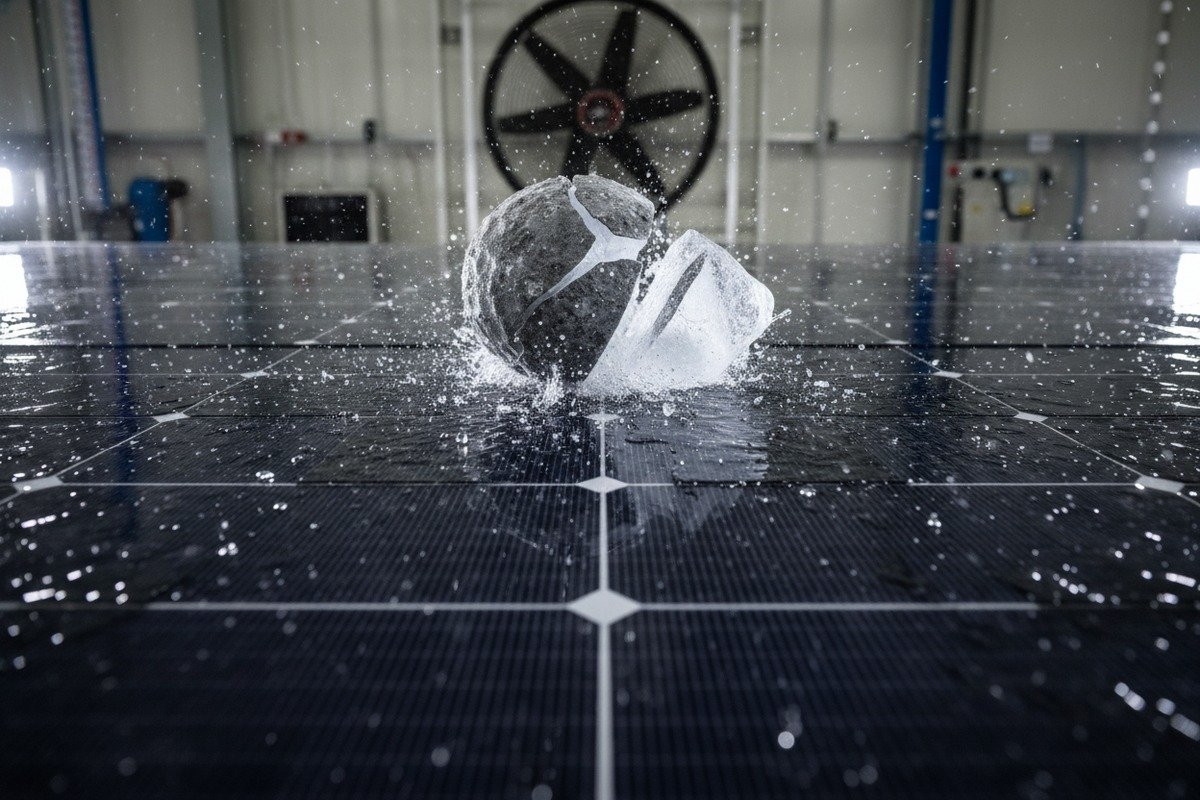
To truly verify hail and wind performance, require IEC 61215 hail impact test reports showing resistance to at least 35mm ice balls at terminal velocity, request independent wind tunnel or uplift test data per EN 1991-1-4 for wind loads up to 150 km/h, and insist on real-world field references from similar European climate zones.
Understanding Europe's Climate Threats
Europe's weather is uniquely challenging for roof-mounted solar products. Temperature swings from -20°C in Scandinavian winters to 40°C in Mediterranean summers create relentless thermal cycling stress. Atlantic storms routinely bring winds of 100–150 km/h to coastal regions. Central Europe experiences severe hailstorms with stones regularly exceeding 25mm in diameter. Heavy, wet snow in Alpine areas adds mechanical load that lightweight PV products were never designed for.
Traditional solar panels mounted on racks sit above the roof surface. Air circulates beneath them. Solar shingles, by contrast, are the roof surface. Every impact, every gust, every freeze-thaw cycle acts directly on the product. This is why lab-tested durability ratings are not optional—they are survival requirements.
Key Tests and What to Demand
| Climate Threat | Relevant Test Standard | Minimum Threshold for Europe |
|---|---|---|
| Hail Impact | IEC 61215 (25mm at 23 m/s standard) | Request 35mm ice ball test for Central/Northern Europe |
| Wind Uplift | EN 1991-1-4 / ASTM D3161 Class F | Resistance to 130+ mph (210 km/h) sustained uplift |
| Thermal Cycling | IEC 61215 (-40°C to +85°C, 200 cycles) | Verify no delamination, micro-cracking, or power loss >5% |
| Snow Load | EN 1991-1-3 | Minimum 2.0 kN/m² for Alpine regions |
| Salt Mist Corrosion | IEC 61701 | Essential for coastal installations in Scandinavia, UK, Atlantic coasts |
Go Beyond the Data Sheet
A data sheet might say "130 mph wind resistance." But how was that number obtained? Was it tested on a flat surface or on a pitched roof assembly? Did the test include the interlocking mechanism or just the individual tile?
Our R&D team learned this lesson early. We now test complete assemblies—shingles interlocked on a 30-degree pitched mock roof—not isolated units. The interlock strength matters as much as the individual tile's strength. A single shingle might survive 200 km/h winds, but if the tongue-and-groove joint fails at 120 km/h, the system fails.
Ask your supplier for assembly-level test data. Request photos or video from the test. If they cannot provide this, consider it a red flag. Also ask for field installation references in your target climate zone. A product proven on rooftops in Hamburg or Amsterdam carries more credibility for European buyers than one tested only in Arizona.
Our shingles use tempered glass rated for 35mm hail impact—well above the standard 25mm threshold in IEC 61215. Combined with Grade 15 wind resistance, they are engineered specifically for Europe's most demanding weather corridors. But we always tell buyers: do not take our word for it. Read the test reports. Visit the reference installations. That is how trust is built.
How do I ensure the solar shingles maintain aesthetic consistency and avoid color batching issues on my clients' roofs?
One of our long-standing partners in the Netherlands once told us a painful story. He installed solar shingles from a previous supplier on a high-end residential project. Under overcast skies, the roof looked fine. The moment direct sunlight hit it, three distinct shades of charcoal became visible. The homeowner refused to sign off. The entire roof section had to be replaced at the distributor's cost.
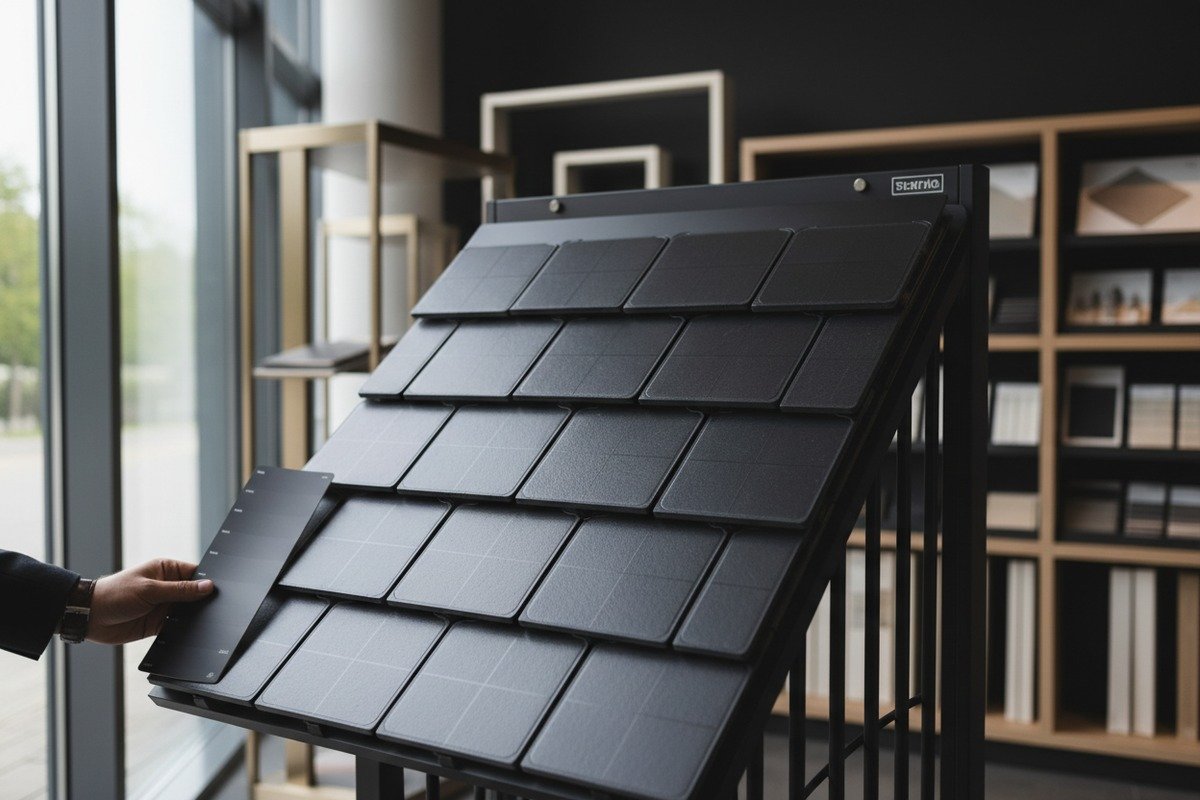
To prevent color batching issues, request pre-production color samples from the specific batch before shipment, require Delta E color deviation reports (ΔE ≤ 1.5 for imperceptible difference), confirm the supplier uses consistent anti-glare coatings, and always order 5–10% extra tiles from the same batch for future repairs or replacements.
Why Color Consistency Is a Make-or-Break Issue
European buyers choose solar shingles over traditional rack-mounted panels for one primary reason: aesthetics. The entire value proposition of BIPV is that the solar product becomes the roof—seamlessly blending with the architecture. If color varies across the rooftop, that value proposition collapses instantly.
Color variation in solar shingles comes from several sources. The solar cell itself can shift slightly in hue depending on the silicon wafer batch. The encapsulant layer and tempered glass coating contribute additional tonal variance. Anti-reflective or anti-glare coatings, if not precisely controlled, create visible differences in reflectivity and color depth.
What Controls to Put in Place
Here is the process we follow in our facility, and what we recommend every buyer demand from any supplier:
Pre-production samples. Before mass production begins, we produce sample tiles from the designated cell batch and glass coating line. These samples are sent to the buyer for visual approval under both diffused and direct light conditions.
Delta E measurement. Delta E (ΔE) is the industry standard for quantifying color difference. A ΔE of 1.0 is barely perceptible to the trained eye. We maintain a ΔE ≤ 1.5 tolerance across all tiles within a single production run. Any tile exceeding this threshold is sorted out during quality control.
Batch tracking. Every pallet of shingles shipped from our factory carries a batch code. If a project requires tiles from multiple production runs, we conduct cross-batch color matching before shipping. This is a step many suppliers skip—and it is the number one cause of patchwork roofs.
Surplus ordering. We always recommend ordering 5–10% more tiles than the project requires, from the same batch. Roofing projects inevitably need replacements over 10–25 years. Without matching surplus tiles stored on site, a single replacement tile can stand out visibly against weathered originals.
Anti-Glare Technology and Architectural Harmony
Our anti-glare coating technology serves a dual purpose. It reduces light reflection—important for neighbors and for aviation regulations near airports—and it creates a more uniform matte appearance across the roof surface. In European markets, where planning authorities in countries like Germany, France, and the UK scrutinize rooftop aesthetics, this uniformity is not a luxury. It is a requirement for project approval.
The deep obsidian black finish on our tiles is achieved through a proprietary coating process that maintains its color stability even after years of UV exposure. We test for color retention under 1,500 hours of accelerated UV aging. The result is a roof that looks as consistent in year ten as it did on installation day.
| Color Control Factor | What to Ask Your Supplier | Acceptable Standard |
|---|---|---|
| Cell batch consistency | Are all tiles for my order from the same cell batch? | Same batch preferred; cross-batch ΔE ≤ 1.5 |
| Glass coating uniformity | What is your coating thickness tolerance? | ±2 microns across production run |
| Delta E color deviation 10 | Can you provide a ΔE test report per batch? | ΔE ≤ 1.5 within batch; ΔE ≤ 2.0 across batches |
| UV color retention | How many hours of accelerated UV testing? | ≥ 1,500 hours with no visible fading |
| Anti-glare reflectivity | What is the measured surface reflectivity? | ≤ 8% for matte finish compliance |
| Surplus availability | Can I order extra tiles from the same batch? | Yes, 5–10% recommended and stored with batch code |
What structural design features should I look for to guarantee long-term waterproofing and lower my installation labor costs?
During a factory visit last year, a roofing contractor from Belgium examined our interlocking mechanism and said something that stuck with us: "In Europe, I pay my installers €45 per hour. Every minute your tile saves me on the roof, I save real money. But if it leaks, I lose everything."
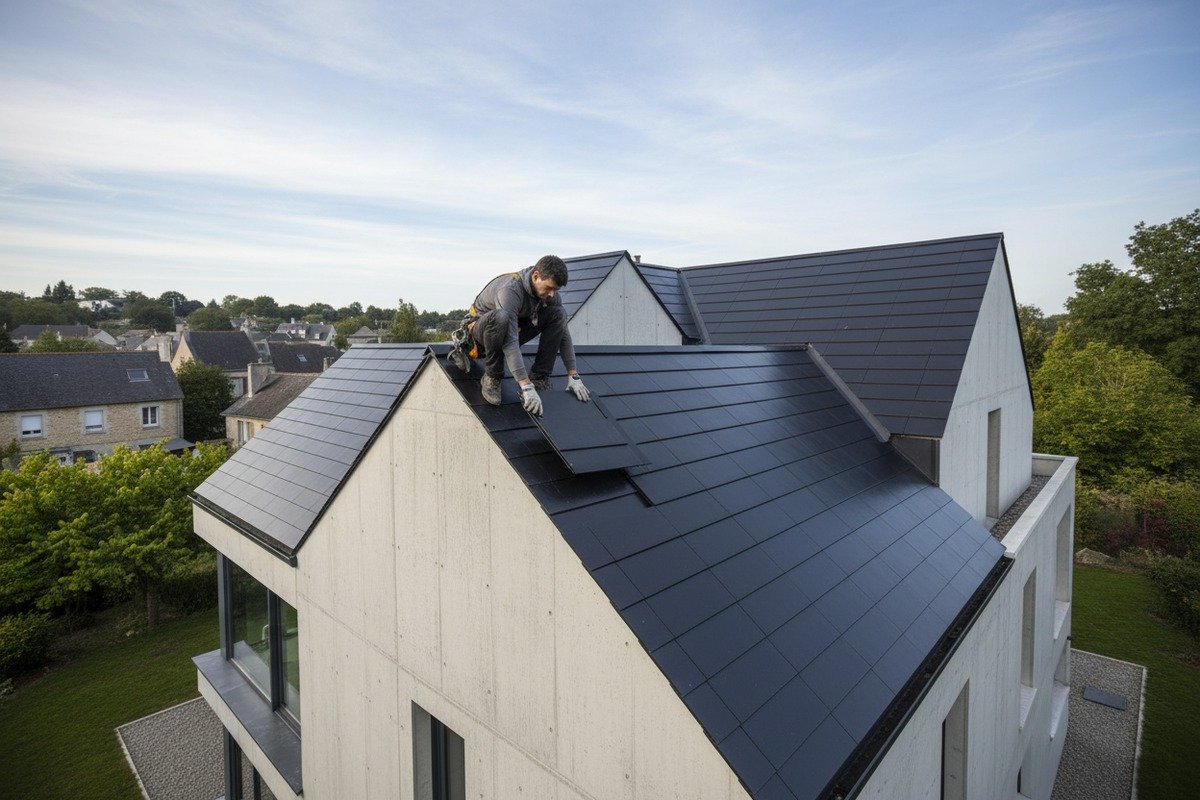
Look for shingles with precision-engineered tongue-and-groove interlocking systems, integrated drainage channels that direct water away from joints, concealed wiring with plug-and-play connectors to cut electrical labor time, and nailable flange designs compatible with standard European roof battens and underlayment systems.
The Waterproofing Problem with Solar Shingles
A traditional solar panel sits on mounting rails above the roof. If water gets under the panel, it hits the actual roof membrane and drains away. No harm done. A solar shingle is the roof membrane. Every penetration point, every joint, every edge is a potential leak path.
This is why structural waterproofing design is the single most important engineering factor for BIPV products in Europe's wet climate. Northern and Western Europe receive 700–1,200mm of annual rainfall. Driving rain pushed by 80 km/h winds can force water upward into joints that would stay dry in calm conditions. Snow melt and ice dam formation in Alpine and Scandinavian regions create standing water conditions that test every seal.
Critical Design Features
Overlapping interlock design. Our shingles use a multi-step overlapping interlock that creates three barriers to water ingress at every joint. The first step sheds bulk water. The second step catches any wind-driven moisture. The third step provides a sealed gasket backup. This triple-redundancy approach is modeled on centuries-old slate roofing principles but engineered for modern PV integration.
Integrated drainage channels. Micro-channels molded into the underside of each shingle direct any moisture that does penetrate to the next lower course, where it exits at the eave. Water never pools. Water never contacts the roof deck.
Concealed fastening. Every nail or screw hole is a potential leak point. Our nailable flange is positioned so that the overlapping upper shingle completely covers it. No fastener is exposed to weather. This also improves aesthetics—no visible hardware on the finished roof.
Reducing Installation Labor Costs
European labor costs make installation time a critical factor in project profitability. A solar shingle system that takes 50% longer to install than a traditional roof can wipe out the energy savings for years.
Here is what reduces time on the roof:
Plug-and-play electrical connectors. Instead of requiring electricians to hand-wire each tile, our shingles use MC4-compatible snap connectors. One click per tile. A trained two-person crew can install and wire a 30m² section in under four hours.
Standardized dimensions. Our tiles are designed to align with common European roof batten spacing (300–345mm for pitched roofs). No custom battens needed. No special cutting. This alone saves 20–30% of layout time compared to products designed for American roof framing.
Pre-wired string configurations. We ship tiles in pre-configured strings where possible, with wiring harnesses already routed and labeled. The installer connects strings to the junction box rather than individual tiles to the string.
Design Feature Comparison
| Feature | Budget Solar Shingles | Mid-Range Products | Lonsontech Design |
|---|---|---|---|
| Interlock type | Single overlap | Double overlap | Triple-step overlap with gasket |
| Drainage channels | None | Surface only | Integrated underside micro-channels |
| Fastener exposure | Exposed nail heads | Partially concealed | Fully concealed under overlap |
| Electrical connection | Hand-wired junction | MC4 connectors | Pre-wired strings with MC4 snap |
| Batten compatibility | US spacing only | Adjustable | Matched to EU 300–345mm standard |
| Waterproof warranty | 5 years | 10 years | 25 years |
Real-World Impact on ROI
The labor savings are not theoretical. On a typical 100m² European residential roof, our interlocking system reduces total installation time by approximately 30% compared to first-generation solar shingle designs. At average European labor rates of €40–50 per hour for a two-person crew, that translates to savings of €800–1,200 per project. Over a distributor's annual volume of 50–100 roofs, the cumulative savings are substantial.
And the waterproofing? Our professional drainage design has maintained a zero-leak record across all European installations over the past five years. That is not marketing language. That is claims data. In a market where a single roof leak can trigger compensation claims of €10,000 or more, proven waterproofing is not a feature. It is insurance.
Conclusion
Choosing the right solar roof shingles for Europe comes down to four pillars: verified dual certifications, climate-tested durability, batch-controlled aesthetics, and labor-saving waterproof design. Get these right, and your sourcing decision protects both your reputation and your margins for decades.
Footnotes
1. Details key international standards for PV module performance and safety. ↩︎
2. Explains the standard for testing PV module resistance to hail damage. ↩︎
3. Provides information on the European standard for assessing wind actions on structures. ↩︎
4. Provides context on the legal requirement for building materials in the EU. ↩︎
5. Clarifies the directive ensuring electrical devices do not interfere with others. ↩︎
6. Explains the legal requirement for electrical products in the EU market. ↩︎
7. Links to the specific European standard for Building-Integrated Photovoltaics. ↩︎
8. Highlights the authority and recognition of these independent testing bodies. ↩︎
9. This article from the original domain provides a comprehensive guide to IEC, UL, and TÜV certifications, including CE marking, making it a suitable replacement. ↩︎
10. Defines the metric used to quantify and control color differences in products. ↩︎