

Every week, our sales team fields calls from European distributors who got burned by a supplier whose warranty turned out to be worthless paper photovoltaic cell 1. The frustration is real — you invest in thousands of solar shingles, install them across dozens of rooftops, and then discover the fine print excludes nearly every realistic failure scenario. That gap between what a warranty promises and what it actually delivers can cost your business hundreds of thousands of euros.
To compare solar roof shingle warranties effectively, you must separately evaluate the product material warranty, the solar performance guarantee, the workmanship coverage, and the structural waterproofing terms. Then assess the supplier’s financial stability, certifications, weather resistance ratings, and whether the warranty includes labor and consequential damage coverage.
This guide breaks down every critical factor — from decoding prorated vs. non-prorated terms to verifying a manufacturer’s bankability over a 25-year horizon. Let’s walk through the exact questions you need to ask before signing any supply agreement.
How do I distinguish between a solar performance warranty and a structural waterproofing guarantee?
When we first started designing our BIPV shingle systems over 20 years ago, the biggest source of confusion among our partners was this exact question. Many buyers assume one warranty covers everything. It does not. Mixing these two up leads to denied claims and expensive disputes.
A solar performance warranty guarantees minimum electricity output over time — typically 80% at 25 years. A structural waterproofing guarantee covers the physical integrity of the tile as a building envelope component, protecting against leaks, wind uplift, and water penetration. They are separate documents with different terms.
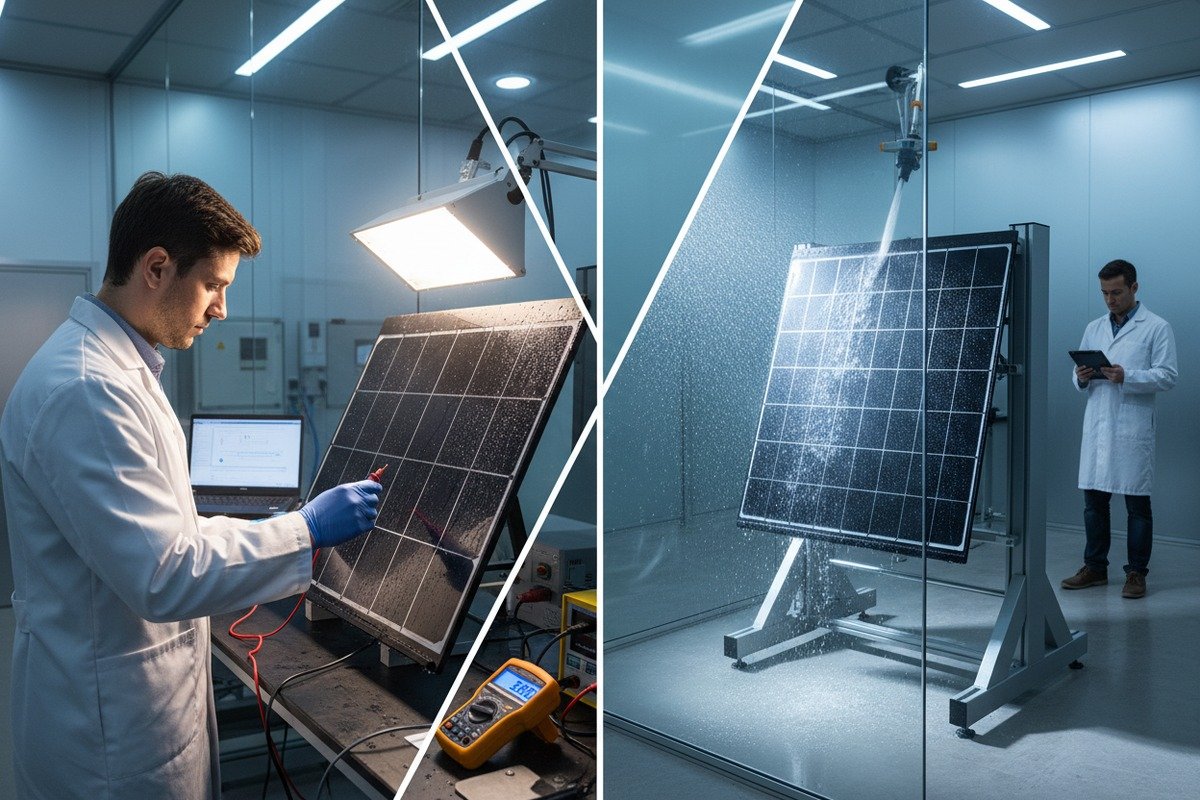
Why These Two Warranties Exist Separately
Solar roof shingles serve two functions. They generate electricity. They also protect the building from rain, wind, and snow. A traditional solar panel only does the first job. A traditional roof tile only does the second. When you merge both into one product, you need two distinct warranty scopes.
The solar performance warranty 2 addresses power degradation. Every photovoltaic cell loses efficiency over time. A good warranty guarantees no more than 2–3% loss in year one and a linear degradation to 80–85% output by year 25. If a batch of shingles drops below that threshold, the manufacturer must replace or compensate.
The structural waterproofing guarantee 3 addresses the tile's role as a building material. It covers cracking, delamination, seal failure, and water ingress. In our production facility, we run hydrostatic pressure tests and cyclic wind-rain simulations before any batch ships. This guarantee matters enormously in Europe, where a single roof leak can trigger compensation claims exceeding €50,000 for interior damage.
Key Differences at a Glance
| Aspect | Solar Performance Warranty | Structural Waterproofing Guarantee |
|---|---|---|
| What It Covers | Minimum power output over time | Physical integrity, leak resistance, wind uplift |
| Typical Duration | 25 years | 10–25 years |
| Measurement | Watts or kWh vs. rated capacity | Pass/fail on water penetration, structural load |
| Common Exclusions | Shading, dirt accumulation, inverter failure | Improper installation, inadequate ventilation |
| Claim Trigger | Output drops below guaranteed % | Water ingress or material cracking |
| Who Tests | Independent PV testing lab | Building inspector or manufacturer's team |
Watch for the "Consequential Damage" Clause
Here is where many buyers get caught. A structural waterproofing guarantee may cover replacing the defective tile — but not the water damage to the ceiling, insulation, or wiring underneath. Our warranty at Lonsontech explicitly addresses consequential damage provisions because we understand that for European contractors, interior damage liability is the real financial risk. Always ask: "If your tile leaks and damages my client's home, does your warranty cover the interior repairs?"
Data Monitoring Requirements
Some manufacturers require your system to stay connected to the internet for the performance warranty to remain valid. If the monitoring system goes offline for an extended period, they may deny a power output claim. Check the fine print. Our approach is to provide monitoring support but not void the warranty for temporary connectivity issues — because real-world installations in rural European areas don't always have perfect internet.
What specific certifications do I need to verify to ensure my solar shingles comply with European building codes?
Our engineering team spent years navigating European certification requirements — and I can tell you, it is one of the most misunderstood areas in the BIPV industry. A product can have a perfect CE mark for its electrical performance and still be illegal to install as a roofing material in Germany or France.
European solar shingles require dual certification: electrical safety (IEC 61215, IEC 61730) validated by TUV or equivalent, plus compliance with the Construction Products Regulation (CPR) covering fire classification (EN 13501-1), wind load (EN 1991-1-4), snow load, and water penetration (EN 539-1). Both sets of certifications are mandatory for legal installation.
The Dual Certification Problem
This is the number one compliance barrier our European partners face. Solar shingles sit at the intersection of two regulatory worlds: photovoltaic equipment and construction materials. Each world has its own set of standards, testing bodies, and approval processes.
On the PV side, you need IEC 61215 4 (crystalline silicon module design qualification) and IEC 61730 5 (PV module safety qualification). These are standard for any solar product entering Europe and are typically certified by TUV Rheinland, TUV SUD, or equivalent notified bodies.
On the construction side, the EU's Construction Products Regulation 6 (CPR) requires that any product permanently integrated into a building must meet specific performance declarations. For roof tiles, this means:
- Fire rating per EN 13501-1 7 (Euroclass A1 to F)
- Wind resistance per EN 1991-1-4 8 and national annexes
- Water tightness per EN 539-1 9
- Mechanical resistance for snow and maintenance loads
- Durability under freeze-thaw cycling
Certification Checklist for European Markets
| Certification / Standard | What It Covers | Required For |
|---|---|---|
| IEC 61215 | PV module design qualification and performance | All EU markets (electrical) |
| IEC 61730 | PV module safety — insulation, fire, mechanical | All EU markets (electrical) |
| EN 13501-1 (CPR) | Fire classification of construction products | Building code compliance |
| EN 1991-1-4 | Wind actions on structures | Structural engineering approval |
| EN 539-1 | Water impermeability of roof tiles | Roofing compliance |
| CE Marking 10 (DoP) | Declaration of Performance under CPR | Mandatory for EU market entry |
| TUV Certificate | Third-party validation of PV standards | Industry standard, buyer requirement |
| MCS (UK-specific) | Microgeneration Certification Scheme | Required for UK feed-in tariffs |
Why "CE Marked" Is Not Enough
A CE mark alone can be misleading. The CE mark on a solar module certifies its electrical safety. The CE mark under CPR certifies its construction performance. These are different declarations. When we prepare our Declaration of Performance (DoP) at Lonsontech, we ensure it covers both the photovoltaic and the construction product requirements. We advise every buyer to request the full DoP and verify which standards are referenced — not just look for the CE logo on the box.
Country-Specific Additions
France requires products to meet specific DTU (Documents Techniques Unifiés) standards for roofing. Germany's building authorities may require additional AbZ (Allgemeine bauaufsichtliche Zulassung) or ETA (European Technical Assessment) approvals. The Netherlands has its own KOMO certification for building products. Always verify national requirements on top of EU-wide standards.
How can I evaluate the long-term stability of a BIPV supplier to ensure my 25-year warranty is actually protected?
I remember a conversation with a distributor in Lyon who told me he had sourced from three different BIPV suppliers in the past decade. Two of them no longer exist. His customers still have tiles on their roofs — but no one to call when something fails. This is the nightmare scenario that keeps procurement managers up at night.
To evaluate a BIPV supplier's long-term stability, examine their financial history, years in operation, production scale, patent portfolio, insurance or escrow arrangements for warranty reserves, and the diversity of their client base. A supplier with 15+ years of track record, audited financials, and a warranty reserve fund offers far more protection than a startup with impressive specs but no proven longevity.
The "Bankability" Question
In the solar industry, "bankability" refers to whether a company is financially stable enough to honor its commitments over the lifespan of the product. For a 25-year warranty, this is not a minor concern. It is arguably the single most important factor in your purchasing decision.
Our company has been in the solar and building materials space for 20 years. We have a team of 100 employees and an established manufacturing base in Hainan. But we don't expect you to take our word for it. We encourage every buyer to conduct due diligence — and here is exactly how to do it.
A Practical Due Diligence Framework
Step 1: Check operational history. How long has the supplier been manufacturing BIPV products specifically? General solar panel experience helps, but BIPV has unique engineering challenges. A company that has been making standard panels for 10 years but only started BIPV last year carries more risk.
Step 2: Request audited financial statements. Any serious manufacturer should be willing to share revenue trends, profitability, and debt levels — at least in summary form. If they refuse, that is a red flag.
Step 3: Ask about warranty reserve funds. Responsible manufacturers set aside a percentage of revenue specifically to cover future warranty claims. At Lonsontech, we maintain a dedicated warranty reserve that scales with our installed base. Ask your supplier if they do the same — and how it's structured.
Step 4: Evaluate client diversity. A supplier dependent on one or two large clients is more vulnerable to sudden revenue loss. Broad distribution across multiple European markets signals resilience.
Step 5: Review their patent portfolio and R&D investment. Companies that invest in proprietary technology are building long-term competitive advantages, which correlates with long-term survival.
Step 6: Investigate insurance options. Some manufacturers offer third-party warranty insurance through companies like Munich Re or Zurich. This means even if the manufacturer fails, the insurance provider honors the warranty. This is the gold standard of warranty protection.
Red Flags That Signal Risk
- The company was founded less than 5 years ago and offers 25-year warranties
- No physical factory tour is possible
- They cannot name reference installations older than 3 years
- Prices are significantly below market average (often subsidized by investor cash that may run out)
- No clear warranty reserve or insurance mechanism
- High employee turnover or frequent leadership changes
The OEM/ODM Advantage
When you work with an established OEM/ODM partner like us, your private-label product is backed by the manufacturer's full production infrastructure and warranty reserves — not by a small brand that might fold. This is why many European distributors prefer the OEM model. The brand on the box is yours. The warranty backstop is ours.
How do I compare the durability of different solar tiles against extreme weather like Grade 15 winds and heavy hail?
When our R&D team tests a new solar shingle design, extreme weather simulation is where the most prototypes fail. We have seen beautifully designed tiles shatter under 30mm hail or lift off at wind speeds well below their rated threshold — because the mounting system was the weak link, not the glass.
To compare durability, verify third-party test reports for hail impact resistance (IEC 61215 requires 25mm at 23 m/s, but premium tiles withstand 35mm+), wind uplift ratings (Grade 15 equals approximately 184–201 km/h), and cycling tests for thermal stress and freeze-thaw. Always confirm that ratings apply to the installed system — not just the tile in isolation.

Understanding Hail Resistance Ratings
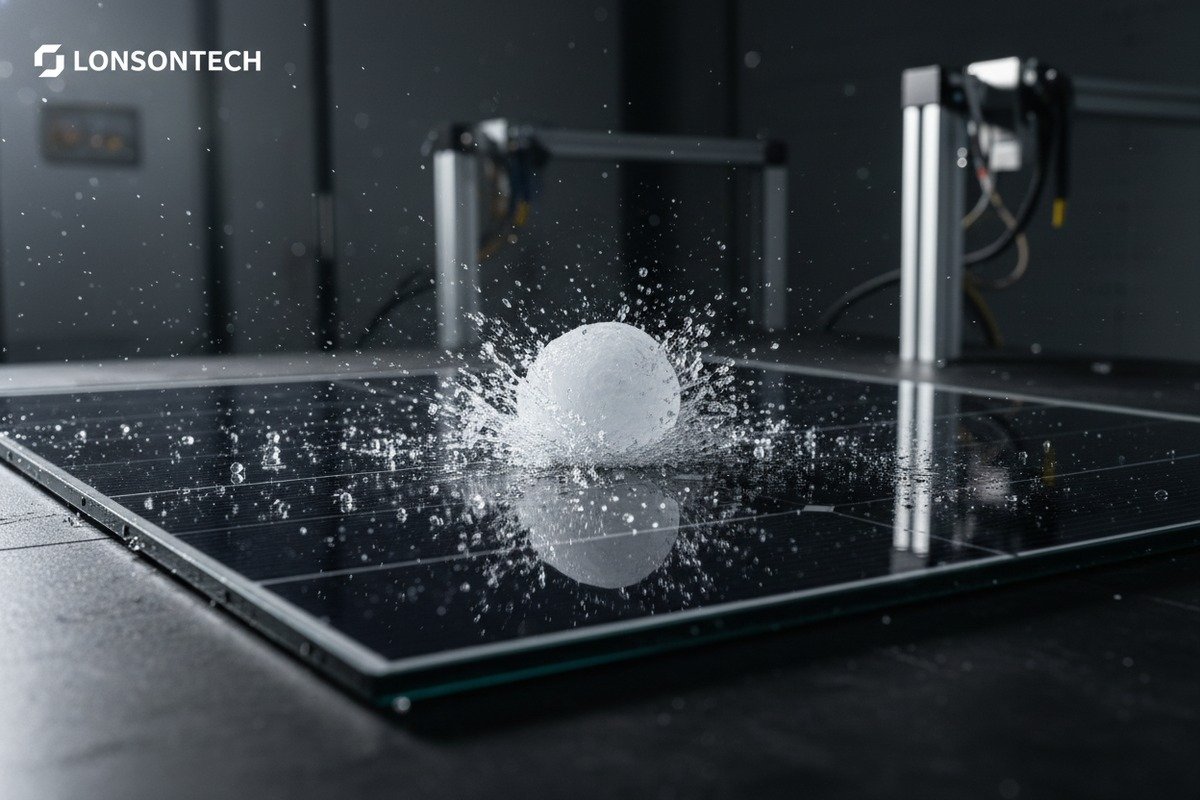
The baseline IEC 61215 hail test fires a 25mm ice ball at 23 m/s at the module surface. This is Class 1 — the minimum. For regions in Europe that experience severe hailstorms (parts of France, Germany, Switzerland, northern Italy), you need higher protection.
Class 4 hail rating, based on UL 2218 or FM 4473, uses a 50mm (2-inch) steel ball dropped from a defined height. Our shingles at Lonsontech are tested to withstand 35mm hailstones — exceeding the IEC baseline by 40%. But here is the critical detail: the test must be performed on the tile as mounted, not floating freely on a test bench. Mounting stresses change how force is distributed.
Understanding Wind Resistance Ratings
Wind ratings for solar tiles can be expressed in different systems, which causes confusion:
| Rating System | Grade 15 Equivalent | Test Method |
|---|---|---|
| Beaufort Scale (Grade 15) | 184–201 km/h | Not a formal test standard — used informally |
| IEC 61215 Mechanical Load | 2400 Pa front / 2400 Pa rear | Static and dynamic load cycling |
| EN 1991-1-4 (Eurocode) | Varies by terrain and building height | Calculated wind pressure on specific installation |
| UL 2703 (US/Global) | Rack-mount system wind loads | Pull-out and shear testing |
| GAF WindProven (proprietary) | No max speed (with full accessory system) | Proprietary certification by GAF |
Grade 15 winds are roughly equivalent to a Category 3 hurricane. Most standard solar panels are rated to 130 km/h without special mounting. Premium BIPV shingles must go well beyond this.
The Mounting System Is the Real Test
A tile can survive a 200 km/h wind in a lab. But if the interlocking mechanism or adhesive fails on a real roof, the tile is airborne. When we design our interlocking profiles, we run full-assembly wind tunnel tests — not just single-tile pull tests. The weakest link in any roofing system is the connection between tiles, not the tile itself.
Thermal Cycling and Freeze-Thaw
Europe's climate puts enormous stress on roof materials. A tile in Stockholm might experience 100+ freeze-thaw cycles per year. IEC 61215 requires 200 thermal cycles between -40°C and +85°C. But real-world cycling in northern Europe can be more demanding due to moisture ingress during thaw periods. We add 50 additional humidity-freeze cycles beyond the standard to validate our products for Scandinavian and Alpine markets.
Comparing Brands on Weather Resistance
| Feature | Lonsontech | Tesla Solar Roof | GAF Timberline Solar | SunTegra |
|---|---|---|---|---|
| Hail Rating | 35mm ice ball | Class 3 (per reports) | Class 4 (UL 2218) | Class 3-4 (varies) |
| Wind Rating | Grade 15 (184–201 km/h) | 110 mph (177 km/h) | No max (WindProven with accessories) | 130 mph (209 km/h) |
| Thermal Cycling | 200 + 50 humidity-freeze cycles | IEC 61215 standard | IEC 61215 standard | IEC 61215 standard |
| Waterproof Design | Professional interlocking drainage system | Integrated flashing | Nailable shingle + seal | Rackless overlay |
| Fire Rating | Class A (per EN 13501-1 equivalent) | Class A | Class A | Class A |
Note that GAF's "no max wind speed" claim through WindProven requires the use of LayerLock technology plus four specific accessories installed by a certified contractor. Without all components, the wind warranty reverts to standard terms. This is an important distinction that many buyers overlook.
Ask for the Full Test Report
Never accept a datasheet specification alone. Request the actual third-party test report — issued by TUV, UL, or an accredited lab. The report will show test conditions, sample sizes, pass/fail criteria, and any deviations. If a supplier cannot produce this document, their durability claims are unverified marketing.
Conclusion
Choosing the right solar roof shingle supplier means looking far beyond the headline warranty number. Compare performance and structural warranties separately, verify dual certifications, assess the supplier's financial longevity, and demand third-party weather resistance test reports. Your roof — and your business reputation — depends on getting this right.
Footnotes
1. Defines what a photovoltaic cell is and how it works. ↩︎
2. Explains what a solar performance guarantee covers. ↩︎
3. Details the standard for roof tile water impermeability. ↩︎
4. Explains the international standard for PV module design qualification. ↩︎
5. Explains the international standard for PV module safety qualification. ↩︎
6. Official guidance on the EU Construction Products Regulation. ↩︎
7. Details the European standard for fire classification of construction products. ↩︎
8. Defines natural wind actions for structural design of buildings. ↩︎
9. Specifies test methods for water impermeability of clay roof tiles. ↩︎
10. Defines CE marking and its significance for European market. ↩︎