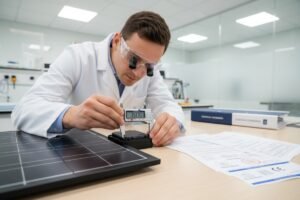
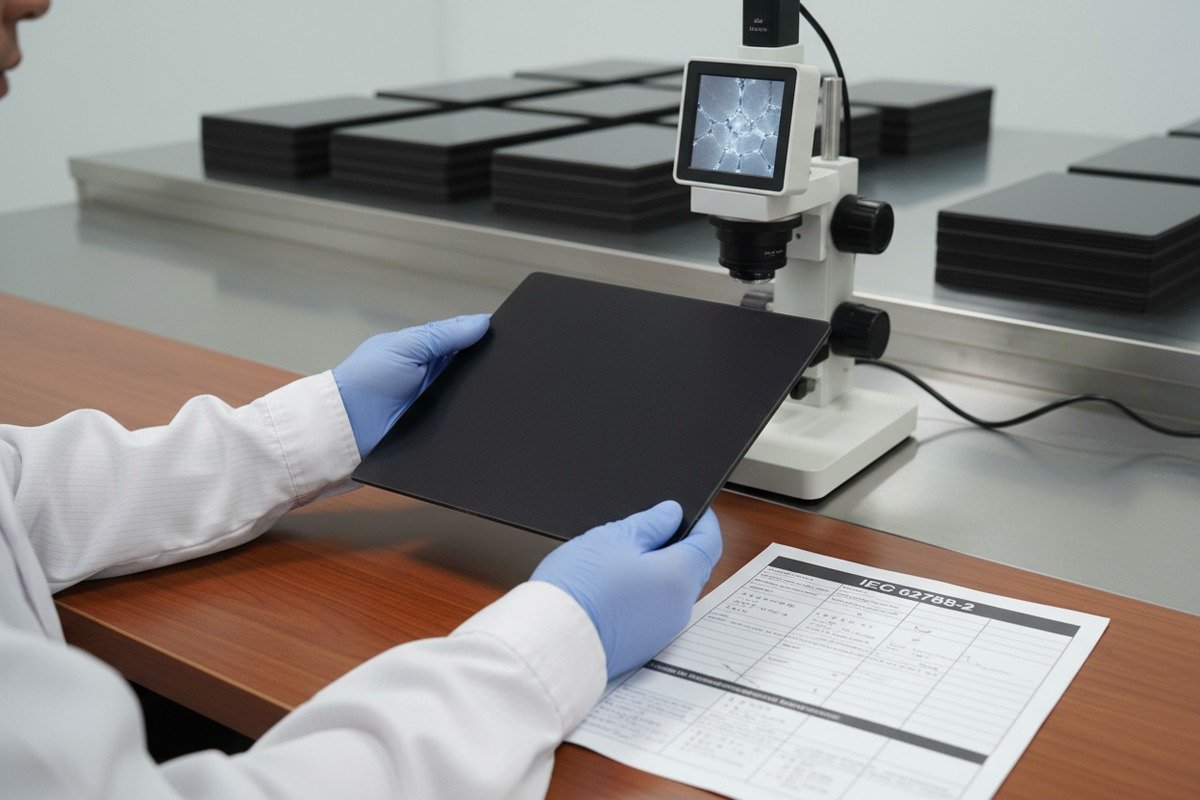
Over 20 years on our production lines, we have seen encapsulant failures destroy entire rooftop projects.
To verify EVA/POE quality grades when sourcing solar roof shingles from China, request third-party test reports for gel content, light transmittance, PID resistance, and yellowness index. Cross-check certifications via IEC 62788-2 and IEC 62804, and conduct independent factory audits before placing bulk orders.
This guide breaks down the exact steps, test benchmarks, and red flags you need to know Differential Scanning Calorimetry 1. Whether you source EVA or POE encapsulants for your solar shingle projects, the details below will help you avoid costly mistakes and protect your 25-year warranty commitments.
How can I distinguish between high-grade POE and standard EVA when reviewing my supplier's technical specifications?
When our R&D team formulates lamination recipes for new shingle lines, the encapsulant choice shapes everything from cell protection to long-term aesthetics.
High-grade POE shows superior moisture resistance, lower yellowness index (<3), higher light transmittance (>92%), and near-zero PID degradation (<1%). Standard EVA offers adequate performance at lower cost but has higher moisture permeability and moderate PID risk (5–15% degradation). Always compare spec sheets side by side against IEC benchmarks.
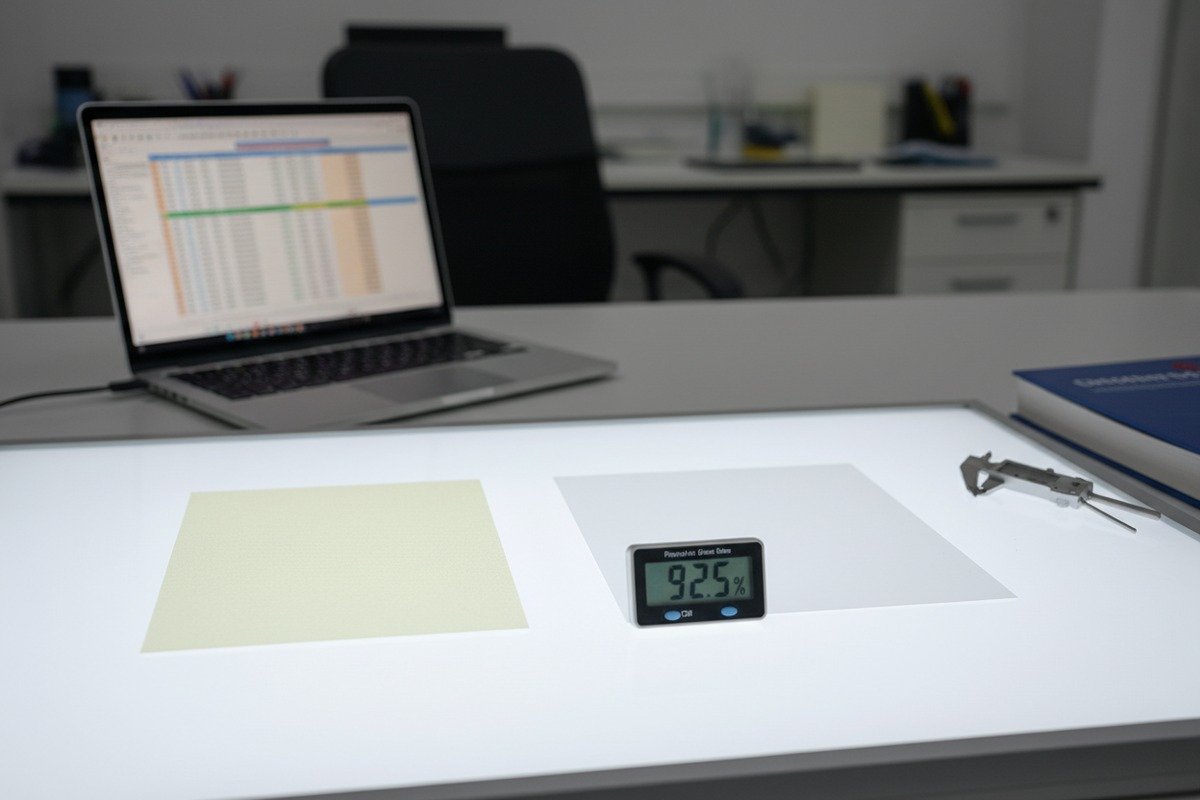
Understanding the Chemistry Behind EVA and POE
EVA stands for Ethylene Vinyl Acetate 2. It is a copolymer. The vinyl acetate (VA) content determines its grade. Solar-grade EVA requires a VA content of 28–33%. Below 28%, you are likely looking at industrial-grade EVA used for shoe soles or packaging. That material will yellow, crack, and delaminate within a few years on a rooftop.
POE stands for Polyolefin Elastomer 3. It is an olefin-based material with no vinyl acetate. POE has a fundamentally different molecular structure. It resists moisture penetration far better than EVA. This matters for solar roof shingles because shingles sit directly on the roof deck, exposed to humidity from both sides.
On our production floor, we run both EVA and POE lamination depending on the customer's market and budget. For European rooftop projects where humidity and temperature cycling are intense, we strongly recommend POE or EPE (EVA/POE/EVA co-extruded film).
Key Specification Differences at a Glance
| Metric | Standard EVA (Solar-Grade) | High-Grade POE | Test Standard |
|---|---|---|---|
| VA Content | 28–33% | N/A (olefin-based) | FTIR Spectroscopy 4 |
| Gel Content 5 (Cross-linking) | >80% | >85% | IEC 62788-2 |
| Light Transmittance 6 | >91% | >92% | ASTM D1003 |
| Yellowness Index | <5 | <3 | ASTM E313 |
| PID Resistance | Moderate (5–15% degradation) | High (<1% degradation) | IEC 62804 7 |
| Water Vapor Transmission Rate | Higher | Significantly Lower | ASTM E96 |
| Typical Lifespan Contribution | 25 years | 30+ years | IEC 61215 |
| Relative Cost | Baseline | 20–30% higher | — |
How to Read a Supplier's Spec Sheet
When a Chinese factory sends you a technical data sheet (TDS), look for these items first:
- VA content — If it says less than 28%, reject it immediately. Some suppliers list "EVA film" without specifying the grade.
- Gel content after lamination — This tells you the cross-linking degree. Anything below 75% is a concern.
- Light transmittance — Must be above 91% for EVA, above 92% for POE.
- Yellowness index — A high starting yellowness means the material will degrade faster under UV.
If the TDS is missing any of these values, that is your first warning sign. A reputable encapsulant supplier will provide complete data. Our engineering team always cross-references supplier TDS data against our own incoming quality control (IQC) test results before approving a batch.
POE for Premium Shingles: When It Makes Sense
POE is not always necessary. For standard p-type PERC cells in moderate climates, solar-grade EVA performs well and costs 20–30% less. But for high-efficiency n-type cells (TOPCon, HJT), bifacial configurations, or installations in humid coastal regions, POE is the safer choice. Our customers in Southern France, the Netherlands, and coastal Germany almost always specify POE or EPE for this reason.
EPE co-extruded film is gaining traction as a middle ground. It combines EVA's easy lamination with POE's moisture barrier on the cell side. This is a practical option if your budget is tight but your climate demands more protection.
What specific test reports should I request from a Chinese factory to verify the cross-linking degree of my solar shingle encapsulants?
During incoming material inspections at our Hainan facility, we run cross-linking tests on every encapsulant batch before it enters lamination.
Request IEC 62788-2 gel content extraction reports, FTIR spectroscopy analysis for resin composition, DSC (Differential Scanning Calorimetry) curves for curing behavior, and IEC 62804 PID test results. All reports should come from accredited third-party labs such as TÜV, SGS, or Intertek — not only from the supplier's in-house lab.
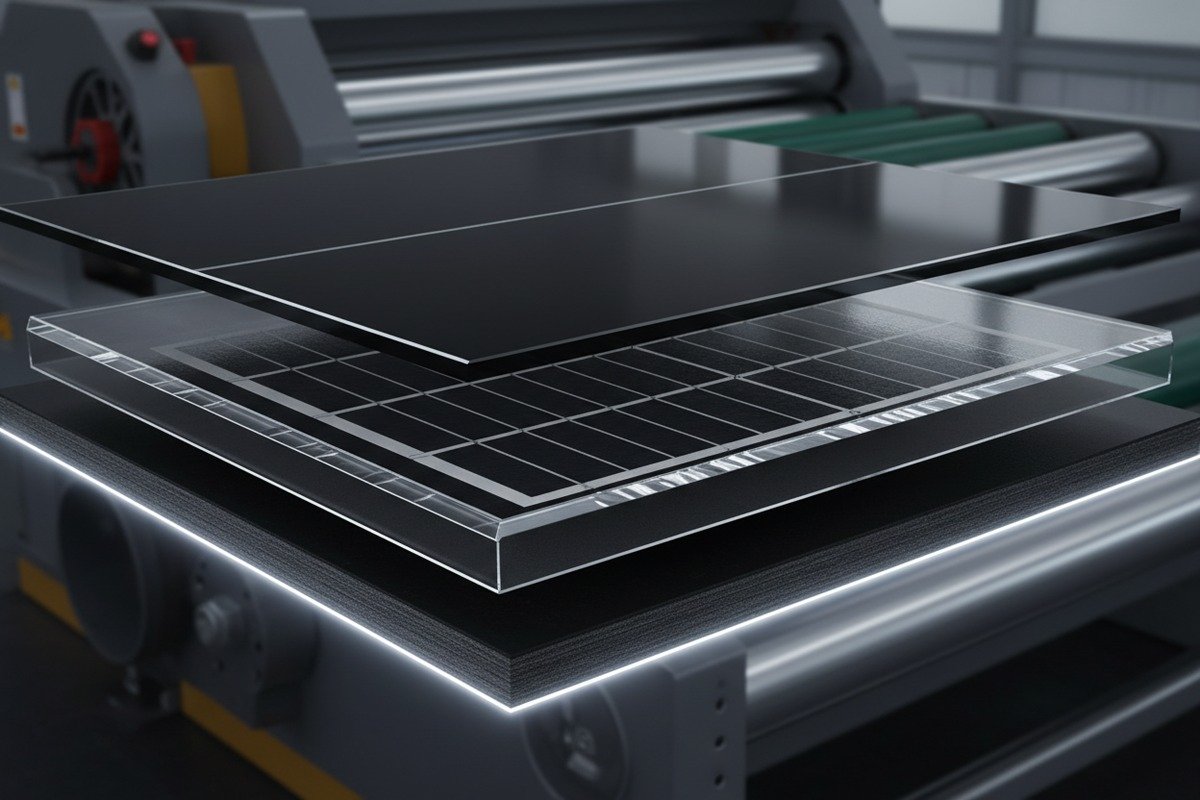
The Gel Content Test: Your Most Important Metric
Gel content measures how much of the encapsulant has cross-linked (cured) during lamination. Higher cross-linking means better adhesion, better creep resistance, and better long-term stability. The test works by dissolving a laminated sample in xylene solvent and measuring how much material remains undissolved. That remaining portion is the gel content.
For solar-grade EVA, you need gel content above 80%. For cross-linked POE, aim for above 85%. If your supplier's report shows 70% or lower, the encapsulant is under-cured. It will creep, delaminate, or lose adhesion over time.
One critical nuance: different standards use slightly different solvents and temperatures for this extraction. Make sure the report specifies which standard was used. IEC 62788-2 8 is the international benchmark. Some Chinese labs use the older GB/T standard, which may yield slightly different numbers.
Essential Test Reports Checklist
| Test Report | What It Verifies | Acceptable Benchmark | Relevant Standard |
|---|---|---|---|
| Gel Content Extraction | Cross-linking degree | EVA >80%, POE >85% | IEC 62788-2 |
| FTIR Spectroscopy | Resin composition, VA content | VA 28–33% for EVA | Internal / ASTM |
| DSC Curve | Curing temperature and completeness | Full cure peak observed | ASTM D3418 |
| Light Transmittance | Optical clarity post-lamination | >91% EVA, >92% POE | ASTM D1003 |
| Yellowness Index 9 | UV stability baseline | <5 EVA, <3 POE | ASTM E313 |
| PID Resistance | Potential Induced Degradation 10 | <5% power loss (EVA), <1% (POE) | IEC 62804 |
| Peel Strength | Adhesion to glass and backsheet | >40 N/cm | IEC 62788 |
| Damp Heat Aging | Long-term humidity resistance | Pass 1000h at 85°C/85% RH | IEC 61215 |
Why Third-Party Reports Matter More Than Supplier Certs
We have encountered situations where suppliers provide in-house test reports showing perfect numbers, but independent lab testing reveals a different story. This is not uncommon in the encapsulant supply chain. Some Chinese encapsulant manufacturers optimize their sample rolls specifically for testing, while bulk production uses a slightly different formulation.
Our recommendation: always request that your specific production batch be tested, not a generic sample. You can hire labs like TÜV Rheinland, SGS, or Bureau Veritas in China to pull samples directly from your order. The cost is typically $500–$1,500 per batch depending on the test scope. This is a small price compared to a field failure on a 500-square-meter roof.
Verifying Certification Authenticity
If a supplier claims TÜV or UL certification for their encapsulant, verify it. Go to the TÜV Rheinland Certipedia website or UL's product iQ database and search the certificate number. Fake certifications exist. We have seen forged TÜV logos on datasheets that were completely fabricated. A five-minute online search can save you years of warranty headaches.
Also verify the scope of the certification. A certificate for "EVA encapsulant film" does not automatically cover all thicknesses, formulations, or applications. The certificate should match the exact product SKU you are ordering.
How do I ensure the EVA/POE quality is sufficient to prevent delamination and PID issues over my 25-year project lifespan?
Our warranty team tracks every field complaint, and delamination and PID remain the two failure modes that cause the most expensive claims in solar roofing.
To prevent delamination and PID over 25 years, specify POE or EPE encapsulants for humid climates, require damp heat test results exceeding 2000 hours at 85°C/85% RH, demand IEC 62804 PID test certification, and include penalty clauses in your supply contract for encapsulant non-conformance. Regular batch testing and traceable raw material documentation are essential.

Why Delamination Happens and How to Stop It
Delamination occurs when the encapsulant loses adhesion to the glass, the solar cell, or the backsheet. The root causes include:
- Insufficient cross-linking — Gel content below 75% means the polymer chains are not bonded tightly enough.
- Moisture ingress — EVA absorbs moisture over time, especially in humid climates. This creates bubbles and voids at the glass-encapsulant interface.
- Poor lamination process — If the factory's lamination vacuum is below 95%, trapped air creates weak spots.
- Contaminated surfaces — Dust or oil on glass before lamination prevents proper bonding.
On our lines, we maintain a Class 10,000 cleanroom environment for lamination. We also run a vacuum below 1 mbar and hold lamination temperature at precisely 145–150°C for EVA and 150–155°C for POE. These parameters are not optional. Even a 5°C deviation can reduce gel content by 10%.
PID: The Silent Killer of Solar Shingles
PID is caused by voltage-driven ion migration through the encapsulant to the cell surface. It degrades cell efficiency over time. In standard EVA, PID can cause 5–15% power loss within the first 5–10 years. For solar roof shingles, this is especially dangerous because shingles are grounded to the building's metal structure, which creates a voltage potential between cells and frame.
POE's low moisture permeability dramatically reduces PID risk. IEC 62804 testing confirms that POE encapsulated modules typically show less than 1% power degradation under accelerated PID conditions. If your project requires a bankable 25-year warranty, POE is the safer choice.
Accelerated Aging Tests You Should Demand
Standard IEC 61215 requires 1000 hours of damp heat testing (85°C/85% RH). But 1000 hours simulates roughly 10–15 years in moderate climates. For a 25-year warranty on a European rooftop, we recommend requesting extended damp heat results at 2000 hours or even 3000 hours.
Additionally, ask for Humidity-Freeze (HF) test results. This test cycles between -40°C and 85°C with 85% relative humidity. It stresses the adhesion bonds far more aggressively than damp heat alone. A passing HF result gives much higher confidence in long-term delamination resistance.
Contract Protection: Penalty Clauses and Traceability
Technical specifications are only as strong as your contract enforcement. Include these clauses in your purchase agreement:
- Encapsulant must meet stated gel content with batch-level third-party verification.
- Any PID-related field failure within the warranty period triggers replacement at supplier cost.
- Full raw material traceability documents (resin grade, additive formulations, lot numbers) must accompany each shipment.
- Right to conduct unannounced factory audits during production.
These clauses are standard practice among our European distribution partners. They protect both sides and create accountability throughout the supply chain.
| Failure Mode | Root Cause | Prevention Strategy | Recommended Test |
|---|---|---|---|
| Delamination (bubbles/voids) | Low gel content, moisture, poor vacuum | POE/EPE, gel content >80%, vacuum <1 mbar | Damp Heat 2000h, Peel Strength |
| PID Power Loss | Ion migration through encapsulant | POE encapsulant, anti-PID glass | IEC 62804 |
| Yellowing | UV degradation of EVA | UV-stabilized formulation, POE | UV Accelerated Aging 1000h |
| Cell Micro-cracking | Excessive encapsulant shrinkage | Controlled curing profile, soft POE | EL Imaging Post-Lamination |
What are the red flags I should look for to avoid low-grade or recycled lamination materials in my solar roof tile order?
Having audited dozens of encapsulant suppliers across Zhejiang and Jiangsu provinces, our procurement team has developed a sharp eye for the warning signs of substandard materials.
Red flags include missing or incomplete technical data sheets, VA content below 28%, no third-party lab certification, unusually low pricing (more than 30% below market), inconsistent film thickness or color, reluctance to allow factory audits, and inability to provide raw material traceability. Any of these signals should trigger immediate further investigation before committing to a purchase order.
Price That Seems Too Good to Be True
The most common red flag is pricing. Solar-grade EVA film costs roughly $1.50–$2.50 per square meter depending on thickness and formulation. POE runs $2.00–$3.50 per square meter. If a supplier quotes you 30–50% below these ranges, they are likely using:
- Recycled EVA resin with degraded VA content
- Industrial-grade EVA repurposed for solar applications
- Lower additive concentrations (UV stabilizers, cross-linking agents)
- Thinner films than specified
We have tested samples from suspiciously cheap suppliers. In one case, a "solar-grade" EVA film had a VA content of only 22% — well below the 28% minimum. It also had a yellowness index of 8, nearly double the acceptable limit. This material would have failed within 3–5 years on any rooftop.
Physical Inspection Tells You a Lot
Before you even send samples to a lab, a basic physical inspection reveals problems:
- Film thickness variation — Measure at multiple points with a micrometer. Thickness should be consistent within ±0.02mm. Large variations indicate poor extrusion control.
- Surface defects — Look for gels (undispersed particles), fish eyes, or foreign particles embedded in the film. These create weak spots during lamination.
- Color consistency — Solar-grade EVA and POE should be uniformly clear or slightly milky. Yellowing, streaks, or cloudiness before lamination is unacceptable.
- Odor — Fresh EVA has a mild, slightly sweet smell from the vinyl acetate. A strong chemical or burnt odor suggests degraded or recycled material.
The Factory Audit: What to Look For
If you are placing a significant order, visit the factory. Our team always checks:
- Raw material storage — Encapsulant rolls must be stored in climate-controlled areas. Moisture-absorbed film creates voids and bubbles during lamination.
- Incoming quality control (IQC) — Does the factory test every incoming batch of encapsulant? Ask to see their IQC records.
- Traceability system — Can they trace a finished shingle back to the specific encapsulant roll, resin lot, and additive batch? Without traceability, quality is uncontrollable.
- Lamination parameters — Check their lamination logs. Temperature, vacuum level, and cycle time should be consistent and documented.
- Electroluminescence (EL) imaging — Every laminated module should be EL-tested to detect micro-cracks, cell misalignment, and encapsulant voids. If the factory does not own an EL tester, that is a serious concern.
Common Tricks and How to Counter Them
Some less scrupulous suppliers send premium samples for testing but ship standard or lower-grade material in bulk. To counter this:
- Have your third-party inspector pull random samples directly from the production line during your order run.
- Mark specific rolls during your factory visit and verify they appear in your shipment.
- Include a clause allowing you to reject the entire shipment if any random sample fails testing.
- Request batch-level certificates of analysis (CoA) that match the production dates of your order.
Our European partners routinely hire inspection firms like SGS or Bureau Veritas to conduct inline inspections at our facility. We welcome this. A factory that resists inspections has something to hide.
Conclusion
Verifying EVA/POE quality is not optional — it is the foundation of a reliable 25-year solar roof shingle project. Test thoroughly, audit honestly, and protect yourself contractually.
Footnotes
1. Replaced with Wikipedia page for comprehensive and authoritative information on Differential Scanning Calorimetry. ↩︎
2. Replaced with Wikipedia page for comprehensive and authoritative information on Ethylene Vinyl Acetate. ↩︎
3. Describes POE as a thermoplastic elastomer with combined rubber and plastic properties. ↩︎
4. Explains FTIR spectroscopy as a technique for analyzing materials by infrared light absorption. ↩︎
5. Defines gel content as a method to quantify polymer cross-linking degree. ↩︎
6. Explains light transmittance as the quantitative measure of light passing through a material. ↩︎
7. Defines procedures to evaluate PV module durability against potential-induced degradation (PID). ↩︎
8. Provides test methods and reporting requirements for polymeric materials in PV modules. ↩︎
9. Defines yellowness index as a spectrophotometric measure of color change towards yellow. ↩︎
10. Explains PID as a phenomenon causing power loss in PV modules due to stray currents. ↩︎