
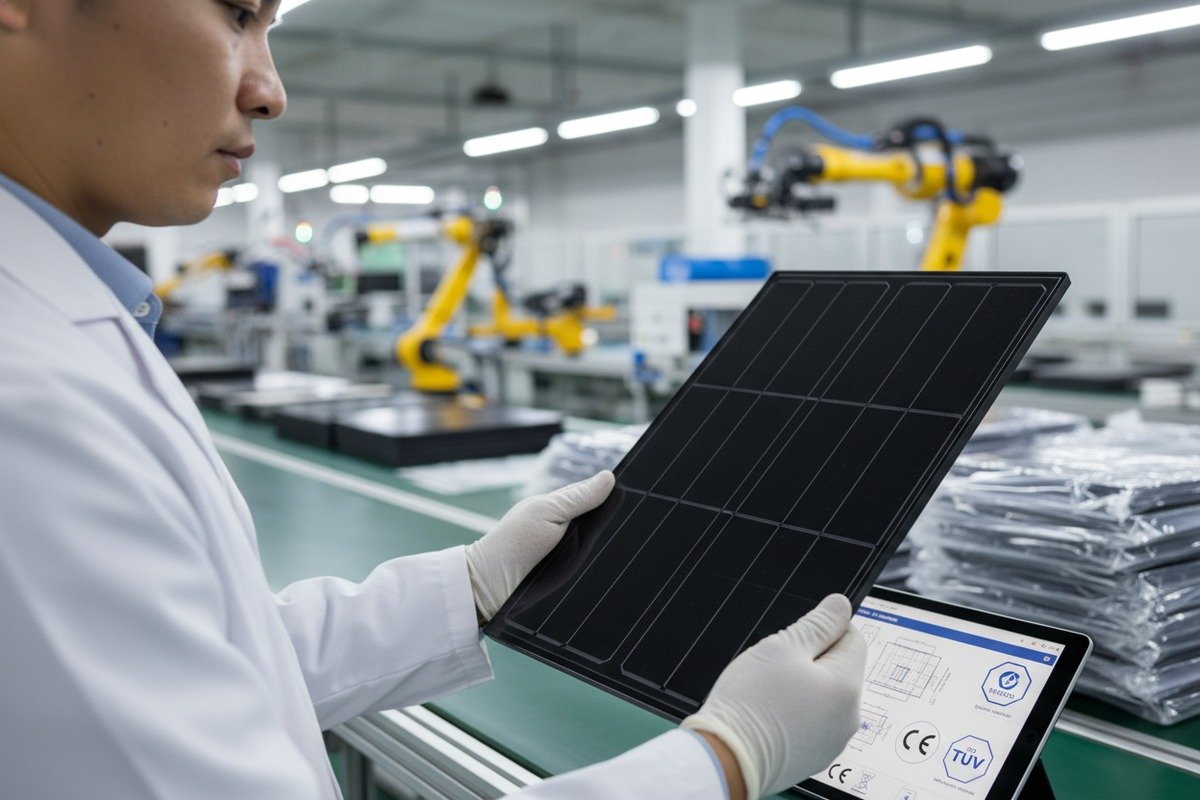
Every year, we see shipments of solar roof shingles get stuck at European ports — not because of quality defects, but because of missing paperwork. One importer lost over €100,000 in a single seized container. After 20 years on the production line, our team knows exactly which certificates open EU doors and which gaps get containers blocked.
Solar roof shingles imported from China into the EU require mandatory CE marking, IEC 61215 and IEC 61730 compliance, RoHS and WEEE registration, and Construction Products Regulation (CPR) conformity including fire and structural ratings. Voluntary certifications like TUV and Solar Keymark further boost market credibility and buyer confidence.
This guide walks you through every certification step, from verifying CE and TUV marks to meeting fire ratings and securing insurance-ready documentation. Let’s break it down section by section.
How do I verify that my Chinese solar roof shingles have the necessary CE and TUV certifications for the EU market?
When we prepare export documentation in our facility, buyers often ask us how to tell real CE compliance from fake stickers on a box. It is a fair concern — the gap between genuine certification and fraudulent claims costs importers millions each year.
To verify CE and TUV certifications, request the manufacturer's Declaration of Conformity, check TUV certificate numbers on the issuing body's online database, and confirm IEC 61215 and IEC 61730 test reports match the exact product model you are purchasing. Never rely on printed logos alone.

Understanding CE Marking for Solar Roof Shingles
CE marking 1 is not a quality mark. It is a legal declaration that a product meets all applicable EU directives. For solar roof shingles, the relevant directives include the Low Voltage Directive (LVD 2014/35/EU), the Electromagnetic Compatibility Directive (EMC 2014/30/EU), and the Restriction of Hazardous Substances Directive 2 (RoHS 2011/65/EU).
The manufacturer or the EU-based importer must compile a technical file. This file includes test reports, risk assessments, circuit diagrams, and a signed Declaration of Conformity 3 (DoC). In our experience, many buyers skip reading the DoC. That is a mistake. The DoC must list the exact product model, the applicable directives, and the harmonized standards used. If the model number on the DoC does not match the product you ordered, the CE mark is invalid for your shipment.
How to Check TUV Certificates
TUV (Technischer Überwachungsverein) certification is voluntary but extremely influential in the EU market. Distributors and roofing companies in Germany, France, and the Netherlands almost always require it. Our products carry both TUV Rheinland and CE certifications because European buyers demand that dual layer of trust.
Here is how to verify a TUV certificate:
- Ask the supplier for the certificate number.
- Go to the TUV Rheinland online certificate database 4 (certipedia.com).
- Enter the certificate number or the manufacturer's name.
- Confirm the product model, test standard, and certificate validity date.
If the supplier cannot provide a verifiable certificate number, walk away.
CE vs. TUV: Key Differences
| Aspect | CE Marking | TUV Certification |
|---|---|---|
| Legal status | Mandatory for EU market entry | Voluntary but widely expected |
| Who issues it | Self-declared by manufacturer or importer | Issued by TUV (third-party body) |
| Test standards | LVD, EMC, RoHS | IEC 61215 5, IEC 61730 |
| Verification | Check DoC and technical file | Check online TUV database |
| Cost | €10,000–€30,000 for testing | €15,000–€50,000 depending on scope |
| Renewal | No expiry if product unchanged | Periodic audits required |
IEC Standards You Must Confirm
IEC 61215 covers design qualification. It subjects modules to 1,000 thermal cycles, 200 humidity-freeze cycles, and mechanical load tests. IEC 61730 6 covers electrical safety, including insulation resistance, dielectric withstand, and fire classification. Both standards apply to solar roof shingles just as they apply to traditional solar panels, because the core photovoltaic technology is identical.
When we run our production lines, every batch goes through in-house IEC-aligned testing before the third-party lab conducts final certification. This two-step process catches defects early and prevents costly re-testing.
Red Flags to Watch For
- The supplier provides a CE certificate instead of a Declaration of Conformity. CE is not "certified" by a body — it is declared.
- Test reports reference an older product model that has been discontinued.
- The supplier refuses to share the full technical file or claims it is "confidential."
- TUV logos appear on marketing materials, but no certificate number is provided.
Do my imported solar tiles need to comply with both PV standards and European Construction Products Regulations (CPR)?
Our engineering team designed our solar roof shingles to function as both energy-generating PV modules and structural roofing materials. This dual function is exactly what creates the dual compliance challenge that trips up so many importers.
Yes, solar roof shingles must comply with PV standards (IEC 61215, IEC 61730) for electrical performance and safety, and with the EU Construction Products Regulation (CPR No. 305/2011) for building material requirements including fire reaction, water tightness, and mechanical resistance. Both are mandatory.

Why Dual Compliance Exists
Traditional solar panels sit on racks above the roof. They are electrical devices, nothing more. Solar roof shingles replace the actual roofing material. They keep rain out. They resist wind uplift. They must not spread fire. This means they are construction products and PV modules at the same time.
The CPR requires that construction products sold in the EU carry a Declaration of Performance 7 (DoP) based on harmonized European standards (hEN) or a European Technical Assessment (ETA). The DoP is separate from the CE Declaration of Conformity for electrical compliance. You need both documents.
What the CPR Requires
Under the CPR, the manufacturer must demonstrate Factory Production Control (FPC). This is a documented quality management system specific to the construction product. It covers raw material inspection, production process control, and finished product testing. Our factory maintains a dedicated FPC system audited annually, which allows us to issue valid DoPs for every shipment.
The CPR also requires assessment of these essential characteristics:
- Reaction to fire (Euroclass rating)
- External fire performance
- Water tightness
- Mechanical resistance (wind, snow loads)
- Release of dangerous substances
PV Standards vs. CPR Requirements
| Requirement | PV Standards (IEC) | Construction Products Regulation 8 (CPR) |
|---|---|---|
| Primary focus | Electrical safety and performance | Structural and fire safety |
| Key standards | IEC 61215, IEC 61730 | EN 14783, ETA route, EN 13501-1 |
| Documentation | Test reports + CE DoC | Declaration of Performance (DoP) |
| Quality system | ISO 9001 (typical) | Factory Production Control (FPC) |
| Who checks | Notified Bodies (e.g., TUV) | Notified Bodies for AVCP systems |
| Applies because | Product generates electricity | Product replaces roofing material |
The ETA Route for BIPV Products
Many solar roof shingles do not fall neatly under an existing harmonized European standard (hEN). In that case, the manufacturer can apply for a European Technical Assessment (ETA) through a Technical Assessment Body (TAB). The ETA process evaluates the product against its intended use and issues a European Assessment Document (EAD).
We went through this process ourselves. It took about eight months and required extensive testing at accredited European labs. But it gave our buyers a clear, recognized document that satisfies building authorities across all EU member states.
Common Pitfall: Ignoring the Construction Side
Many Chinese suppliers focus entirely on IEC testing and forget the CPR. The result? The product clears customs because CE marking covers the electrical directives, but then the building inspector on-site rejects it because there is no Declaration of Performance. The contractor cannot install it. The distributor is stuck with unsellable inventory. We have seen this happen to competitors' customers more than once.
Always ask your supplier: "Can you provide both the CE Declaration of Conformity for PV directives and a Declaration of Performance under CPR?" If the answer is no, you have a problem.
What specific fire rating and wind load certifications should I look for to ensure my project meets local building codes?
When we test our solar roof shingles for hail resistance and wind uplift, we push them well beyond the minimum thresholds. Our products withstand 35mm hailstones and Grade 15 winds — but knowing what the local code actually demands is the buyer's responsibility, and the numbers vary across Europe.
Look for Euroclass fire ratings (typically B-s1,d0 or better for roofing) under EN 13501-1, external fire performance per EN 13501-5, and wind load resistance tested to EN 1991-1-4 or equivalent. Specific requirements vary by country: Germany, France, and the Netherlands each enforce different thresholds based on local climate and building type.
Fire Ratings Explained
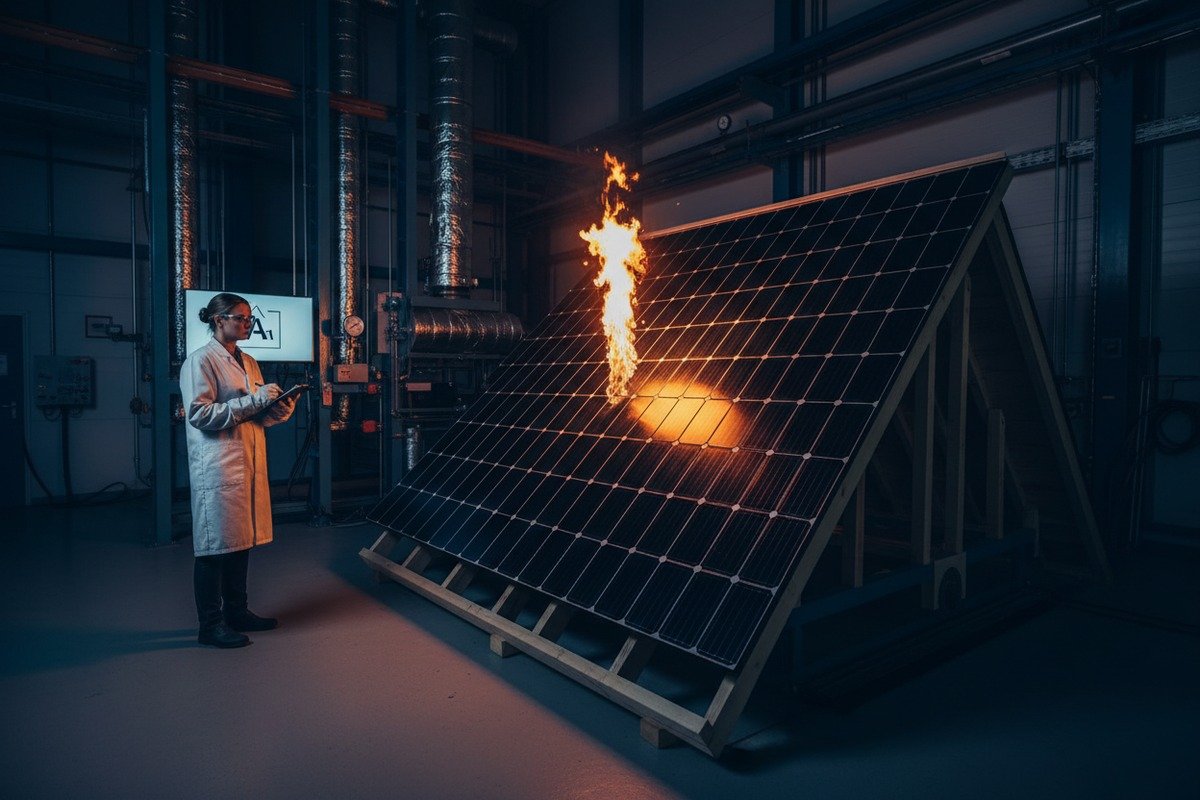
The EU uses the Euroclass system 9 to classify the reaction to fire of construction products. For roof coverings, you also need external fire performance classification. These are two separate tests.
Reaction to fire is tested under EN 13501-1. The classes range from A1 (non-combustible) to F (no performance determined). For solar roof shingles, most EU markets expect at least class B-s1,d0, meaning very limited contribution to fire, minimal smoke production, and no flaming droplets.
External fire performance is tested under EN 13501-5 and uses the classification BROOF(t1) through BROOF(t4). Most countries require at least BROOF(t1) for roof coverings. This test simulates burning brands landing on the roof surface.
Wind Load Requirements
Wind load resistance matters enormously for roofing products. The Eurocode EN 1991-1-4 defines wind actions on structures. Local national annexes adjust the values based on geographic wind zones, terrain categories, and building height.
Our shingles are tested to resist wind speeds corresponding to Grade 15 on the Beaufort scale, which exceeds typical requirements even in coastal regions of the Netherlands or Northern France. However, the installer must also follow the specified fixing pattern. A product tested to high wind loads will fail if installed with too few fasteners.
Country-Specific Fire and Wind Requirements
| Country | Typical Fire Rating Required | Wind Zone Consideration | Additional Notes |
|---|---|---|---|
| Germany | B-s1,d0; BROOF(t1) | DIN EN 1991-1-4/NA wind zones 1–4 | Strict Bauordnung requirements; varies by Bundesland |
| France | Euroclass B minimum; BROOF(t1) | NF EN 1991-1-4/NA, 4 wind regions | DTU roofing guidelines apply |
| Netherlands | Class B-s2,d0 or better; BROOF(t1) | NEN-EN 1991-1-4/NB, high coastal wind | Flat roof prevalent; uplift critical |
| Italy | Euroclass B; BROOF(t1) | NTC 2018 wind maps | Seismic zones add structural demands |
| Spain | Euroclass B; BROOF(t1) | CTE DB-SE-AE wind zones A–C | Lower wind loads in inland areas |
Hail Resistance
IEC 61215 includes a hail test using a 25mm ice ball at 23 m/s. But in some Alpine and Central European regions, 35mm hailstones are common. Our production line tests to 35mm as standard because we know where our products end up. Ask your supplier what hail size their product is rated for. If they only meet the IEC minimum 25mm, your project in Southern Germany or Northern Italy could be at risk.
How to Match Certifications to Your Project
Start with the local building authority. Get the exact requirements for your project's location, building type, and height. Then compare those requirements against the test reports your supplier provides. Do not assume that a product certified for one EU country automatically meets the codes in another. National annexes and local amendments create real differences.
If you are a distributor serving multiple markets, you need a supplier whose certifications cover the strictest requirements across your entire territory. That is why we test to the highest thresholds — so our buyers can sell confidently in any EU market without re-testing.
How can I confirm that the manufacturer's warranty and technical documentation will be accepted by European insurance companies?
Our 25-year product warranty is not just a marketing number — we back it with third-party bankable test data and contractual frameworks designed specifically for the European insurance landscape. But we have watched competitors offer similar headline warranties that collapse under scrutiny the moment an insurer reviews the fine print.
To ensure acceptance by European insurers, demand independently verified performance data (IEC 61215, IEC 61730), a bankable warranty backed by a performance guarantee bond or escrow arrangement, complete technical documentation in the local language, and proof of the manufacturer's product liability insurance covering EU jurisdictions.
What European Insurers Actually Check
Insurance companies in the EU — particularly those covering building and property risk — evaluate solar roof products on three dimensions: product certification, manufacturer financial stability, and documentation completeness.
First, they look for third-party test reports from accredited labs (ILAC-recognized). Self-declared data from the manufacturer's in-house lab is usually rejected. Second, they assess whether the manufacturer will still exist in 10 or 20 years to honor warranty claims. This is a real concern with Chinese suppliers. Third, they check that the technical documentation package includes installation manuals, maintenance schedules, material safety data sheets, and performance degradation curves — all in the language of the insured country.
The "After-Sales Disappearance" Problem
This is the number one fear among European buyers sourcing from China. A supplier offers a 25-year warranty, but five years later the company has closed, rebranded, or become unreachable. The warranty is worthless.
We address this in several ways. Our company has been operating for 20 years with a stable 100-person team. We provide DDP delivery with full traceability. And we offer 24/7 after-sales support with dedicated European-market representatives. But not every supplier does this. Here is what to demand:
Documentation Checklist for Insurance Acceptance
- Declaration of Conformity (CE) with full technical file
- Declaration of Performance (DoP) under CPR
- IEC 61215 and IEC 61730 test reports from ILAC-accredited labs
- Fire classification report (EN 13501-1 and EN 13501-5)
- Wind load and mechanical resistance test data
- Product liability insurance certificate covering EU markets
- Installation manual in the local language
- Maintenance and inspection schedule
- Linear power degradation guarantee (typically ≤0.5% per year)
- Manufacturer's financial audit or credit report (optional but powerful)
Warranty Structures That Work
A strong warranty for the EU market includes two components: a product warranty (covering material and manufacturing defects for 10–15 years) and a performance warranty (guaranteeing minimum power output for 25–30 years). Our standard offering includes both.
Some importers go further by setting up an escrow account or performance bond. This means a portion of the purchase price is held by a third party and released only as the warranty period progresses without claims. It protects the buyer and satisfies the insurer.
RoHS, WEEE, and Long-Term Compliance
European insurers increasingly check environmental compliance too. RoHS compliance means the product contains less than 0.1% lead, mercury, and other restricted substances by weight in homogeneous materials. WEEE registration 10 means the producer or importer has registered with the national recycling scheme and will fund end-of-life collection.
These are not just regulatory checkboxes. If your product causes environmental contamination because of non-compliant materials, the insurer may void your coverage. We maintain full RoHS documentation with 10-year record retention, and we support our buyers with WEEE registration guidance in every target market.
Emerging Concerns: Cybersecurity and Smart Integration
For solar roof shingles with integrated smart inverters or IoT monitoring, the EU's Radio Equipment Directive (RED) now introduces cybersecurity requirements. Insurers are beginning to flag products that connect to the grid or home energy management systems without proper cybersecurity certification. If your shingles include microinverters with wireless communication, confirm RED compliance. This is a small but growing concern that could become a major issue by 2027.
Conclusion
Sourcing EU-compliant solar roof shingles from China requires CE, TUV, IEC, CPR, RoHS, and WEEE compliance — verified through accredited third-party testing and complete documentation. Partner with a manufacturer who already holds these certifications to protect your projects and profits.
Footnotes
1. Replaced HTTP 404 with an authoritative European Commission page on CE marking. ↩︎
2. Explains the RoHS Directive (2011/65/EU) and its purpose in restricting hazardous substances. ↩︎
3. Defines the EU Declaration of Conformity as a manufacturer’s statement of product compliance with directives. ↩︎
4. Direct link to TÜV Rheinland’s official Certipedia database for verifying certificates. ↩︎
5. Provides official information on IEC 61215, a key standard for PV module design qualification. ↩︎
6. Offers official details on IEC 61730, essential for PV module electrical safety and fire classification. ↩︎
7. Explains the Declaration of Performance (DoP) as a document for construction product characteristics under CPR. ↩︎
8. Explains the Construction Products Regulation (CPR) and its harmonized rules for marketing construction products. ↩︎
9. Describes the Euroclass system for classifying the fire reaction of construction materials according to EN 13501-1. ↩︎
10. Provides official EU information on WEEE registration and responsibilities for producers and importers. ↩︎