
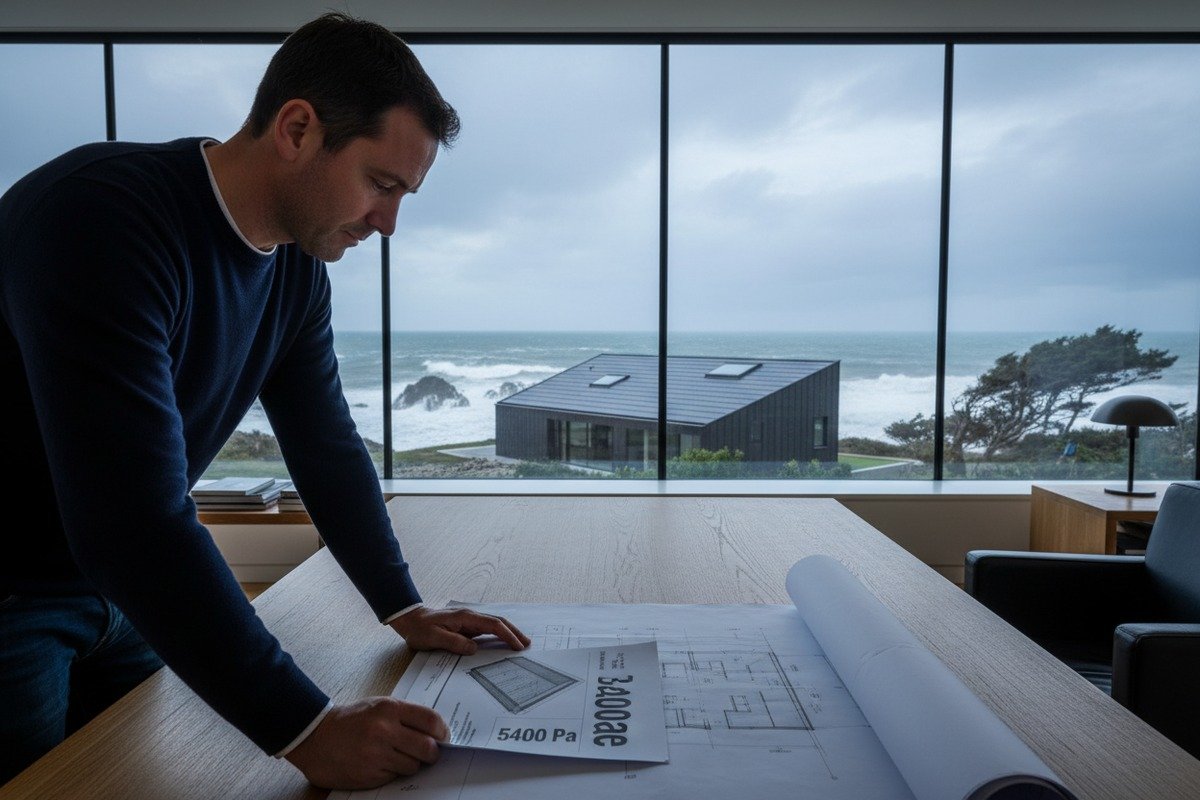
Every year, we see calls from panicked distributors after coastal storms rip unverified solar shingles off European rooftops Euroclass 1. The damage claims are devastating. The reputational fallout is worse.
To verify solar shingle wind load ratings for European coastal regions, cross-reference manufacturer TUV and CE certifications against EN 1991-1-4 Eurocode wind action calculations, request IEC 61215 mechanical load test reports showing 5400 Pa minimum ratings, and confirm IEC 61701 salt mist corrosion compliance for coastal durability.
This guide walks you through the exact verification steps, testing standards, and coastal-specific challenges. Whether you develop properties, distribute building materials, or install roofing systems across Europe’s coastlines, these details protect your projects and your warranties.
How do I verify that the TUV and CE certifications meet the specific wind load standards for European coastal projects?
When our engineering team first adapted our solar shingles for the European market, we quickly learned that a CE mark 2 alone does not guarantee coastal wind performance. Many buyers assume it does. That assumption costs money.
To verify TUV and CE certifications meet coastal wind load standards, confirm the certificates reference IEC 61215 mechanical load testing at 5400 Pa or higher, check that EN 1991-1-4 Eurocode wind zone calculations match your project site, and validate that the testing lab is accredited by a recognized European body.
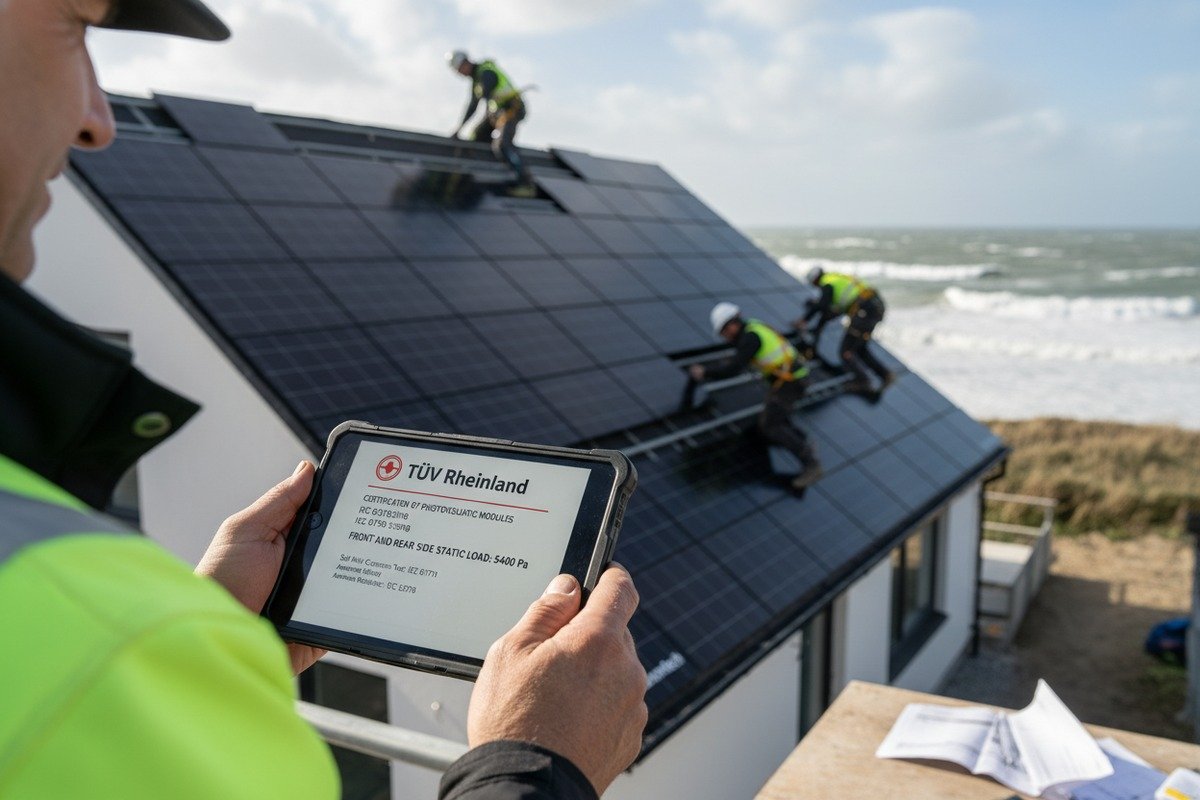
Understanding the difference between a generic CE mark and a coastal-ready certification is the first step. A CE mark confirms the product meets minimum EU safety directives. But "minimum" is the key word. Coastal environments demand more.
What Does TUV Certification Actually Test?
TUV certification 3 for solar shingles typically covers electrical safety, fire resistance, and mechanical load testing. The mechanical load test follows IEC 61215, which applies static pressure to the front and rear of the shingle. IEC 61215 mechanical load test 4 The result is expressed in Pascals (Pa). A rating of 2400 Pa handles moderate inland winds. But for a project on the Brittany coast or the Belgian North Sea edge, you need 5400 Pa minimum.
Our production line tests every batch to 5400 Pa because we know where these shingles end up. We have seen competitors ship 2400 Pa products to coastal sites. The result is always the same: uplift failures within the first major storm season.
How to Read the Certificate Correctly
Look for three things on any TUV or CE certificate:
- The specific IEC standard referenced (IEC 61215 for mechanical loads)
- The tested Pa value (front load and rear load separately)
- The testing laboratory's accreditation number
If any of these are missing, request clarification from the supplier before ordering.
National Code Variations You Must Check
The Eurocode EN 1991-1-4 provides the framework, but each country applies its own National Annex 5. EN 1991-1-4 Eurocode 6 France divides its territory into four wind zones. Belgium uses base wind speeds of 23–26 m/s. These differences matter.
| Country / Region | Base Wind Speed (m/s) | Estimated Dynamic Pressure (Pa) | Recommended Min. Rating |
|---|---|---|---|
| Belgium Coast | 26 | ~450 | 5400 Pa |
| France Zone 3 (Brittany) | 26 | ~420 | 4800+ Pa |
| France Zone 4 (Mediterranean) | 28 | ~490 | 5400 Pa |
| Netherlands Coast | 27 | ~460 | 5400 Pa |
| UK Northeast Coast | 25 | ~400 | 4800+ Pa |
Always multiply the base dynamic pressure by the terrain coefficient. Open coastal terrain uses a coefficient of 1.15 to 1.20. This pushes the effective pressure higher than inland calculations suggest. A structural engineer familiar with local codes can run these numbers for your exact site.
The Terrain Coefficient Trap
Many buyers overlook terrain coefficients 7. An urban site 10 km inland might use a coefficient of 0.80. The same postcode on the seafront uses 1.20. That is a 50% increase in effective wind pressure. Our technical team provides Eurocode wind load calculation support for every European coastal project we supply. We do this because getting it wrong voids warranties and endangers buildings.
Can I trust the interlocking design of these solar shingles to remain secure during a Grade 15 wind storm?
During our 20 years of R&D, our engineers redesigned our interlocking mechanism seven times. Each redesign came after real-world storm feedback. Grade 15 wind — that is over 140 km/h — is not theoretical for European coastlines. It is a regular event.
Yes, you can trust a properly engineered interlocking system during Grade 15 winds, provided the shingles are tested to 5400 Pa or above, installed with stainless steel fasteners at 6–8 fixing points per tile, and the roof substrate has been structurally assessed for uplift resistance per Eurocode standards.
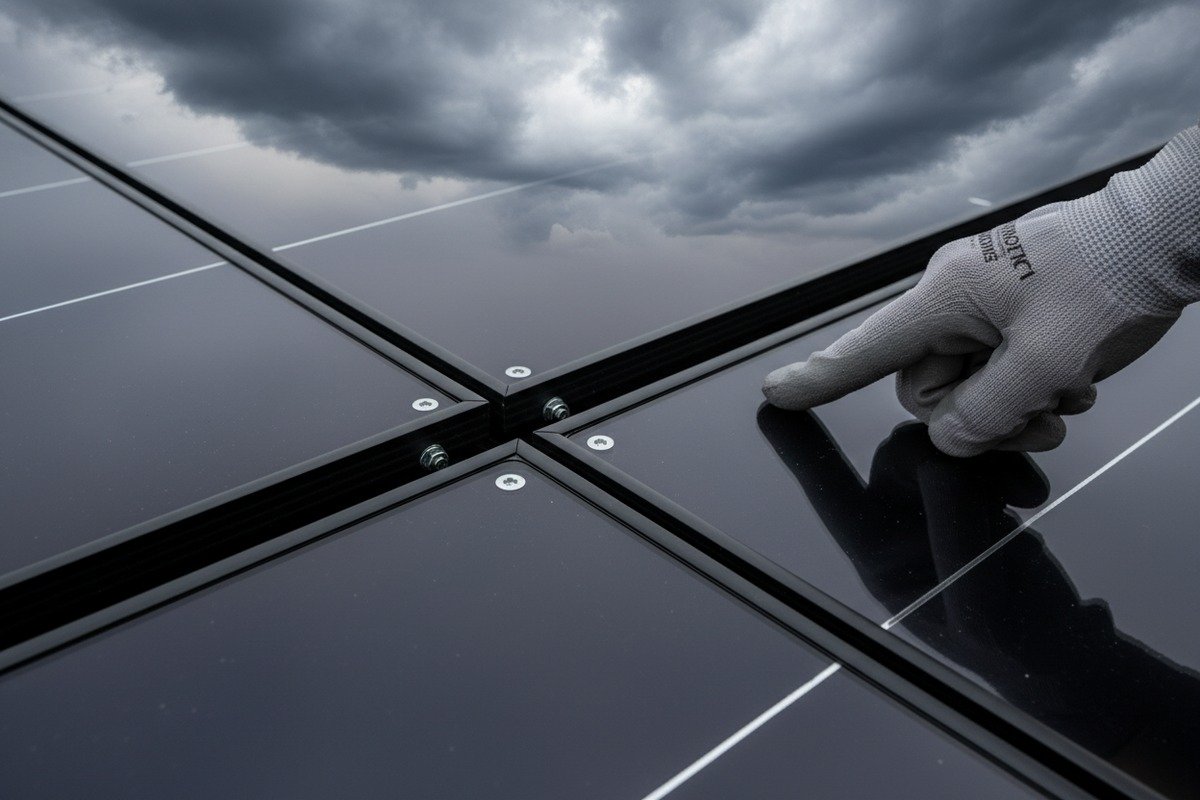
The interlocking design is arguably the most critical structural feature of any solar shingle system. Unlike racked solar panels, which sit above the roof on metal frames and catch wind like sails, solar shingles lie flat against the roof deck. This low profile is a major advantage. But the interlock is what keeps them there.
How Interlocking Mechanisms Resist Uplift
Wind does not push shingles off a roof. It pulls them off. The Bernoulli effect 8 creates negative pressure (suction) on the roof surface during high winds. The interlocking system must resist this upward force.
Our shingles use a multi-point interlocking rail that connects each tile to its neighbors on all four sides. This distributes uplift force across multiple tiles instead of concentrating it on one. When tested in wind tunnel simulations per IEC 61215 protocols, this design withstands sustained loads exceeding 5400 Pa — equivalent to approximately 150 mph winds.
Why Edges and Corners Fail First
Building aerodynamics create the highest wind pressures at roof edges, ridgelines, and corners. Eurocode EN 1991-1-4 divides the roof into pressure zones. Corner zones can experience two to three times the pressure of the central roof area.
| Roof Zone | Pressure Multiplier vs. Center | Recommended Action |
|---|---|---|
| Center field | 1.0x | Standard fixing pattern |
| Edge zones | 1.5–2.0x | Additional fasteners, reduced tile spacing |
| Corner zones | 2.0–3.0x | Double fastener density, structural adhesive backup |
| Ridge line | 1.5–2.0x | Ridge-specific capping system with enhanced clips |
We design our installation guides to specify different fixing patterns for each zone. In our experience, coastal installations that follow zone-specific fixing patterns have a near-zero failure rate, even during Grade 15 events. Projects that use a uniform pattern across the entire roof are the ones that call us after storms.
The Role of Fastener Materials
Salt air corrodes standard zinc-plated fasteners within 3–5 years. Once a fastener weakens, the interlock cannot do its job. We require stainless steel A4-grade (316) fasteners for all coastal installations. The cost difference per roof is marginal. The difference in longevity is enormous.
Racked Panels vs. Integrated Shingles in High Wind
Some critics argue that racked panels are easier to certify for high wind loads because there is more test data available. This is true — there are more racked panel wind studies. But the physics favor shingles. A racked panel sits 10–15 cm above the roof surface, creating a gap for wind to enter and generate lift. A solar shingle sits flush. The aerodynamic profile is inherently more wind-resistant. Our shingles achieve Class 3/4 hurricane-equivalent ratings precisely because of this flush integration.
What specific test reports should I request from my supplier to ensure the shingles won't lift in high-pressure coastal environments?
Our sales team fields this question weekly from European distributors. The good news is that the answer is straightforward. The bad news is that many suppliers cannot provide what you need, and that tells you everything.
Request the IEC 61215 mechanical load test report showing front and rear load values in Pascals, the IEC 61701 salt mist corrosion test certificate, a wind tunnel or cyclic loading test summary, and documented compliance with the Construction Products Regulation (CPR) including fire rating and water penetration results.
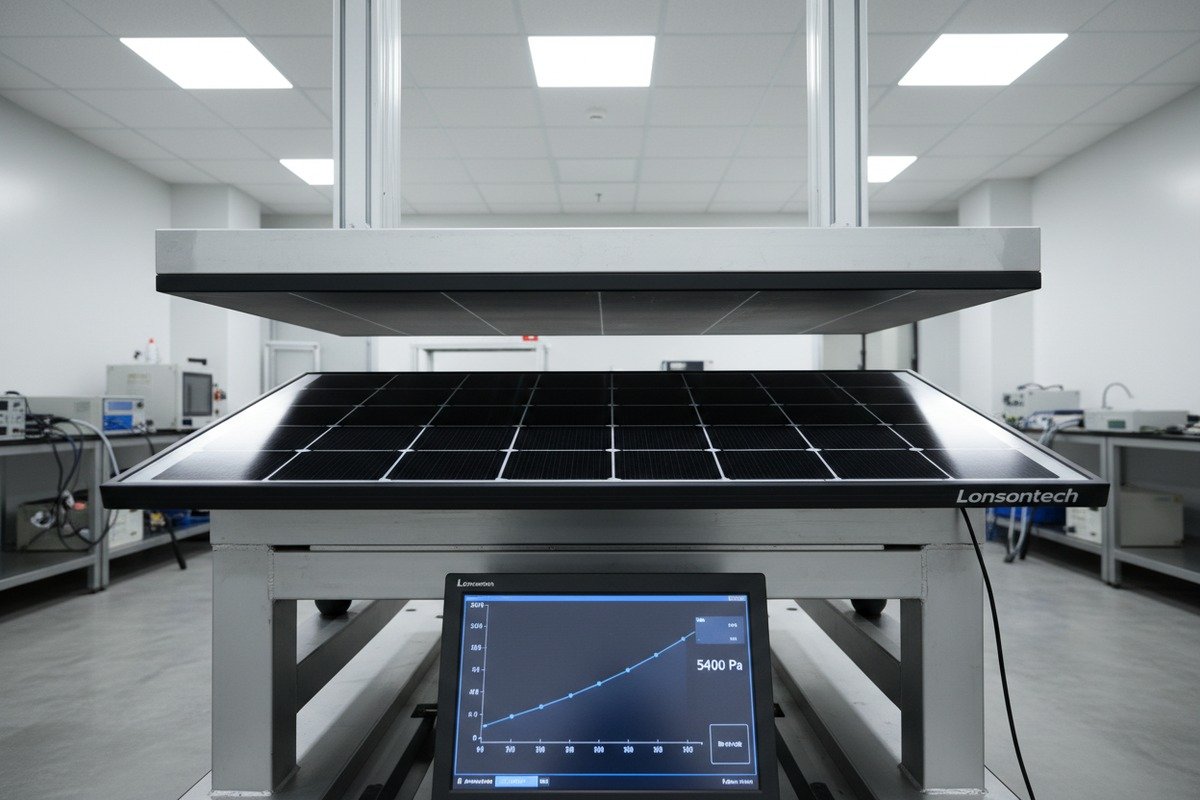
Getting the right paperwork before you commit to a supplier is non-negotiable for coastal projects. Here is a detailed breakdown of what to ask for and what each document tells you.
The Essential Document Checklist
There are five core documents you need. If a supplier cannot provide all five, move on.
-
IEC 61215 Mechanical Load Test Report — This is the foundation. It shows the maximum static load the shingle survived without cracking, delamination, or electrical degradation. Look for 5400 Pa front load and 2400 Pa rear load as minimums for coastal use.
-
IEC 61701 Salt Mist Corrosion Test Certificate — This test exposes the shingle to accelerated salt spray for hundreds of hours. It simulates years of coastal salt air exposure. Without this, metal components and cell connections will degrade prematurely.
-
Wind Tunnel or Cyclic Loading Test Summary — Static load tests (IEC 61215) apply pressure once. Real wind is dynamic. Cyclic loading tests apply and release pressure thousands of times. This reveals fatigue weaknesses in interlocking mechanisms and fastener points.
-
CPR (Construction Products Regulation) Documentation — This confirms the shingle meets European building material standards, not just PV electrical standards. Construction Products Regulation (CPR) 9 It covers fire rating (Euroclass), water penetration, and structural load performance as a roofing element.
-
Fastener and Mounting System Specification Sheet — Often overlooked. The shingle might be rated to 5400 Pa, but if the mounting rails and fasteners are rated lower, the system fails at the weakest link.
How to Read Pa Values on Test Reports
| Test Metric | What It Means | Coastal Minimum |
|---|---|---|
| Front static load (Pa) | Resistance to downward wind pressure | 5400 Pa |
| Rear static load (Pa) | Resistance to uplift suction | 2400 Pa |
| Cyclic load (cycles) | Fatigue resistance over repeated loading | 1000+ cycles at rated Pa |
| Hail impact (mm) | Resistance to hailstone strikes | 35 mm at terminal velocity |
| Salt mist exposure (hours) | Corrosion resistance in coastal salt air | 500+ hours (IEC 61701) |
When reviewing these numbers, pay attention to whether the report says "survived" or "no degradation." A shingle that survives 5400 Pa but shows micro-cracks afterward is not truly rated for that load over 25 years. Our test reports include post-load electroluminescence imaging to prove zero cell degradation. Ask your supplier if they do the same.
Red Flags in Supplier Documentation
Watch out for these warning signs:
- Test reports from non-accredited labs
- Pa ratings listed without specifying front vs. rear load
- No mention of IEC 61701 salt mist testing
- CPR documentation missing or listed as "in progress"
- Fastener specifications not included or left to the installer's discretion
Our approach at Lonsontech is to provide a complete documentation package with every quotation. We include all five documents plus a site-specific Eurocode wind load calculation tool. This transparency is not just good practice — it is what protects your project and your reputation.
Why Cyclic Loading Matters More Than Static
A single 5400 Pa gust will not destroy a well-made shingle. But thousands of pressure cycles during a multi-hour storm will fatigue weak points. Cyclic loading tests simulate this reality. FM Global datasheets have noted that static-only testing overestimates real-world performance for rooftop products. Always ask for cyclic data in addition to static Pa ratings.
How does the wind load rating impact the 25-year structural warranty I offer to my property development clients?
When we first drafted our 25-year product warranty, our legal team spent months with our engineers linking every warranty clause to specific test data. The reason was simple: a warranty without verified wind load data behind it is just a marketing promise on paper.
Wind load ratings directly determine the enforceability of a 25-year structural warranty. If installed shingles are rated below the site-specific Eurocode wind load requirement, any storm damage may void the warranty, exposing property developers to uninsured repair costs and liability claims from building owners.

For property developers and roofing companies, the warranty is the final line of defense. Your end clients — homeowners, commercial tenants, building investors — rely on it. Here is how wind load ratings tie directly into warranty validity.
The Warranty Chain of Responsibility
A 25-year structural warranty on a solar shingle roof involves multiple parties. Each link in the chain must hold.
- Manufacturer warranty — Covers product defects, including structural failure under rated conditions
- Installer warranty — Covers workmanship, including correct fixing patterns and fastener selection
- Developer warranty — Covers the overall building envelope, including roof performance
If the manufacturer's product is rated to 5400 Pa but the installer uses an inland fixing pattern suitable for 2400 Pa conditions, the manufacturer warranty may still be valid — but the installer warranty is void. The developer is caught in the middle.
How Underrated Products Destroy Warranty Coverage
Consider this scenario. A developer installs solar shingles rated at 2400 Pa on a Belgian coast project. The Eurocode calculation for that site, after applying the 1.15 terrain coefficient, requires 5400 Pa. A storm hits. Shingles lift. The developer files a warranty claim with the manufacturer. The manufacturer's response: "Product performed as rated. Site requirements exceeded product specifications. Claim denied."
This happens. We have seen it happen to competitors' clients. It is why we provide a site-specific wind load verification letter with every coastal order. This letter confirms that our product's rated Pa meets or exceeds the calculated Eurocode requirement for the specific installation address.
What Future-Proofing Looks Like
Climate change is intensifying coastal storms across Europe. The EU's Joint Research Centre (JRC) now recommends designing for wind loads above current Eurocode minimums. A shingle rated at exactly the current code requirement today may be under-spec in 10 years.
Our recommendation for any 25-year warranty project: specify shingles rated at least 20% above the current Eurocode calculation for the site. For a site requiring 4800 Pa, use 5400 Pa products. For a site requiring 5400 Pa, discuss enhanced fixing systems with your manufacturer.
Warranty Documentation Developers Should Maintain
| Document | Purpose | Retention Period |
|---|---|---|
| Manufacturer wind load test report (IEC 61215) | Proves product rating | 25+ years |
| Site-specific Eurocode wind calculation | Proves design adequacy | 25+ years |
| Installer fixing pattern sign-off | Proves correct installation | 25+ years |
| Salt mist corrosion certificate (IEC 61701) | Proves coastal material suitability | 25+ years |
| Post-installation inspection report | Proves initial compliance | 25+ years |
| Manufacturer warranty letter with site reference | Links warranty to specific project | 25+ years |
Keep every document. In a dispute 15 years from now, these papers are your evidence. Our 24/7 after-sales team maintains digital copies of all project documentation for the full warranty period. We do this because we understand that a 25-year warranty is a 25-year relationship.
The Cost of Getting It Wrong
Budget solar shingles with 2400 Pa ratings cost less upfront. But a single storm-related roof failure on a coastal property can cost €30,000–€80,000 in repairs, plus tenant displacement, insurance disputes, and reputational damage. Premium 5400 Pa shingles with full IEC 61701 certification cost perhaps 10–15% more per square meter. The math is clear. In our experience, every European coastal developer who has compared these numbers reaches the same conclusion.
Conclusion
Verifying solar shingle wind load ratings for European coastal regions requires matching certified Pa ratings to site-specific Eurocode calculations, demanding complete test documentation, and choosing suppliers who stand behind 25-year warranties with transparent data.
Footnotes
1. Defines the European classification system for fire safety of construction materials. ↩︎
2. Official European Union explanation of CE marking requirements and significance. ↩︎
3. Explains what TÜV certification means and its importance for product safety and quality. ↩︎
4. Explains the standard for PV module design qualification and mechanical load testing. ↩︎
5. Official European Commission Joint Research Centre explanation of Eurocode National Annexes. ↩︎
6. Official portal for European structural design standards, including wind actions. ↩︎
7. Explains terrain categories and factors influencing wind load calculations in Eurocode. ↩︎
8. Demonstrates how the Bernoulli effect causes uplift on roofs due to wind flow. ↩︎
9. Explains the EU Construction Products Regulation (CPR) and its requirements for products. ↩︎
10. Details the international standard for salt mist corrosion testing of PV modules. ↩︎