
Every year, our engineering team fields dozens of calls from European distributors worried about the same thing: will these solar shingles pass fire inspection?
To evaluate if solar roof shingles meet European fire safety regulations, you must verify compliance with EN 13501-1 for material reaction-to-fire classification, EN 13501-5 for roof assembly performance (typically BROOF(t4)), and IEC 61730-2 for PV module fire ratings—testing the full system, not just individual components.
This guide breaks down the exact standards, verification steps, and insurance considerations you need DC Arc Fault Circuit Interrupters 1. Whether you are a roofing company, distributor, or architect sourcing BIPV products for the European market, the steps below will save you from costly compliance mistakes.
Which specific European fire rating standards should I look for when sourcing solar shingles?
When we first started exporting solar roof tiles to France and Germany, the patchwork of fire standards caught even our compliance engineers off guard Module-level rapid shutdown 2.
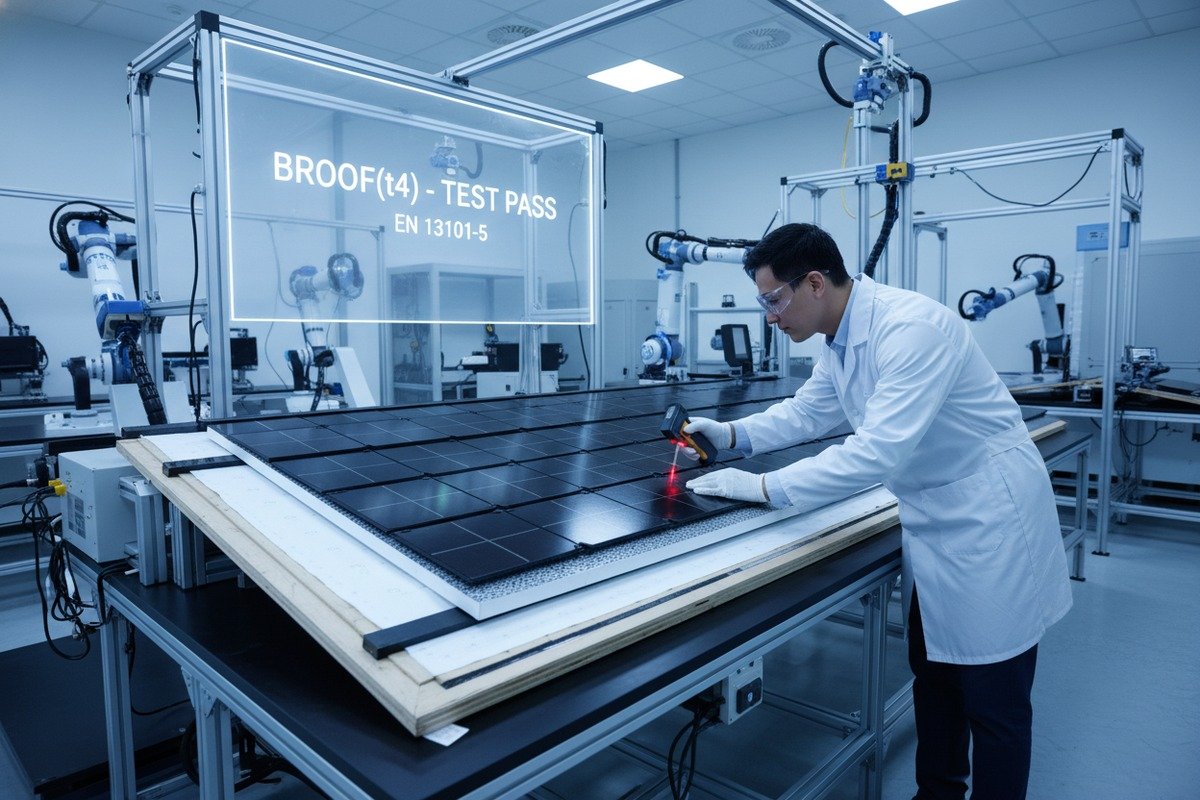
You should look for three core standards: EN 13501-1 for the reaction-to-fire classification of individual materials, EN 13501-5 (based on CEN/TS 1187 test 4) for the external fire performance of the complete roof assembly, and IEC 61730-2 for the electrical fire safety classification of the PV module itself.
Understanding EN 13501-1: Material Classification
EN 13501-1 3 classifies how a building material reacts when exposed to fire. It ranges from A1 (non-combustible) down to F (no performance determined). For solar roof shingles, the substrate materials, backsheet, encapsulant, and frame all matter. Insurers increasingly recommend A1 or A2-s1,d0 rated substrates beneath your solar shingles. The "s1" means very limited smoke production. The "d0" means no flaming droplets. These details matter because a fire on a rooftop is hard to reach, and toxic smoke or dripping material can turn a small incident into a catastrophe.
Understanding EN 13501-5: Roof Assembly Performance
This standard tests the entire roof system, not just one tile. It uses CEN/TS 1187 test methods 4. The most commonly required classification across Europe is BROOF(t4). This test simulates a fire landing on the external surface of a roof and measures flame spread, penetration, and falling debris. Here is the critical point: your solar shingle, the waterproof membrane beneath it, the insulation, and the deck together must pass. A shingle that passes alone may fail when combined with a combustible underlayment.
Recent UK Government experiments proved this dramatically. PV panels installed on plastic roof tiles that individually held a BROOF(t4) rating caused rapid fire spread—both vertical and horizontal—once the PV altered heat dynamics. Nearly all tiles beneath the panels were involved in the fire.
Understanding IEC 61730-2: PV Module Fire Classification
IEC 61730-2 5 assigns fire classes to PV modules: Class A (highest), Class B, and Class C (lowest). Class A modules resist fire spread best. Some budget products only achieve Class C, which many European insurers and local codes reject. When we design our solar shingles at the Lonsontech facility, we target Class A certification because it opens more markets and reduces pushback from building inspectors.
Quick Reference: Key Fire Standards for Solar Shingles
| Standard | What It Tests | Key Rating to Target | Scope |
|---|---|---|---|
| EN 13501-1 | Reaction-to-fire of individual materials | A1 or A2-s1,d0 for substrates | Material level |
| EN 13501-5 6 | External fire performance of roof assemblies | BROOF(t4) | Full roof system |
| IEC 61730-2 | Fire classification of PV modules | Class A | PV module level |
| CEN/TS 1187 | Test methods for roof fire exposure | Test 4 (most stringent common test) | Test protocol |
National Variations Still Apply
Despite EU-wide harmonization, France, Germany, the Netherlands, and Nordic countries each add local nuances. Germany's Bauregelliste may impose additional requirements. France has specific DTU (Documents Techniques Unifiés) guidance for rooftop PV. Always confirm with local building authorities before assuming a CE mark alone is sufficient.
How can I verify that my supplier's fire safety test reports are valid for local building codes?
Our quality control team has seen it many times—a test report that looks legitimate but was conducted under conditions that do not match the buyer's actual roof configuration.
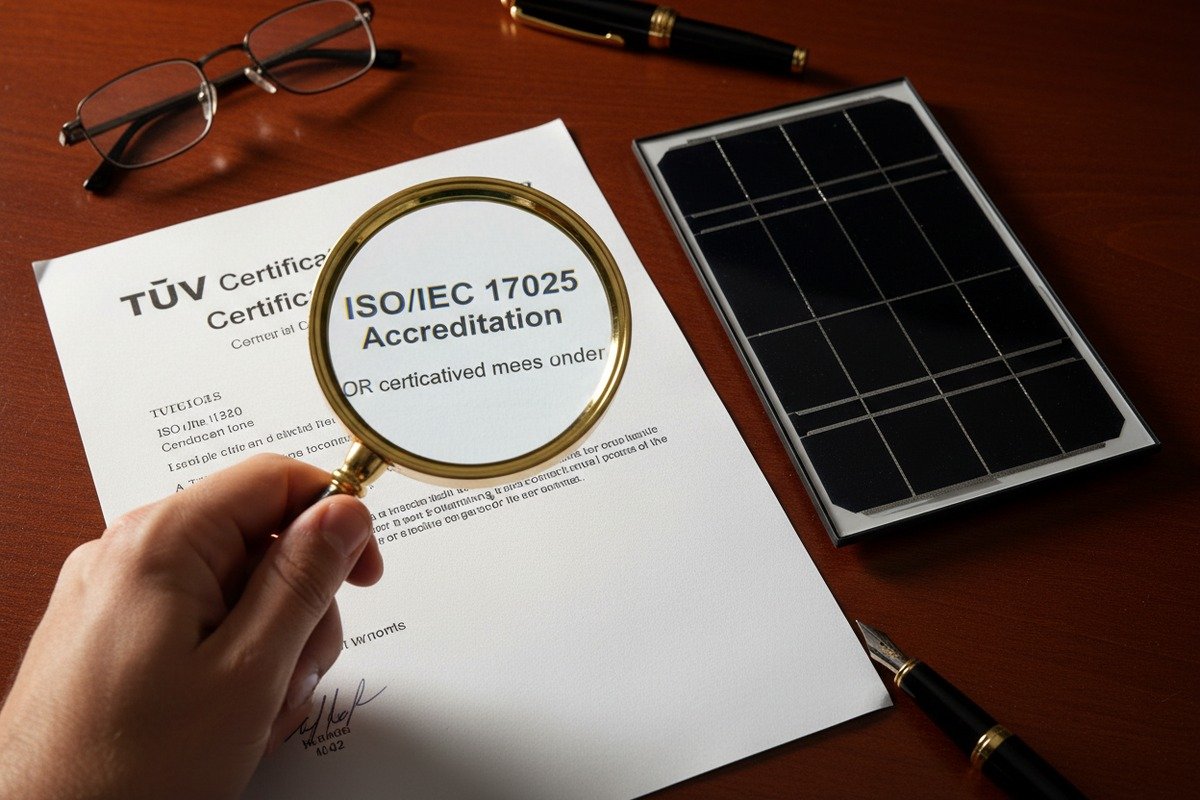
To verify validity, confirm that test reports come from an accredited laboratory (ISO/IEC 17025), that the tested assembly matches your exact roof build-up, that the report references the correct EN or IEC standard version, and that your local building authority or notified body accepts the specific certification.
Step 1: Check the Testing Laboratory
The lab must hold ISO/IEC 17025 accreditation 8 for the specific fire tests performed. Look for accreditation from bodies like DAkkS (Germany), COFRAC (France), or UKAS (UK). An unaccredited test report has zero legal weight in most European jurisdictions. Ask your supplier for the lab's accreditation certificate and cross-check it on the national accreditation body's website.
Step 2: Match the Tested Configuration to Your Roof
This is where many projects fail. A supplier may present a BROOF(t4) certificate, but the test was done on a concrete deck with mineral wool insulation. If your project uses a timber deck with PIR insulation, that report may not apply. The tested configuration must closely replicate or encompass your actual build-up. At our production facility, we maintain multiple test reports covering common European roof assemblies—timber rafters, steel decks, various insulation types—so our clients can match their specific project.
Step 3: Verify the Standard Version and Scope
Standards get updated. A report based on an outdated version of CEN/TS 1187 may be rejected. Check that the report references the current edition. Also verify the scope: does the report cover the shingle as a standalone product, or as part of a BIPV system including wiring, junction boxes, and mounting clips? A system-level report is far more useful.
Step 4: Consult Local Authorities and Notified Bodies
In France, the CSTB (Centre Scientifique et Technique du Bâtiment) issues Avis Techniques for novel building products. In Germany, the DIBt (Deutsches Institut für Bautechnik) may require an abZ (allgemeine bauaufsichtliche Zulassung) or an ETA (European Technical Assessment). These go beyond standard test reports and provide official acceptance for use in construction.
Verification Checklist
| Verification Step | What to Check | Red Flag |
|---|---|---|
| Lab accreditation | ISO/IEC 17025 for fire testing | Lab not listed on national accreditation database |
| Tested assembly match | Deck type, insulation, membrane | Report tested on concrete but your project uses timber |
| Standard version | Current edition of EN 13501-5 or IEC 61730-2 | Outdated standard referenced |
| Scope of report | System-level vs. component-level | Only the glass surface tested, not the full shingle system |
| Local acceptance | Avis Technique, ETA, or abZ where required | No local technical approval for BIPV use |
| Declaration of Performance | DoP issued under CPR | Missing or incomplete DoP document |
A Word on the Construction Products Regulation (CPR)
Under the EU CPR, any product permanently incorporated into a building must have a Declaration of Performance (DoP) 9 and CE marking. Construction Products Regulation 10 Solar roof shingles that replace conventional roofing material fall squarely under this regulation. The DoP must declare fire performance among other essential characteristics. If your supplier cannot provide a DoP, that is a serious compliance gap.
We issue a full DoP for every solar shingle product line we ship to Europe. It is not optional—it is the legal baseline.
What is the difference between electrical fire safety and building material fire ratings for my roof?
During the development of our latest BIPV shingle series, our engineers spent months working across two entirely separate certification tracks—one for the electrical system, one for the building envelope.
Electrical fire safety (governed by IEC 61730 and IEC 62109) addresses ignition risks from the PV system itself—arc faults, short circuits, and overheated connectors—while building material fire ratings (EN 13501 series) evaluate how roof materials react to and resist external fire exposure, flame spread, and penetration.
Two Separate Worlds of Risk
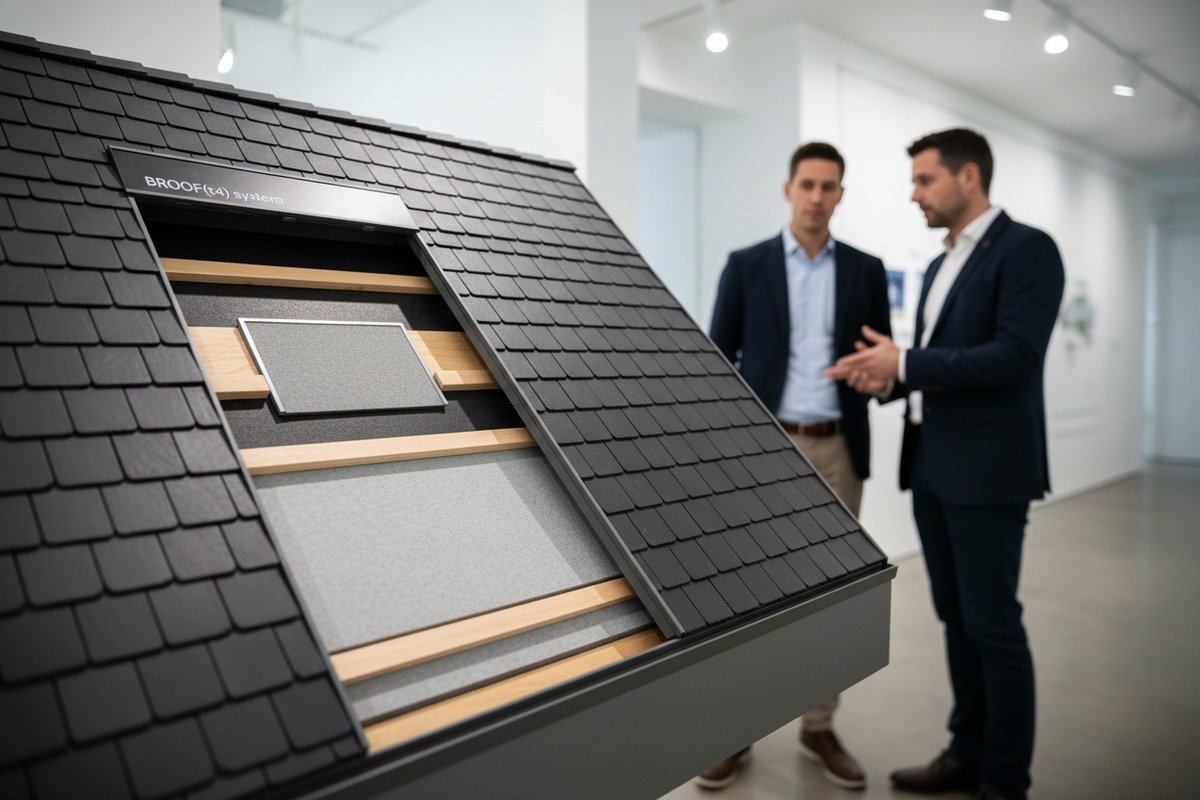
Think of it this way. Electrical fire safety asks: "Can this solar system start a fire?" Building material fire ratings ask: "If a fire reaches this roof, how does it behave?" Both questions must be answered for a safe installation. Ignoring either one creates a blind spot.
Electrical Fire Safety: Preventing Ignition
The PV system generates DC electricity whenever light hits the cells. DC arcs are harder to extinguish than AC arcs. Faulty connectors, damaged cables, poor crimps, or moisture ingress can all create arc faults. IEC 61730-2 tests the module for resistance to these risks. IEC 62109 covers inverter safety. CEA (the European insurance federation) audited over 600 solar systems and found electrical failures as the top ignition source.
Practical mitigation measures include:
- DC Arc Fault Circuit Interrupters (AFCIs): These detect arc signatures and shut down the circuit in milliseconds.
- Module-level rapid shutdown: Required in some jurisdictions, it de-energizes the DC wiring on the roof within seconds of a grid disconnect.
- High-quality connectors: MC4-compatible connectors with proper IP ratings reduce moisture-related failures.
- Professional installation: Most PV fires trace back to installation errors, not product defects. SolarPower Europe data supports this.
Building Material Fire Ratings: Containing Spread
Once a fire exists—from any source—the roof materials determine whether it stays small or engulfs the building. EN 13501-1 classifies each material. EN 13501-5 classifies the assembled roof. The BROOF(t4) rating specifically tests resistance to external fire on the roof surface.
Solar shingles add complexity. They can trap heat between the shingle and the deck, alter airflow, and create cavities where fire can travel unseen. This is why system-level testing matters more than component-level testing.
Side-by-Side Comparison
| Aspect | Electrical Fire Safety | Building Material Fire Rating |
|---|---|---|
| Primary question | Can the PV system ignite a fire? | How does the roof behave during a fire? |
| Key standards | IEC 61730-2, IEC 62109 | EN 13501-1, EN 13501-5 |
| Test focus | Arc faults, insulation resistance, hot spots | Flame spread, penetration, smoke, droplets |
| Typical causes addressed | Faulty connectors, damaged cables, moisture | External fire exposure (embers, radiant heat) |
| Mitigation tools | AFCIs, rapid shutdown, quality connectors | Non-combustible substrates, fire barriers |
| Who certifies | TUV, UL, MCS | Notified bodies under CPR |
| Relevance to insurers | Critical for liability coverage | Critical for property coverage |
Why You Need Both
A solar shingle with Class A fire rating under IEC 61730-2 but installed on a combustible roof without BROOF(t4) certification is still a fire hazard. Conversely, a perfectly fire-rated roof assembly with cheap PV connectors is an ignition risk waiting to happen. Our approach at Lonsontech is to deliver products that satisfy both tracks simultaneously, because our European clients cannot afford to explain gaps to insurers or inspectors.
Heat Entrapment and Ventilation
One factor unique to BIPV is heat entrapment. Traditional rack-mounted panels allow air to circulate underneath. Integrated shingles sit flush against the roof. This reduces cooling and can raise temperatures in the roof cavity. Higher temperatures stress cables and connectors. They also change fire dynamics if a blaze occurs. Designing ventilation channels or compartmentalization within the shingle system helps manage this risk. Some building codes now require specific cavity depth or fire stops at intervals.
How do I ensure my solar roof tiles won't compromise the fire insurance policy of my project?
One of our distribution partners in the Netherlands learned this the hard way—a completed installation was denied insurance coverage because the roof assembly lacked a documented BROOF(t4) rating for the specific combination used.
To protect your fire insurance policy, ensure the complete roof system holds valid BROOF(t4) classification, use PV modules rated IEC 61730-2 Class A, install DC arc fault protection, obtain written confirmation from your insurer before installation, and keep all test reports and Declarations of Performance on file.
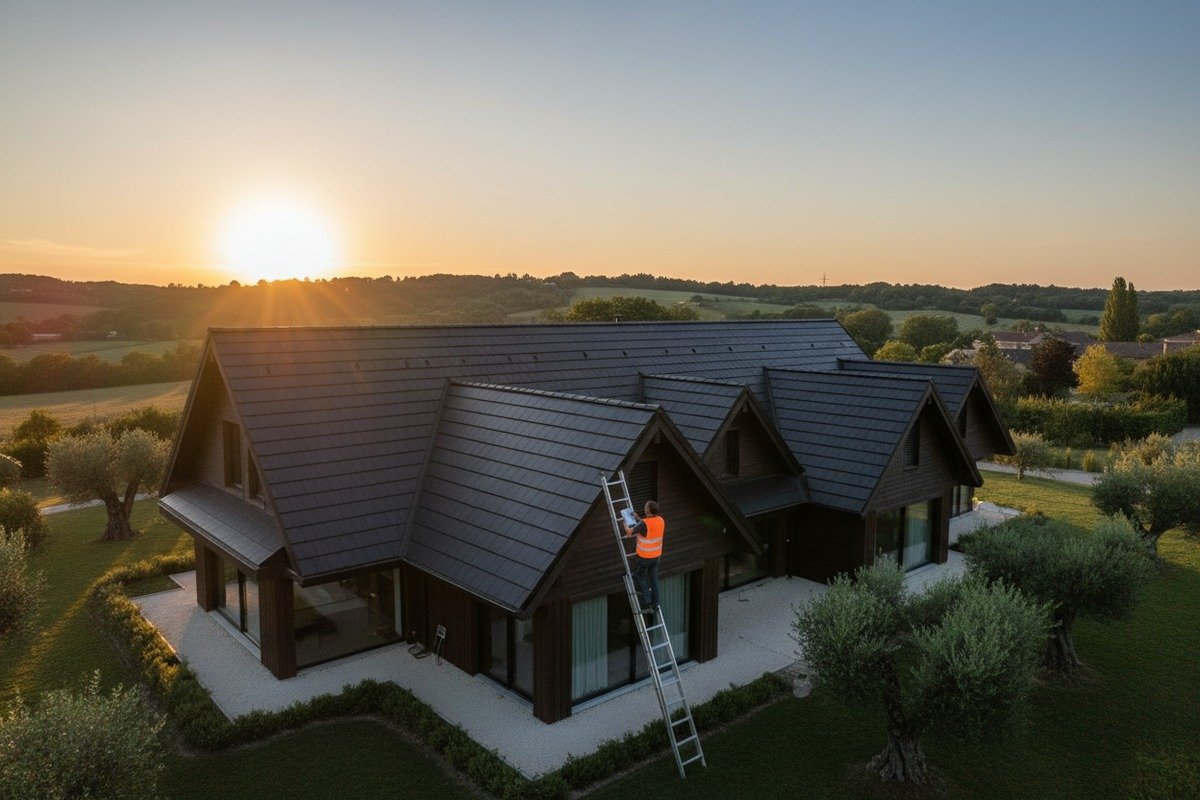
Why Insurers Are Getting Stricter
The rapid expansion of rooftop solar under REPowerEU and EPBD mandates is driving installations at unprecedented scale. Public buildings over 250 m² will require solar by 2027. Experts project around 3 PV fires per 100 MWh of installed capacity annually. As capacity grows, so does the absolute number of incidents. Insurers are responding with tighter requirements.
Some insurers now mandate non-combustible roof substrates (A1 or A2-s1,d0) for any building with integrated PV. Others require annual thermographic inspections. A few have begun excluding coverage for systems with Class C modules entirely.
What Insurers Typically Require
Here is what we see our European partners being asked for most often:
- BROOF(t4) certificate for the installed roof assembly, not just the shingle product.
- IEC 61730-2 Class A rating for the PV module.
- AFCI protection either at the module level or inverter level.
- Professional installation certificate from a qualified contractor.
- Maintenance plan with scheduled electrical inspections.
- Declaration of Performance under CPR.
Talk to Your Insurer Early
Do not wait until the roof is installed. Contact your insurer during the design phase. Provide them with the product datasheets, test reports, and the planned roof build-up. Ask for written confirmation that the proposed system will not void or limit coverage. If they have concerns, you still have time to adjust materials or add fire barriers.
Practical Tips for Risk Reduction
- Use non-combustible insulation (mineral wool, not EPS) directly beneath the solar shingles.
- Install fire stops at regular intervals in the roof cavity to compartmentalize any potential fire.
- Choose cables with flame-retardant jackets rated to EN 50575.
- Ensure all DC wiring is accessible for firefighter intervention—avoid burying it behind permanent fixtures.
- Maintain clear labeling on the exterior indicating that the building has a DC-generating PV system. Firefighters need this information to operate safely.
Digital Monitoring as an Insurance Asset
Some forward-thinking insurers offer premium discounts for systems with real-time monitoring. Module-level power electronics can detect anomalies—sudden drops in output, unusual temperature spikes—that signal developing faults. Digital twin technology takes this further, modeling the thermal behavior of the entire roof assembly and flagging risks before they become fires. We are seeing more of our clients integrate monitoring platforms as standard, partly because it strengthens their insurance position.
End-of-Life Considerations
Insurers also consider what happens when the system ages. Degraded encapsulants, cracked backsheets, and corroded connectors increase fire risk over time. Your warranty and maintenance agreement should address periodic replacement of vulnerable components. Our 25-year product warranty covers structural and performance degradation, giving insurers confidence in long-term risk profiles.
Conclusion
Evaluating solar roof shingles for European fire safety means checking material ratings, roof assembly certifications, electrical protections, and insurer requirements together—not in isolation. Get it right at the sourcing stage, and every step after becomes simpler.
Footnotes
1. Safety device for PV systems designed to detect and interrupt dangerous electrical arcs. ↩︎
2. Safety feature that quickly reduces voltage in solar energy systems during emergencies. ↩︎
3. Official standard for reaction-to-fire classification of construction products. ↩︎
4. Technical specification defining test methods for external fire exposure to roofs. ↩︎
5. Official standard for safety qualification testing of photovoltaic (PV) modules. ↩︎
6. Official standard for fire classification of roofs based on external fire exposure tests. ↩︎
7. Highest fire rating classification for roofs under European standard BS EN 13501-5. ↩︎
8. International standard for the competence of testing and calibration laboratories. ↩︎
9. Key concept in Construction Products Regulation, providing product performance information. ↩︎
10. Replaced with a working link from Construction Products Europe, detailing the updated Construction Products Regulation (EU) 2024/3110. ↩︎