

Every year, our production team fields dozens of urgent calls from European distributors who discover — too late — that their solar shingle wiring fails local electrical inspections. The problem is real: a single non-compliant connector or undersized cable can stall an entire roofing project, trigger liability claims, and destroy hard-won customer trust.
To ensure solar roof shingle wiring meets European electrical safety standards, verify CE marking under the Low Voltage Directive, obtain TÜV certification to EN IEC 61730 and EN IEC 61215, use IP-rated MC4 connectors from certified brands, confirm arc-fault protection, and demand EN 62446-1 commissioning documentation from your supplier before shipment.
This guide walks you through every checkpoint — from certification labels to connector longevity — so you can source with confidence. Let’s break it down section by section.
Which specific TUV and CE certifications should I verify for my solar shingle wiring?
When we prepare shipments for our French and German partners, certification questions always come first. The wrong paperwork means your container sits at customs while your project timeline collapses.
You should verify CE marking under the Low Voltage Directive (2014/35/EU) and EMC Directive (2014/30/EU), plus TÜV certification confirming compliance with EN IEC 61730 (safety qualification), EN IEC 61215 (design qualification), and EN 62446-1 (commissioning and documentation) for your solar shingle wiring.
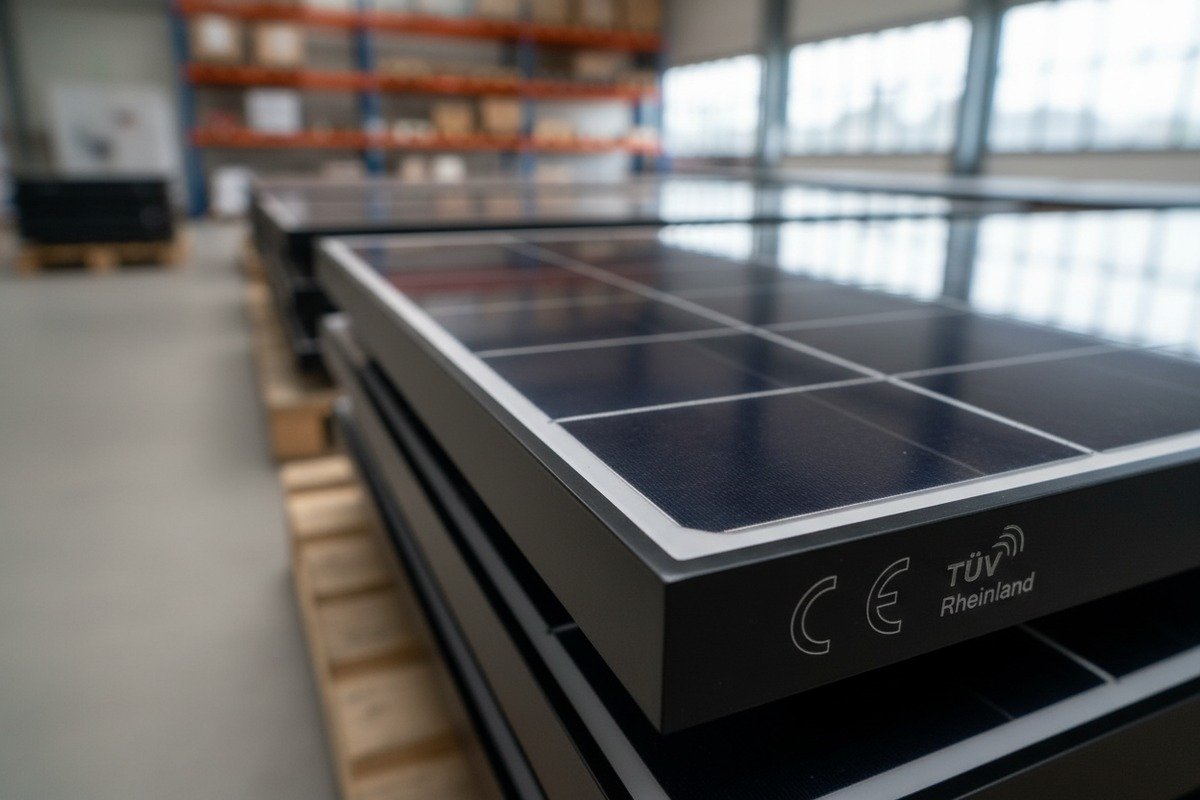
Understanding CE Marking for Solar Shingles
CE marking 1 is not a quality mark. It is a legal declaration that the product meets all applicable EU directives. For solar roof shingle wiring, two directives matter most:
- Low Voltage Directive (LVD) 2014/35/EU — covers electrical equipment operating between 50 and 1000 V AC or 75 and 1500 V DC. Your shingle wiring falls squarely in this range.
- EMC Directive 2014/30/EU — ensures your wiring and electronics do not emit excessive electromagnetic interference and can resist interference from other sources.
Without valid CE marking, your product cannot legally enter the EU market. Period.
TÜV Certification: Going Beyond the Minimum
CE is mandatory. TÜV is voluntary — but in practice, most European roofing companies and distributors will not touch a solar shingle without it. TÜV SÜD 2 and TÜV Rheinland test modules and wiring systems against the following standards:
| Standard | What It Covers | Why It Matters for Wiring |
|---|---|---|
| EN IEC 61215 | Design qualification and type approval | Validates that wiring withstands thermal cycling, damp heat, and UV exposure |
| EN IEC 61730 3 | Safety qualification | Tests insulation resistance, dielectric strength, and fire resistance of wiring |
| EN 62446-1 | Commissioning, documentation, and inspection | Requires wiring diagrams, string layouts, and test records at handover |
| IEC 62852 | Connectors for DC PV systems | Ensures MC4-type connectors meet mating, locking, and contact resistance specs |
At our facility, we keep TÜV test reports updated every production cycle. If your supplier cannot produce current reports — not ones from five years ago — that is a red flag.
National Add-Ons You Cannot Ignore
The EU sets a baseline, but individual countries add layers. In France, the UTE C 15-712-1 governs PV installation. In Germany, VDE 0100-712 applies. The UK (post-Brexit) requires MCS certification 4 and compliance with BS 7671, the 18th Edition IET Wiring Regulations. Always ask your supplier which national markets they have tested for — not just "Europe" in general.
What to Request from Your Supplier
Ask for these documents before you place a purchase order:
- CE Declaration of Conformity — signed by the legal manufacturer
- TÜV certificate with the test report number
- EN 62446-1 commissioning template or completed sample
- Bill of materials listing cable type, insulation rating, and connector brand
- Fire classification report per EN 13501-5
If any document is missing, pause. It costs far less to wait than to recall.
How can I be sure the wiring design prevents electrical fires and water leakage?
Fire and water are the two nightmares that keep our engineering team up at night. In twenty years of manufacturing solar roofing products, we have learned that most failures trace back to wiring design choices made at the sourcing stage — not on the rooftop.
A fire- and leak-safe wiring design requires arc-fault circuit interrupter (AFCI) protection, double-insulated solar cables rated to at least 1500 V DC, IP67 or higher connectors, proper cable routing that avoids roof penetrations, and integrated drainage channels tested to prevent water ingress over the product's full lifespan.
The Fire Risk Is Real — and Growing
Clean Energy Associates analyzed over 600 PV fire incidents 5 globally. EU projections suggest thousands of PV-related fires per year without proper mitigation guidelines. For solar shingles specifically, the risk is amplified because the wiring sits directly on — or inside — the roofing structure. There is no air gap to slow a fire.
Key fire prevention measures in wiring design:
- AFCI-equipped inverters — devices like Huawei's SUN2000 series detect arc faults and shut down within 0.5 seconds. This is not optional for responsible sourcing.
- Double-insulated cables — standard solar cables (e.g., H1Z2Z2-K type) must carry a minimum 1500 V DC rating with halogen-free, flame-retardant insulation.
- No mixed connector brands — mixing MC4 connectors from different manufacturers is one of the most common fire causes. Contact resistance increases, heat builds, and arcing follows.
Water Leakage: The Silent Profit Killer
A leak from a traditional rooftop panel wets the mounting rail. A leak from a solar shingle soaks your ceiling. European labor costs for repair can exceed €150 per hour. One leak claim can wipe out the margin on an entire project.
Our waterproof design uses three layers of protection:
| Layer | Component | Standard / Rating |
|---|---|---|
| Primary | Overlapping shingle drainage channel | Tested per EN 14437 and internal 2000 Pa water pressure test |
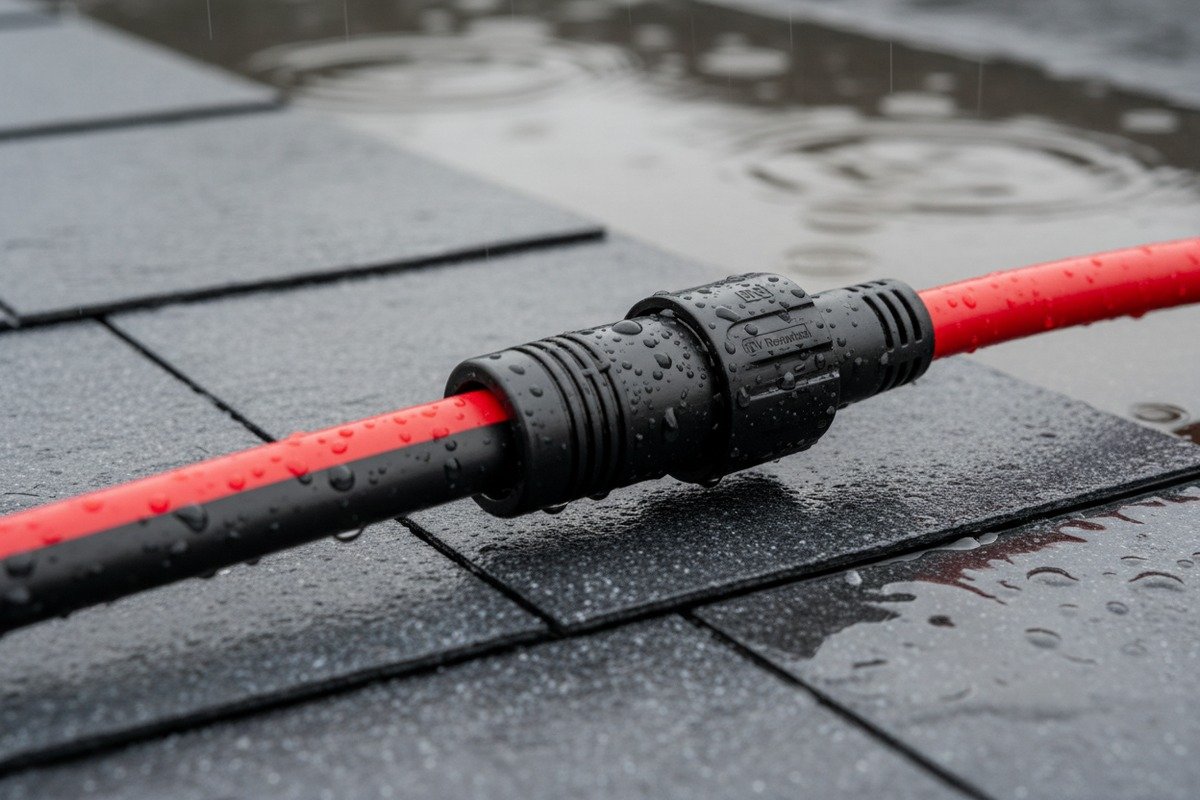
| Secondary | IP67-rated MC4 EVO2 connectors | IEC 62852 — withstand temporary submersion |
| Tertiary | Sealed cable entry boots with UV-resistant EPDM gaskets | BS 5534 compliance for slating and tiling integration |
Cable Routing Best Practices
Never route DC cables 6 through the roof membrane unless absolutely unavoidable. If penetration is necessary, use manufacturer-specified flashing boots and seal with butyl tape plus a mechanical clamp. On flat roofs, EU fire safety guidelines limit array sizes to 40 m × 40 m with 1 m access strips around each array. For arrays longer than 75 m, a 1.8 m fire break is required.
Our shingles are designed with hidden cable channels along the interlocking edges. This means zero roof penetrations for inter-shingle wiring. The only penetrations occur at string endpoints where cables enter the building — and we supply pre-molded flashing kits for those points.
Grounding and Fault Protection
Every metal frame in the array must be bonded to a continuous equipment grounding conductor 7. Residual current devices (RCDs) rated for DC fault detection should be installed at the inverter end. In the UK, BS 7671 Section 712 specifically requires Type B RCDs for PV systems.
What evidence do I need that the connectors will last for my 25-year product warranty?
We offer a 25-year product warranty on our solar roof shingles, and every single warranty claim we have investigated in the past decade traces back to one component category: connectors. They are small, cheap, and absolutely critical.
To back a 25-year warranty, demand connectors tested to IEC 62852 with documented results for 1000-hour damp heat aging, 200 thermal cycles, 10,000 mating cycles, UV exposure resistance, and contact resistance below 0.5 mΩ — plus third-party certification from TÜV or equivalent labs confirming these results.

Why Connectors Fail Before Anything Else
A solar shingle module might last 30 years. The glass, the cells, the encapsulant — all robust. But a connector exposed to rain, freeze-thaw cycles, and UV radiation for 25 years? That is where corners get cut during sourcing, and that is where failures begin.
Common failure modes:
- Corrosion of contact pins — cheap tin-plated pins corrode within 5–7 years in coastal climates. Silver or gold plating is essential.
- Seal degradation — EPDM or silicone O-rings harden and crack under UV, allowing moisture into the contact chamber.
- Creep and loosening — polymer housings expand and contract with temperature. Low-quality plastics lose clamping force over time.
The Gold Standard: Stäubli MC4 EVO2
We use Stäubli MC4 EVO2 connectors 8 in our standard product line. Here is why:
| Test Parameter | IEC 62852 Requirement | Stäubli MC4 EVO2 Result |
|---|---|---|
| Damp heat (85°C, 85% RH) | 1000 hours | 2000 hours pass |
| Thermal cycling (-40°C to +85°C) | 200 cycles | 400 cycles pass |
| Contact resistance | ≤ 0.5 mΩ | 0.15 mΩ typical |
| UV resistance | 15 kWh/m² | 30 kWh/m² pass |
| IP rating | IP65 minimum | IP68 rated |
| Mating cycles | 25 minimum | 100+ tested |
These numbers matter when a property owner files a claim in year 18. You need documentation that your connector was designed to outlast your warranty — not just meet it.
What Documents to Request
When you evaluate a supplier's connectors, ask for:
- IEC 62852 type-test report — from TÜV, VDE, or an accredited ILAC lab
- Accelerated aging data — damp heat, thermal cycling, salt mist (IEC 61701 for coastal zones)
- Field return rate data — any reputable connector manufacturer tracks this
- Material safety data sheets — confirm housing is PPO or PA66, not recycled ABS
- Traceability codes — each connector should have a batch-traceable serial or lot number
The Hidden Cost of Cheap Connectors
A single Stäubli MC4 EVO2 connector pair costs roughly €3–4. A generic unbranded pair costs €0.50. On a 50-shingle roof, switching to generics saves about €125. But one field failure — one truck roll, one scaffolding hire, one afternoon of a licensed electrician's time — costs €800 or more in Western Europe. The math is simple. Do not save on connectors.
Our OEM customers sometimes request alternative connector brands for cost reasons. We accommodate this — but only if the alternative carries its own IEC 62852 certification 9 and the customer accepts the warranty implications in writing.
How do I confirm the wiring system meets the latest European electrical safety norms?
Regulations in Europe do not stand still. The REPowerEU plan 10 and the updated Energy Performance of Buildings Directive are pushing solar requirements into every new building permit from 2027 for non-residential and 2030 for residential. When we update our wiring designs, we track not just current norms but the ones coming in 18 months.
Confirm compliance by requesting a current CE Declaration of Conformity referencing the latest harmonized standards, verifying EN 62446-1 commissioning documentation, checking for AFCI and RCD protection per national wiring regulations, and auditing your supplier's testing regime including IV curve tracing and electroluminescence imaging.
The Standards Landscape in 2025
The European standards ecosystem for solar shingle wiring is layered. Here is the hierarchy:
- EU Directives — set mandatory safety objectives (LVD, EMC, CPR)
- Harmonized EN/IEC Standards — provide the technical pathway to compliance
- National Wiring Regulations — add country-specific installation rules
- Installer Certifications — MCS (UK), QualiPV (France), EUPVSEC guidelines
You need compliance at every layer. A product certified to EN IEC 61730 but installed outside BS 7671 rules in the UK is still non-compliant.
Upcoming Regulatory Changes
The Energy Performance of Buildings Directive (EPBD) recast is reshaping the market:
- From 2027, all new non-residential buildings over 250 m² must incorporate solar energy systems.
- From 2028, non-residential buildings over 500 m² undergoing major renovation must add solar.
- From 2030, all new residential buildings must include solar.
This means demand for compliant solar shingles will surge. Suppliers who cannot demonstrate full electrical safety compliance will be excluded from tenders.
In-House Testing You Should Demand
Premium suppliers — and we include ourselves in this category — run in-house quality checks on every production batch:
- IV Curve Tracing — measures the current-voltage characteristic of each shingle module to detect cell cracks, poor solder joints, or wiring defects
- Electroluminescence (EL) Imaging — uses infrared cameras to reveal micro-cracks and inactive cell areas invisible to the naked eye
- Insulation Resistance Testing — per EN IEC 61730, measures leakage current between live conductors and frame at 1000 V DC minimum
- Wet Leakage Current Test — the module is sprayed with water while energized to simulate rain conditions
Your Compliance Audit Checklist
Before confirming any order, walk through this checklist with your supplier:
- Is the CE Declaration of Conformity dated within the last 12 months and referencing current standard editions?
- Does the TÜV certificate cover the exact model and wiring configuration you are ordering?
- Can the supplier provide EN 62446-1 documentation templates for your installers?
- Are AFCI-compatible inverters specified or offered as part of the system?
- Does the supplier track national variations (VDE, UTE, BS 7671, MCS) for your target market?
- Is there a process for notifying you when standards change?
At Lonsontech, we assign a dedicated compliance engineer to each OEM account. When EN IEC 61730 or IEC 62852 updates are published, we notify our partners within 30 days and provide a gap analysis showing what — if anything — changes in the product.
Digital Tools for Ongoing Compliance
Forward-thinking buyers are adopting digital twin technology to model their solar shingle installations from design through decommissioning. This allows continuous monitoring of electrical integrity and predictive maintenance alerts. AI-driven monitoring can detect subtle anomalies — a connector's resistance drifting upward, a string's voltage dropping — before they become safety hazards. Blockchain-based supply chain records are also emerging, creating an immutable trail from raw material to installed shingle. These are not science fiction. They are tools already in use by large European developers, and the technology is filtering down to mid-market projects.
Conclusion
Sourcing compliant solar shingle wiring is not optional — it is the foundation of every successful European roofing project. Verify certifications, demand tested connectors, audit fire and water protection, and stay ahead of evolving norms. Your 25-year warranty depends on it.
Footnotes
1. Provides official EU information on the purpose and requirements of CE marking. ↩︎
2. Official website of TÜV SÜD, a leading international certification body. ↩︎
3. Replaced HTTP 404 with the official IEC page for the EN IEC 61730-1 standard (safety qualification). ↩︎
4. Official website for the Microgeneration Certification Scheme in the UK. ↩︎
5. Replaced HTTP 404 with an authoritative government source on solar PV fire safety. ↩︎
6. Provides best practices for DC cable management in solar PV systems from a national lab. ↩︎
7. Official OSHA regulation detailing requirements for equipment grounding conductors. ↩︎
8. Official manufacturer’s page providing technical specifications for MC4-Evo 2 connectors. ↩︎
9. Official International Electrotechnical Commission (IEC) page for the IEC 62852 standard. ↩︎
10. Official European Commission page detailing the REPowerEU plan and its objectives. ↩︎