

Every year, our export team receives dozens of calls from European distributors who bought solar shingles from another supplier — only to discover that “installation support” meant a 12-page PDF and a generic email address CE marking training programs 1. The roofing crew shows up, the tiles arrive on pallets, and nobody on-site knows how to handle the waterproof interlocking or the wiring sequence. The result? Delays, leaks, warranty disputes, and angry homeowners MCS-certified installers 2. After 20 years of manufacturing solar roof tiles and shingles at our facility, we have learned one truth: the product is only as good as the installation behind it.
To confirm a solar roof shingle supplier provides on-site installation guidance in Europe, request documented proof of previous European project supervision, verify dedicated engineer deployment clauses in your procurement contract, and check for CE/TUV-certified training programs that cover waterproofing, wiring, and local building code compliance.
This article walks you through the exact steps to verify on-site support before you sign a contract. We cover track record verification, required documentation, crew training commitments, and how to lock technical support into your BIPV procurement agreement. Let’s dig in.
How can I verify if my solar roof shingle supplier has a proven track record of sending technical teams to Europe?
When our first container of solar roof shingles landed in Lyon back in 2018, the local roofing company had never touched a BIPV product 3 before. We quickly realized that shipping great products means nothing if the installer cannot execute the job. That experience shaped how we now approach every European project.
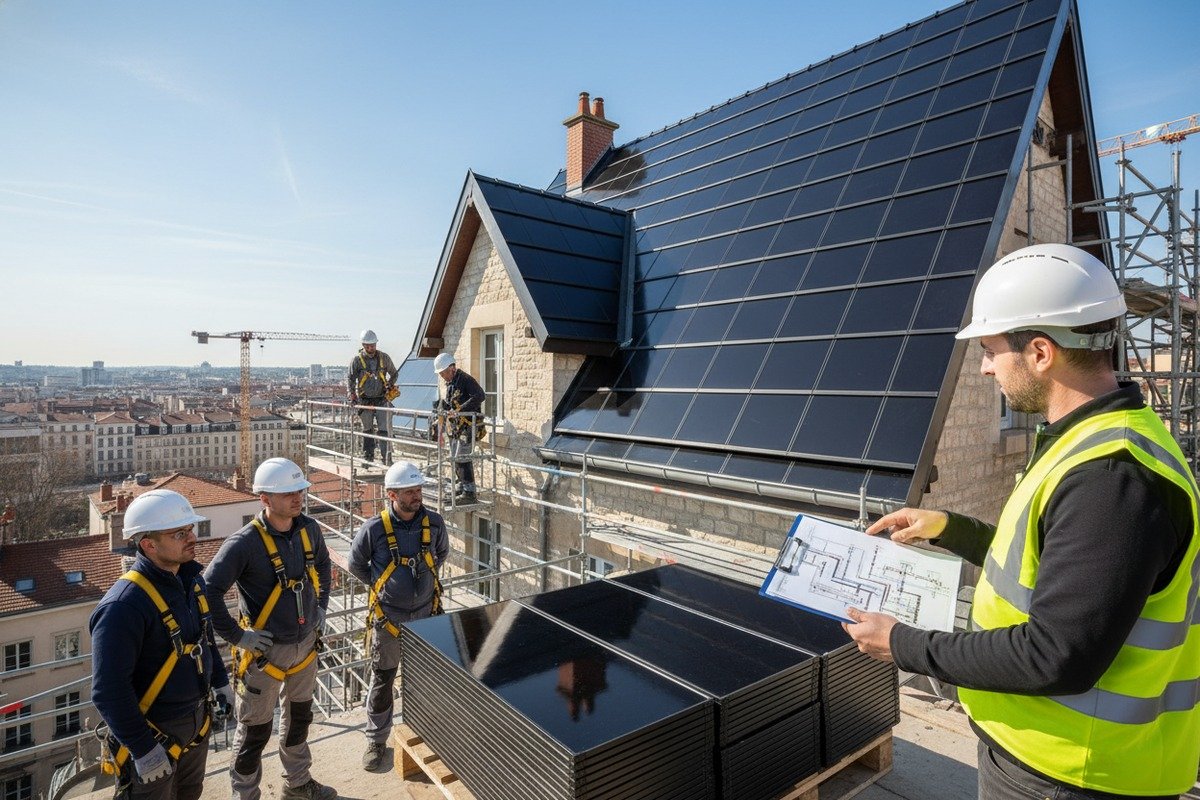
Verify a supplier's European track record by requesting a portfolio of completed projects with client references, checking for region-specific certifications like CE and TUV, and confirming past deployment of technical teams through dated service reports, travel records, or testimonial videos from European job sites.
Why Track Record Matters More Than Promises
A glossy brochure is not proof. Many solar shingle suppliers claim "global support" on their websites but have never sent a single engineer outside their home country. The European market has unique challenges — steep pitched roofs, strict building codes under the Construction Products Regulation (CPR) 4, and high labor costs that make installation errors extremely expensive.
Here is what you should ask for:
- A list of at least 3 completed European projects with addresses or GPS coordinates.
- Contact details for the project manager or distributor on each reference project.
- Photos or video showing the supplier's technical team physically on-site.
- Dated service reports that include travel itineraries and engineer names.
Red Flags to Watch For
| Red Flag | What It Means | What to Do Instead |
|---|---|---|
| Supplier only provides PDF manuals | No on-site experience in Europe | Ask for video calls with past European clients |
| "We can arrange support if needed" | No established process or team | Request a written deployment policy with timelines |
| References only from domestic projects | Untested in European conditions | Prioritize suppliers with EU-specific case studies |
| No CE or TUV certification | Product may not meet EU standards | Walk away or demand third-party testing first |
Cross-Check with Independent Sources
Do not rely solely on what the supplier tells you. Search for the supplier's name on European solar energy forums, LinkedIn groups for BIPV professionals, and trade show exhibitor lists from Intersolar Europe 5 or Solar Solutions International. If they have been sending teams to Europe, there will be a digital footprint.
At our company, we keep a dedicated project archive with photos, installation logs, and signed completion certificates from every European job we support. We share these openly with prospective buyers because transparency builds trust faster than any sales pitch.
You should also verify whether the supplier's products carry EN IEC 61730 safety certification 6 and whether they have partnerships with MCS-certified installers in your target country. These certifications indicate not just product quality but also a serious commitment to the European market.
What specific documentation should I request to confirm their on-site supervision capabilities for my project?
Our engineering team learned early on that verbal promises vanish the moment a container clears customs. When we prepare documentation packages for our European partners, every detail — from torque specifications to drainage slope angles — is written down, signed, and version-controlled. That discipline protects both sides.
Request product-specific installation manuals, waterproofing test reports, on-site supervision service agreements, engineer credential certificates, and a detailed project deployment plan that specifies the number of engineers, duration of on-site stay, and scope of technical tasks they will perform.

The Essential Document Checklist
Before signing any procurement contract, collect and review the following documents. If a supplier cannot provide them, treat that as a serious warning sign.
| Document | Purpose | Key Details to Verify |
|---|---|---|
| Product Installation Manual | Step-by-step guidance for roofers | Must include waterproofing, wiring, torque specs (e.g., 2 Nm for mounting screws), and load limits (e.g., max 160 kg/m²) |
| On-Site Service Agreement | Defines what the supplier will do on your job site | Number of engineers, days on-site, tasks covered, travel cost allocation |
| Engineer Credential Certificates | Proves the engineer is qualified | Look for electrical certifications, BIPV training records, and language skills |
| Waterproofing Test Report 7 | Proves the product resists water ingress | Must reference EN or ISO standards 8; include test pressure, duration, and results |
| CE / TUV / VDE Certificates | Regulatory compliance proof | Check validity dates, product model numbers, and testing lab accreditation |
| Project Deployment Plan | Timeline and logistics for on-site support | Should specify arrival date relative to installation start, milestone checkpoints, and sign-off procedures |
Why Waterproofing Documentation Is Non-Negotiable
In our experience shipping solar roof shingles across Europe, the single biggest source of post-installation complaints is water leakage. Unlike traditional solar panels mounted on racks above the roof surface, solar shingles replace the roof covering itself. If the interlocking design or drainage channels fail, rainwater enters the building directly.
That is why we provide every European buyer with a dedicated waterproofing test report. This report shows how our shingles perform under simulated heavy rain at various pitch angles. It also documents the drainage channel design and the sealing materials used at overlap joints.
Go Beyond the Manual
A good installation manual is necessary but not sufficient. The manual tells your roofers what to do. The on-site supervision agreement tells you that a qualified engineer will be there to make sure they do it right. These are two different things.
Ask the supplier to include specific deliverables in the on-site service agreement:
- Pre-installation roof assessment (pitch, structural condition, existing waterproofing).
- Live demonstration of the first row of shingles.
- Wiring and connector inspection before system energization.
- Final waterproofing walkthrough with photo documentation.
- A signed completion report that you can use for warranty claims.
Our team typically spends 3 to 5 days on-site during the first phase of a European project. We walk the crew through the interlocking mechanism, verify the drainage slope, and check every electrical connection before we leave. That level of documentation and physical presence is what separates a reliable supplier from one that just ships boxes.
Will the supplier provide a dedicated engineer to train my local roofing crew on-site during the first phase of installation?
The first time our installation engineer landed in Hamburg for a 200-unit residential project, the local roofing crew had 15 years of experience with clay tiles — but zero experience with photovoltaic shingles. Within three days of hands-on training, they were installing independently at full speed. That transformation only happens face-to-face.
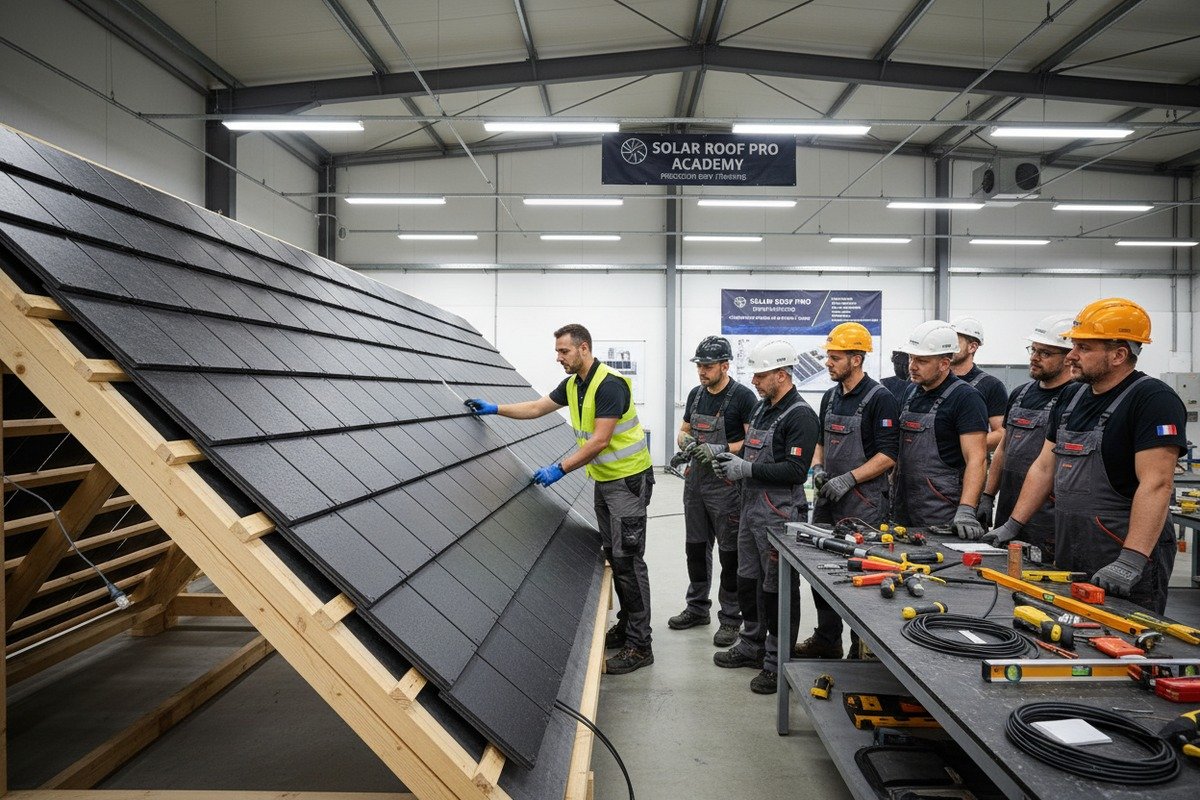
A reliable solar shingle supplier should deploy a dedicated engineer to your European project site during the first installation phase to train your local crew on mounting sequences, waterproof interlocking, electrical connections, and safety protocols — typically for 3 to 7 days depending on project scale and crew experience.
What "First Phase Training" Should Include
The first phase of installation is when most mistakes happen. Roofers are unfamiliar with the product. They may apply too much force on the glass surface, use power tools where only manual screwdrivers are permitted, or skip critical sealing steps. A dedicated engineer on-site prevents all of this.
Here is what a proper first-phase training program looks like:
Classroom Session vs. Hands-On Training
The best suppliers combine a brief classroom session (1–2 hours covering theory and safety) with extended hands-on training on the actual roof. Our engineers use the first 10–20 shingles as a live teaching exercise. They install alongside the crew, correct errors in real time, and do not leave until the team can work independently.
| Training Component | Duration | Delivered By | Key Topics |
|---|---|---|---|
| Product overview and safety briefing | 1–2 hours | Supplier engineer | Glass handling, load limits, no-power-tool policy, fall protection |
| Mounting system demonstration | Half day | Supplier engineer + crew lead | Batten layout, screw torque (2 Nm), interlocking sequence |
| Waterproofing and drainage walkthrough | Half day | Supplier engineer | Overlap sealing, flashing integration, ridge and valley details |
| Electrical wiring and connector training | Half day | Supplier engineer (certified) | String wiring, MC4 connections 9, grounding, inverter compatibility |
| Independent crew installation under supervision | 1–3 days | Crew works, engineer observes and corrects | Full installation cycle with real-time feedback |
| Final quality inspection and sign-off | 2–4 hours | Supplier engineer | Waterproof test, electrical continuity check, documentation |
How to Confirm This Before You Buy
Do not assume the supplier will send someone. Get it in writing. Here are the questions to ask:
- Will you assign a named engineer to my project?
- What is the engineer's experience with European installations?
- Does the engineer speak English or the local language?
- How many days will the engineer stay on-site?
- Who covers travel and accommodation costs?
- What happens if the crew needs additional training days?
At our facility, we assign engineers who have completed at least 5 European installation projects. We cover their travel costs for the first deployment as part of our standard service for orders above a minimum volume. This is not a marketing gimmick — it is how we protect our 25-year product warranty. If the shingles are installed incorrectly, the warranty means nothing.
The Cost of Skipping On-Site Training
European labor costs range from €35 to €80 per hour for skilled roofers. If an untrained crew takes twice as long to install because they are figuring things out from a manual, the added labor cost alone can exceed €10,000 on a mid-size residential project. Add the risk of water damage claims — which can run €50,000 or more for interior repairs — and the value of a 5-day engineer visit becomes obvious.
Some suppliers, like SunStyle and Wienerberger, require trained personnel for installation but rely primarily on manuals and certified installer networks rather than direct engineer deployment. Others, including our team at Lonsontech, offer direct on-site supervision as a standard part of the first-project relationship. Know the difference before you commit.
How do I include guaranteed on-site technical support and waterproofing inspections in my BIPV procurement contract?
When we draft supply agreements with our European partners, the technical support clause is never an afterthought — it is one of the first items we negotiate. Our legal and engineering teams collaborate to make sure the language is specific, measurable, and enforceable. Vague promises like "we will support you" have no place in a BIPV contract.
Include guaranteed on-site support in your BIPV contract by adding specific clauses that define engineer deployment timelines, waterproofing inspection checkpoints, acceptance criteria, penalty mechanisms for non-compliance, and a clear allocation of travel costs — all tied to project milestones rather than vague commitments.

Key Contract Clauses You Must Include
A BIPV procurement contract is not a standard product purchase order. It involves building-integrated components where product failure equals building failure. Your contract must reflect that reality.
Clause 1: Engineer Deployment Schedule
Specify exactly when the supplier's engineer must arrive relative to your installation start date. For example: "Supplier shall deploy one qualified installation engineer to the project site no later than 2 business days before the scheduled installation start date. The engineer shall remain on-site for a minimum of 5 working days or until the first 50 units are installed and inspected, whichever is longer."
Clause 2: Waterproofing Inspection Protocol
This is the clause that saves you from €50,000 leak damage claims. Define mandatory inspection checkpoints:
- After the first row of shingles is installed.
- After each roof plane is completed.
- At all critical junctions: ridges, valleys, flashings, and penetrations.
- A final water spray test before project handover.
Each inspection should be documented with photos, signed by both the supplier's engineer and your site foreman, and attached to the project file.
Clause 3: Acceptance Criteria and Penalties
Define what "acceptable installation" means in measurable terms. For example:
- Zero visible gaps in interlocking joints exceeding 0.5 mm.
- All mounting screws torqued to 2 Nm (±0.5 Nm).
- Electrical continuity confirmed on 100% of strings.
- No water ingress detected during a 15-minute spray test at 45° angle.
If the supplier's engineer fails to show up or the installation does not meet these criteria due to supplier-side issues, the contract should specify remedies: re-deployment at supplier's cost, a credit against the purchase price, or extended warranty coverage.
Clause 4: Cost Allocation
Be explicit about who pays for what. Travel, accommodation, daily rates, and overtime charges should all be defined upfront.
| Cost Item | Paid By Supplier | Paid By Buyer | Notes |
|---|---|---|---|
| Engineer's salary during on-site days | ✔ | Standard for first project with most reputable suppliers | |
| International airfare | ✔ | Often included in orders above a minimum volume threshold | |
| Local accommodation | ✔ | Buyer usually arranges lodging near the project site | |
| Local transportation | ✔ | Rental car or project vehicle provided by buyer | |
| Additional training days beyond agreed scope | ✔ | Negotiable; define daily rate in advance | |
| Return visit for warranty inspection | ✔ | Should be included in the 25-year warranty terms |
Clause 5: Post-Installation Support and Monitoring
Your contract should not end when the engineer leaves the job site. Include provisions for remote technical support (24/7 hotline or dedicated WhatsApp/email channel), annual performance monitoring reports, and a commitment to return for warranty inspections if issues arise within the first 2 years.
At our company, we include all of these clauses in our standard European distribution agreements. We have found that buyers who negotiate these terms upfront have significantly fewer post-installation disputes. The contract is not about distrust — it is about clarity. Both sides know exactly what to expect, and that makes the entire project run smoother.
A Note on Local Building Code Compliance
Your contract should also require the supplier to provide documentation confirming compliance with local building regulations. In Europe, this means CPR (Construction Products Regulation) compliance, fire ratings 10, wind and snow load calculations, and water penetration test results per relevant EN standards. If the supplier's engineer is on-site, they should also verify that the installation meets these codes before sign-off. This protects you legally and ensures your project passes local inspections without delays.
Conclusion
Confirming on-site installation guidance comes down to evidence, documentation, and enforceable contract language. Verify track records, request specific credentials, demand hands-on engineer training, and write every commitment into your BIPV procurement agreement.
Footnotes
1. Replaced inaccessible TÜV SÜD link with a relevant CE marking training program from TÜV AUSTRIA, an authoritative source. ↩︎
2. Explains the Microgeneration Certification Scheme for renewable energy installers in the UK. ↩︎
3. Provides a comprehensive overview and definition of Building-integrated photovoltaics (BIPV). ↩︎
4. Official government guidance on the EU Construction Products Regulation and its obligations for manufacturers. ↩︎
5. Official website for the world’s leading exhibition for the solar industry, held annually in Munich. ↩︎
6. Replaced inaccessible link with the official International Electrotechnical Commission (IEC) page for the IEC 61730-1 standard, the most authoritative source. ↩︎
7. Discusses industry field testing protocols and standards for waterproofing installations in construction. ↩︎
8. Explains the differences and relationship between European (EN) and International (ISO) standards. ↩︎
9. Explains MC4 connectors, commonly used for connecting solar panels in photovoltaic systems. ↩︎
10. Explains Euroclass fire ratings, the European standard for classifying fire performance of building materials. ↩︎