
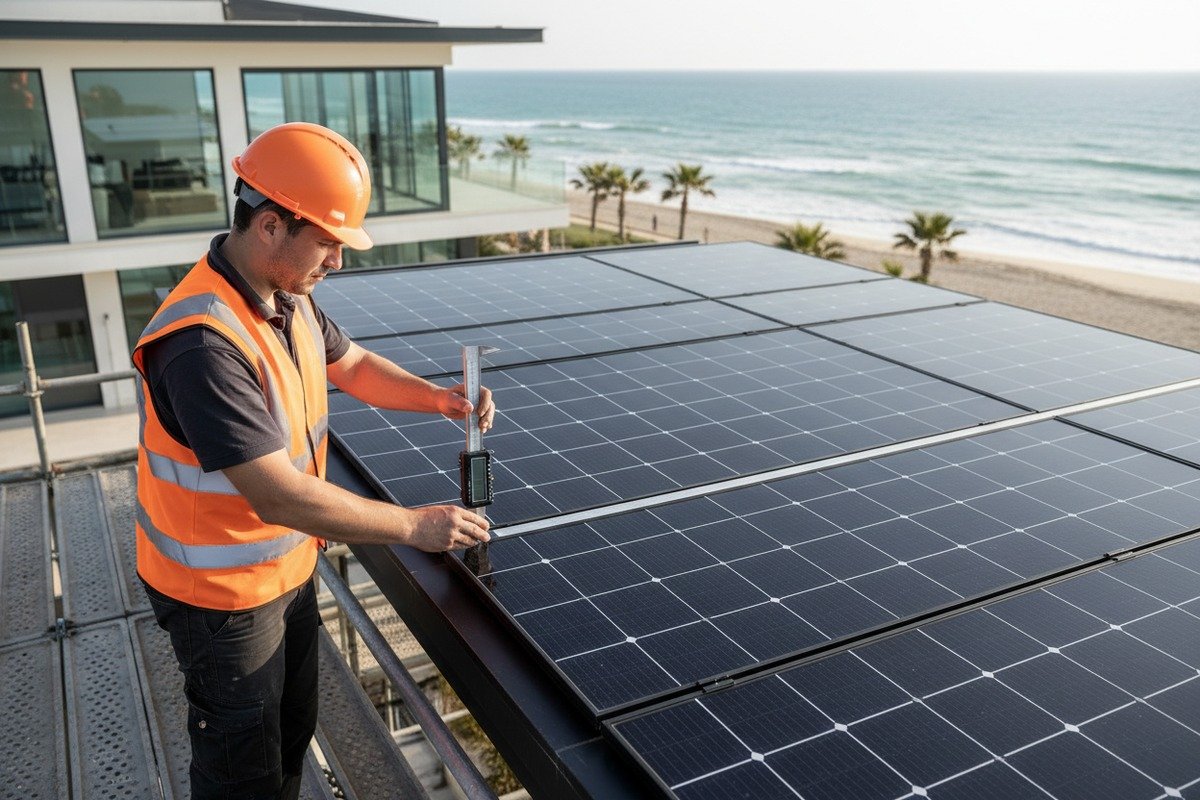
Every year, we see warranty claims come in from coastal installations where salt air quietly ate through frames, connectors, and coatings that looked fine on paper.
To evaluate solar roof shingle corrosion resistance, buyers should verify IEC 61701 salt mist certification, inspect frame material grades like 5052-H32 aluminum, confirm IP65+ sealing on all electrical components, review interlocking drainage design details, and demand written performance warranties specifically covering high-salinity and high-humidity environments.
This guide breaks down the exact standards, design features, coating technologies, and warranty terms you need to check before placing an order IEC 61701 salt mist certification 1. Let’s walk through each critical factor step by step.
Which international testing standards should I check to confirm salt spray resistance for my order?
When our quality team reviews test reports before shipment, we see many buyers confused about which certifications actually matter for coastal corrosion resistance versus general durability.
Buyers should verify IEC 61701 salt mist corrosion certification as the primary standard, supplemented by IEC 61215 for damp heat testing and IEC 60068-2-30 for humidity freeze cycles. Together, these three standards confirm a solar roof shingle can withstand salt spray, moisture penetration, and thermal stress in coastal climates.
IEC 61701: The Core Salt Spray Standard
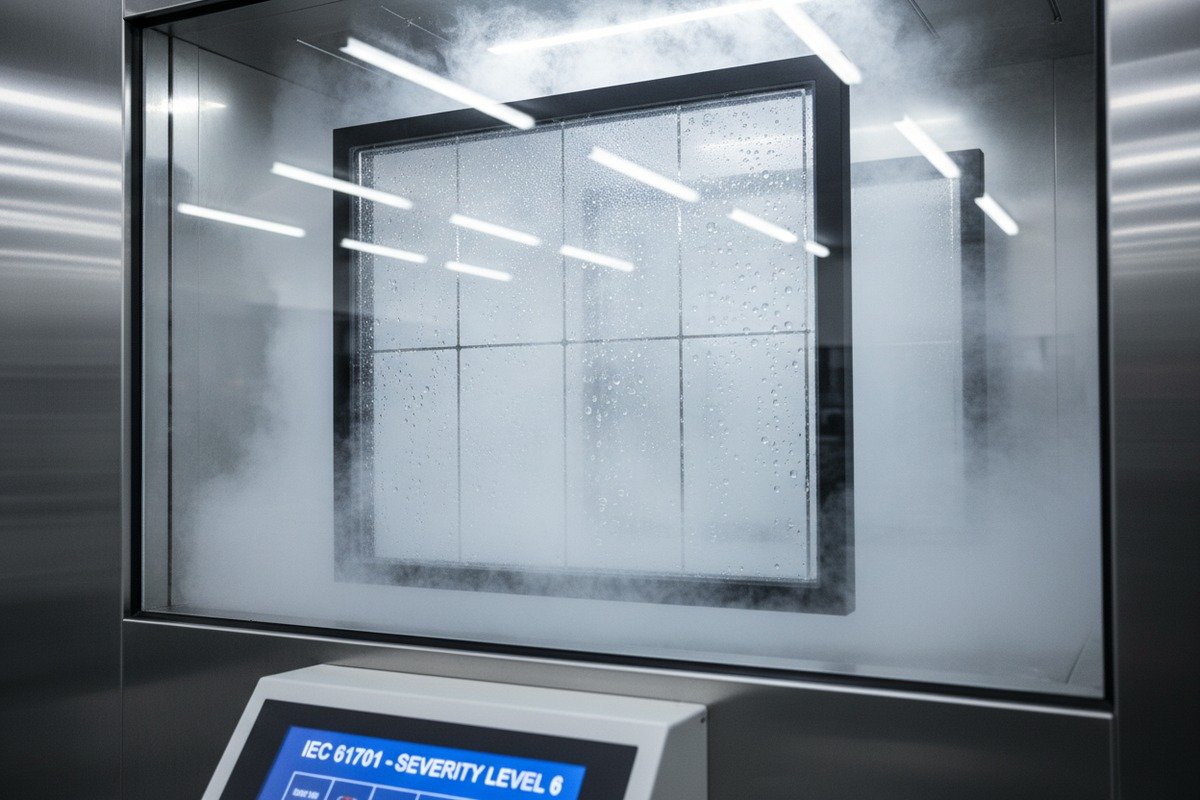
IEC 61701 is the single most important certification for any solar product destined for a coastal environment. This standard requires the module to endure exposure to a 5% salt spray solution. The test chamber holds the product at a 15–30° inclination and maintains an air temperature of 35°C. The minimum exposure is 96 hours. After the test, inspectors check for corrosion on screw holes, mounting fasteners, electrical connections, and frame surfaces.
However, 96 hours is a minimum threshold. In our production facility, we routinely test beyond 1,000 hours because real-world coastal exposure lasts decades, not days. Products rated at higher severity levels — such as Level 6 — offer significantly better protection. Always ask your supplier for the actual test duration and severity level, not just a pass/fail statement.
IEC 61215 and IEC 60068-2-30: The Supporting Standards
IEC 61215 2 covers damp heat testing. It simulates prolonged exposure to high humidity at elevated temperatures. This is critical because humidity alone can cause delamination and cell degradation even without salt. IEC 60068-2-30 3 adds humidity freeze cycles. These cycles test whether moisture that penetrates during warm periods expands and cracks materials when temperatures drop.
For integrated solar roof shingles, you also need to consider building material standards. European buyers should check CPR (Construction Products Regulation) compliance 4. Solar shingles must pass both electrical and structural tests — fire rating, wind load, snow load, and water penetration.
Quick Reference: Key Standards for Coastal Solar Roof Shingles
| Standard | What It Tests | Minimum Requirement | Recommended for Coastal |
|---|---|---|---|
| IEC 61701 | Salt mist corrosion | 96 hours, 5% NaCl solution | 1,000+ hours, Severity Level 6 |
| IEC 61215 | Damp heat durability | 1,000 hours at 85°C / 85% RH | Extended protocols preferred |
| IEC 60068-2-30 | Humidity freeze cycles | Multiple cycles per protocol | Full cycle completion required |
| CPR (EU) | Building material compliance | Fire, wind, snow, water tests | Mandatory for EU roofing products |
What Documents Should You Request?
Ask your manufacturer for full test reports — not just certificates. A certificate confirms a test was done. A report shows you the actual results: how many hours, what severity level, which components were inspected, and what condition they were in after testing. Our engineering team always provides full third-party test documentation upon request because we believe transparency builds trust.
Also check whether the test was performed by an accredited lab. Look for TUV, SGS, or equivalent ILAC-accredited laboratories 5. In-house tests alone are not sufficient for verification.
How can I tell if the interlocking drainage design will prevent moisture buildup and corrosion in humid climates?
During our R&D phase for each new shingle profile, our engineers run thousands of liters of simulated rainwater mixed with salt solution across the interlocking joints — because a single trapped puddle can start corrosion within weeks.
An effective interlocking drainage design features overlapping channels that direct water downward without pooling, sealed electrical pass-throughs that prevent moisture wicking into wiring cavities, and a minimum roof pitch requirement that ensures gravity-assisted drainage. Buyers should request cross-section drawings and water ingress test data before ordering.
Why Drainage Design Matters More Than You Think
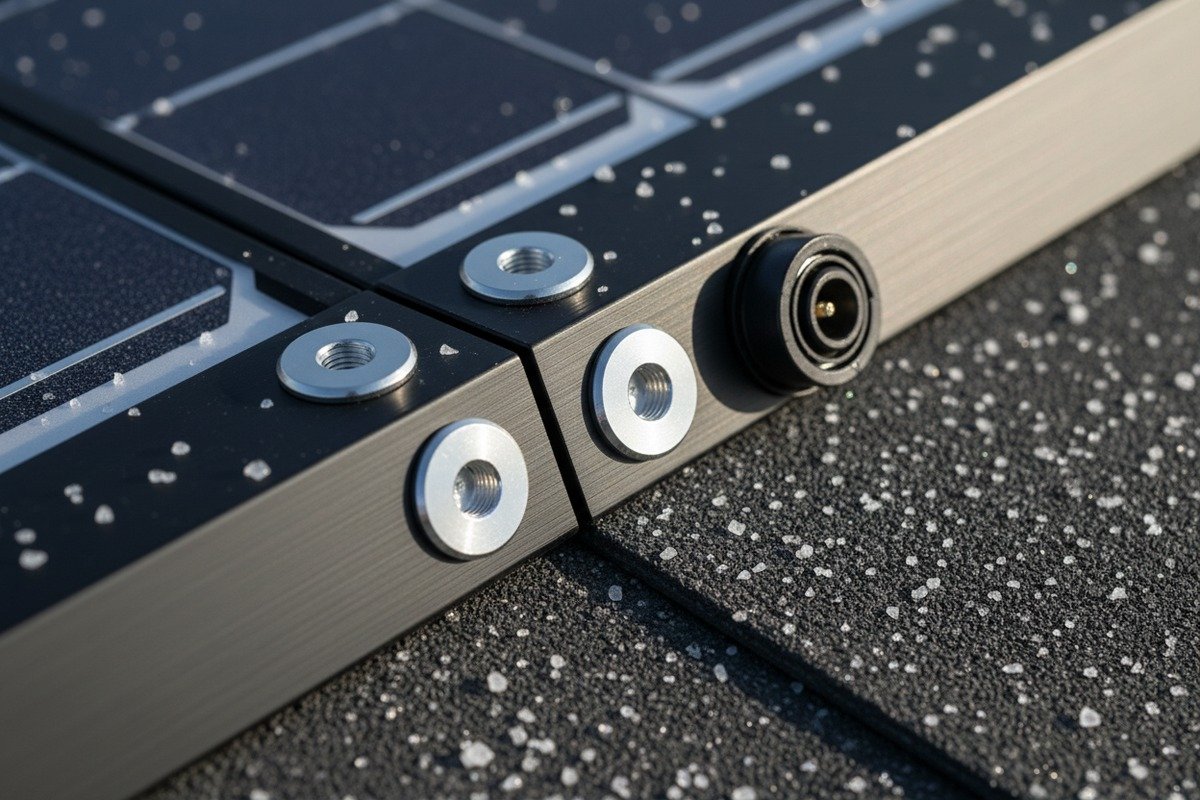
Traditional solar panels sit on racks above the roof surface. Water flows freely underneath. Solar roof shingles replace the roof itself. This means every drop of rain, every salt particle carried by wind, and every condensation event interacts directly with the shingle surface and its joints. If moisture gets trapped at an interlocking seam, it creates a micro-environment where chloride ions concentrate. This accelerates electrochemical corrosion on any exposed metal — frames, clips, connectors, and wiring.
In high-humidity climates, condensation forms overnight even without rain. Salt deposits from earlier wind exposure dissolve in this condensation and create a thin, highly corrosive film. A well-designed drainage system prevents this film from pooling.
Key Design Features to Inspect
Look for these specific features in the cross-section drawings:
Overlapping channels. Each shingle should overlap its neighbor with a stepped channel that directs water downward. The overlap should be deep enough that wind-driven rain cannot reverse-flow upward into the joint.
Weep holes or drain slots. At the lowest point of each interlock, small openings should allow trapped water to escape. These should be sized to prevent clogging by debris but small enough to block insects.
Sealed electrical pass-throughs. The wiring from each shingle must pass through the waterproof layer without creating a leak path. Look for silicone gaskets, compression seals, or potted connections rated to IP65 or higher.
Minimum pitch requirements. Every interlocking system has a minimum roof angle at which it functions correctly. Below that angle, water may not drain fast enough. Our shingles, for example, are tested and rated for specific pitch ranges. Installing below the minimum pitch voids the waterproofing performance.
Drainage Design Evaluation Checklist
| Feature | What to Check | Red Flag |
|---|---|---|
| Overlap depth | Cross-section drawing shows ≥15mm overlap | Shallow overlap with no step channel |
| Weep drainage | Visible drain slots at interlock base | Fully sealed joints with no escape path |
| Electrical sealing | IP65+ rated pass-throughs with gaskets | Exposed wire entry points without sealing |
| Pitch rating | Manufacturer specifies minimum pitch angle | No pitch guidance or "universal" claims |
| Condensation management | Ventilated underlayment recommended | Direct mounting on solid deck with no airflow |
Ask for Water Ingress Test Data
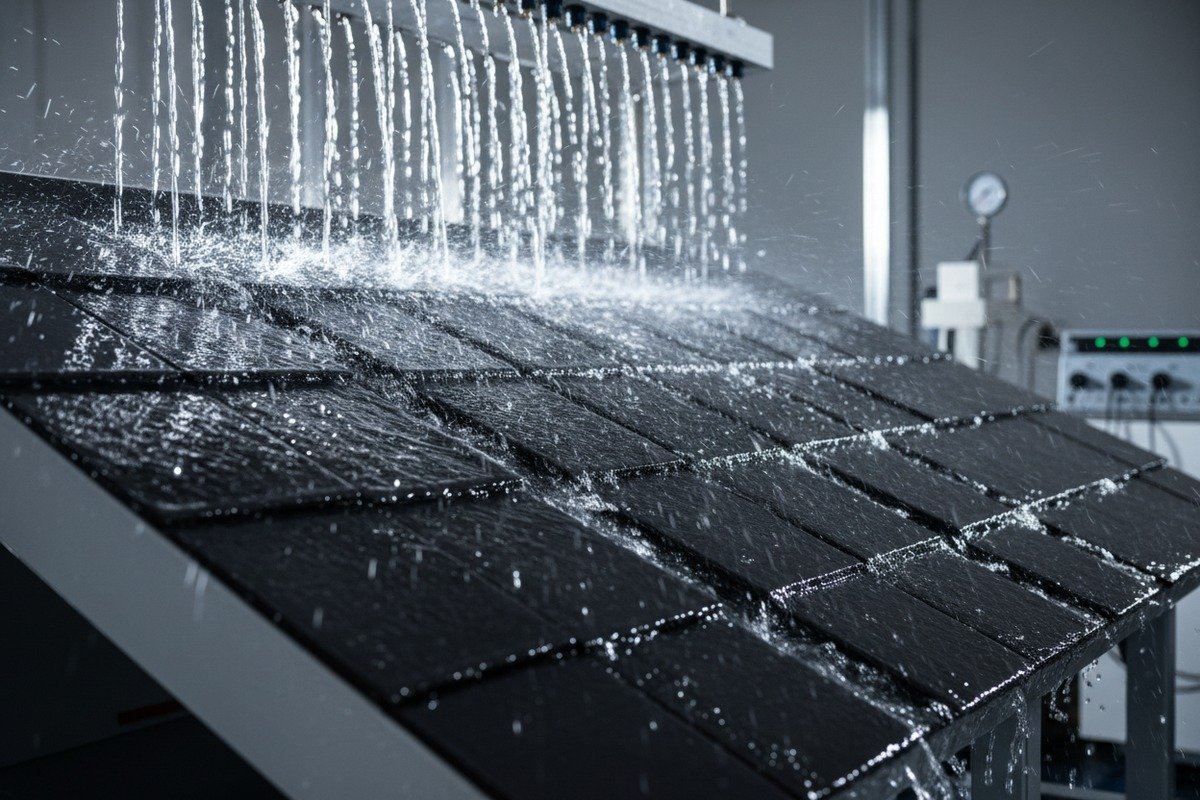
Do not rely on drawings alone. Request the actual water ingress test results. These tests simulate heavy rain at various angles and wind speeds. The results show whether water penetrated any joint under those conditions. Some manufacturers also conduct wind-driven rain tests, which are more demanding than static water tests.
In our experience exporting to coastal regions in Europe, we have found that buyers who review drainage test data upfront avoid the most common installation failures. A leak in a solar tile does not just damage the panel — it damages the building interior. In European markets, interior water damage from a faulty solar roof can trigger massive compensation claims. The drainage design is your first line of defense.
What specific performance guarantees should I demand from my manufacturer for high-salinity environments?
Our sales team in Hainan — an island surrounded by salt air — has learned firsthand that vague warranty language costs buyers money when problems appear five or ten years into a project.
For high-salinity environments, buyers should demand a written 25-year performance warranty that explicitly covers salt spray degradation, a 10-year structural warranty including frame and mounting hardware corrosion, documented anti-PID test results, and a clear replacement or compensation clause for premature corrosion-related failures. Generic warranties without coastal-specific terms are insufficient.
Why Generic Warranties Fall Short
Most solar product warranties cover power output degradation and manufacturing defects. They rarely mention corrosion, salt exposure, or coastal climate conditions. Some manufacturers even include exclusion clauses that void the warranty if the product is installed within a certain distance from the coastline. This is a critical gap. If you are buying for a coastal project, a generic warranty is essentially worthless for corrosion-related failures.
The Five Guarantees You Need in Writing
1. Salt spray corrosion coverage. The warranty must explicitly state that corrosion caused by salt spray exposure is covered. It should reference the IEC 61701 test level the product was certified to and confirm coverage for installations in environments matching that severity.
2. Frame and hardware structural warranty. Frames, mounting clips, and fasteners should be covered for at least 10 years against corrosion-related structural failure. The warranty should specify the frame material — ideally 5052-H32 aluminum 7 or marine-grade equivalent — and confirm it was tested under salt spray conditions.
3. Anti-PID guarantee. Potential Induced Degradation 8 is accelerated by salt deposits that create conductive paths on glass surfaces. The manufacturer should provide anti-PID test results showing the product was tested at higher temperatures, higher humidity, and longer durations than standard protocols. Double-glass module designs 9 are preferred because they offer superior anti-PID performance.
4. Electrical component sealing guarantee. Junction boxes, connectors, and wiring should be guaranteed against moisture ingress for the full warranty period. The IP rating should be stated, and the warranty should cover failures caused by seal degradation.
5. Replacement and response terms. The warranty should specify what happens when a claim is filed. Will the manufacturer ship replacement shingles? Who covers installation labor? What is the response timeline? For cross-border purchases, this is especially important. Our policy, for example, includes 24/7 after-sales support and clear DDP logistics for warranty replacements.
Warranty Comparison: Standard vs. Coastal-Specific
| Warranty Element | Standard Warranty | Coastal-Specific Warranty |
|---|---|---|
| Power output guarantee | 25 years, 80% output | 25 years, 80% output with salt spray clause |
| Structural/frame warranty | 10 years, manufacturing defects only | 10 years, including corrosion from salt exposure |
| Anti-PID coverage | Not typically included | Included with test documentation |
| Electrical sealing | Basic IP rating stated | IP65+ with seal degradation coverage |
| Coastal exclusion clause | Often present | Explicitly removed or inapplicable |
| Replacement logistics | FOB shipping only | DDP delivery with labor cost support |
How to Verify the Warranty Is Real
A warranty document is only as good as the company behind it. Check the manufacturer's track record. How long have they been in business? Do they have installations in comparable coastal climates with verifiable performance data? At Lonsontech, we have 20 years of production and R&D experience, and we back every product with CE and TUV certification. We encourage buyers to request reference projects and contact previous customers.
Also verify that the warranty is insured or backed by a third-party guarantee. Some manufacturers offer warranty insurance through independent providers. This protects you even if the manufacturer faces financial difficulties years down the line.
Finally, keep detailed installation records. Most warranty claims require proof of correct installation — including roof pitch, fastener torque, and electrical connection documentation. Incomplete records are the most common reason legitimate claims get denied.
How do I ensure the anti-glare coating on my solar tiles won't degrade or peel due to salt air exposure?
When we developed our anti-glare coating formula, one of the toughest challenges was making sure it could survive not just UV and rain, but the relentless chemical attack of chloride ions carried in coastal winds.
To ensure anti-glare coatings resist salt air degradation, buyers should verify the coating passed IEC 61701 salt spray testing as part of the complete module, request adhesion test results after salt exposure, confirm the coating uses inorganic materials rather than organic films prone to peeling, and check that the manufacturer guarantees coating integrity for the full warranty period.

How Salt Air Attacks Coatings
Anti-glare coatings on solar tiles serve two purposes: they reduce light reflection for better aesthetics (important for residential acceptance and planning approvals), and they increase light absorption for higher energy output. These coatings are typically thin — measured in nanometers or micrometers. Salt air attacks them through a simple but destructive process.
Chloride ions from salt spray land on the coating surface. In humid conditions, they absorb moisture and form a thin saline film. This film chemically reacts with the coating material. Organic coatings — those based on polymer films — are especially vulnerable. The chloride ions break chemical bonds in the polymer chain, causing the coating to cloud, crack, bubble, and eventually peel. Once the coating fails, the exposed glass surface becomes a site for further salt accumulation, which then attacks the solar cells underneath.
Inorganic coatings — such as those based on silicon dioxide or titanium dioxide 10 — are far more resistant. They bond chemically to the glass surface rather than sitting on top of it. This makes them harder to separate and more resistant to chemical attack.
What to Ask Your Supplier
Request the following specific information:
Coating material type. Is it organic (polymer-based) or inorganic (mineral-based)? Inorganic coatings are strongly preferred for coastal environments.
Adhesion test results after salt exposure. The coating should be tested for adhesion strength after completing the full IEC 61701 salt spray cycle. A coating that passes adhesion tests before salt exposure but fails after is useless for your project.
Coating thickness and uniformity. Thicker is not always better — uniformity matters more. Uneven coatings create weak spots where salt attack begins. Ask for quality control data showing coating thickness consistency across production batches.
Self-cleaning or hydrophobic properties. Some advanced coatings incorporate lotus-effect or hydrophobic surfaces that cause water to bead and roll off, carrying salt particles with it. This reduces salt residence time and slows corrosion. Self-healing coatings, which can repair minor scratches automatically, are an emerging technology worth considering for high-value coastal projects.
Coating Durability Indicators
| Coating Property | Standard Grade | Coastal Grade |
|---|---|---|
| Material base | Organic polymer | Inorganic (SiO₂, TiO₂) |
| Adhesion after salt spray | Not typically tested | Tested and documented post-IEC 61701 |
| Hydrophobic properties | Basic water resistance | Lotus-effect or active water repellency |
| Self-healing capability | Not available | Available on premium products |
| Warranty coverage | General coating defects | Explicit salt air degradation coverage |
| Batch consistency | Visual inspection only | Measured thickness with QC data |
The Aesthetic Factor
For European markets especially, appearance matters as much as performance. Our buyers — architects, developers, roofing companies — choose solar roof shingles specifically because they look like premium slate or traditional shingles. A coating that degrades turns a sleek charcoal-black surface into a cloudy, patchy eyesore. This is not just a performance issue; it is a sales issue. End customers reject roofs that look damaged, even if they still produce electricity.
That is why we test our anti-glare coatings for both functional performance and visual consistency after salt exposure. The coating must maintain its deep, uniform appearance with the same semi-reflective finish it had on day one. If your manufacturer cannot show you photos or samples of their product after extended salt spray testing, that is a significant red flag.
Monitoring and Maintenance
Even the best coatings benefit from regular maintenance. For coastal installations, we recommend cleaning with warm fresh water at least twice per year to remove salt deposits before they concentrate. Avoid salt-based de-icing products entirely. If your manufacturer offers shingles with integrated sensor technology that monitors surface conditions and provides maintenance alerts, this can be a valuable addition for large projects where manual inspection is impractical.
Conclusion
Evaluating solar roof shingle corrosion resistance requires checking certifications, drainage design, warranty specifics, and coating durability — every detail matters for long-term coastal performance.
Footnotes
1. Official standard for salt mist corrosion testing of photovoltaic modules. ↩︎
2. Replaced with the official IEC page for the IEC 61215 standard, providing authoritative information. ↩︎
3. Details the international standard for damp heat, cyclic testing, simulating humidity freeze. ↩︎
4. Explains the European Union regulation for construction products and their marketing. ↩︎
5. Provides information on the International Laboratory Accreditation Cooperation and its role. ↩︎
6. Explains the IP65 rating for dust and water protection in electrical enclosures. ↩︎
7. Details properties and corrosion resistance of 5052-H32 aluminum alloy. ↩︎
8. Explains the phenomenon of Potential Induced Degradation (PID) in solar modules. ↩︎
9. Describes the benefits and construction of double-glass solar modules for durability. ↩︎
10. Explains the properties and use of silicon dioxide and titanium dioxide in coatings. ↩︎