
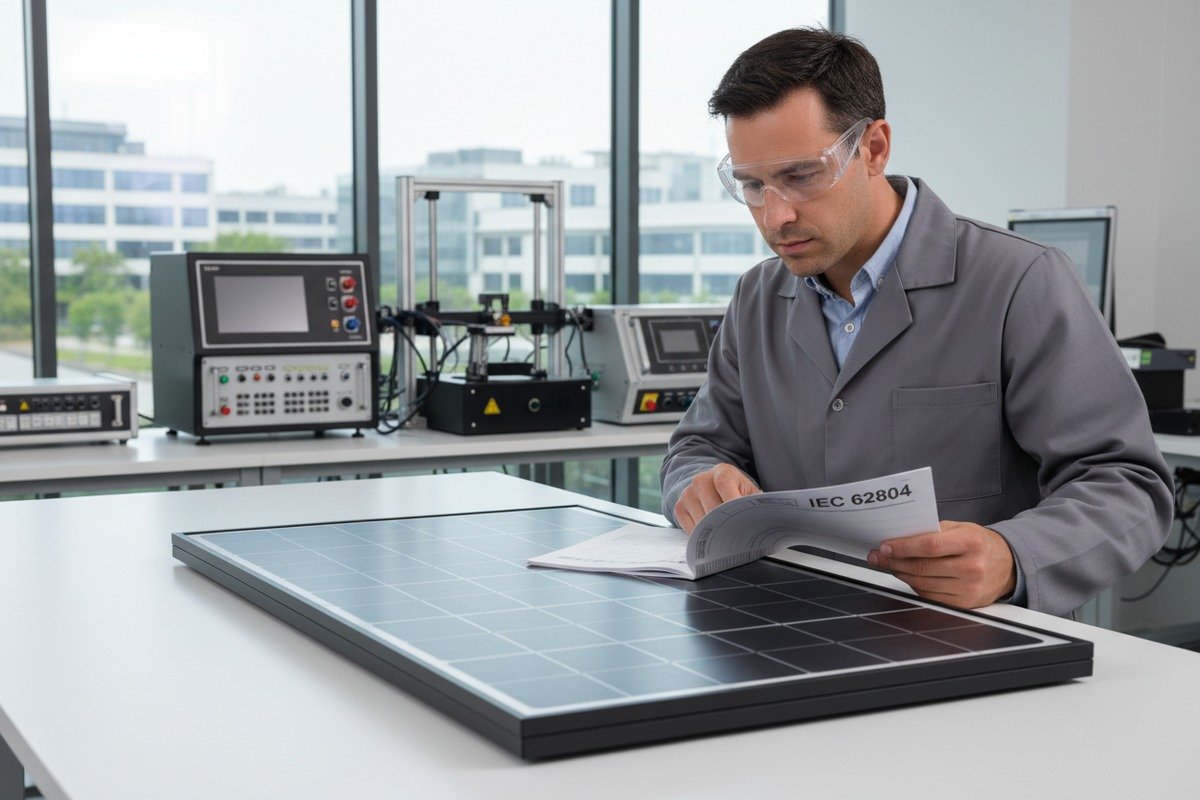
Every year, our customer service team fields calls from European distributors worried about unexplained power drops in rooftop solar installations — and more often than not, the culprit is Potential Induced Degradation 1.
To evaluate PID resistance when sourcing solar roof shingles for Europe, verify IEC 62804 test certification, demand third-party lab reports showing less than 5% power loss after 96 hours under “double 85” conditions (85°C, 85% RH), and confirm the manufacturer uses PID-resistant encapsulants like POE or EPE alongside high-resistivity cell coatings.
PID can silently destroy up to 30% of a solar shingle’s output over time IEC 62804 test certification 2. For European buyers facing mandatory rooftop solar deadlines under the EPBD, this is not just a technical issue — it is a business risk. Let’s break down exactly how to evaluate PID resistance step by step.
How can I verify if the TUV certification for my solar shingles specifically includes PID resistance testing?
When we first applied for TUV certification on our solar roof shingles, we quickly learned that not all TUV certificates are created equal — some cover basic safety, while others include the critical PID test scope.
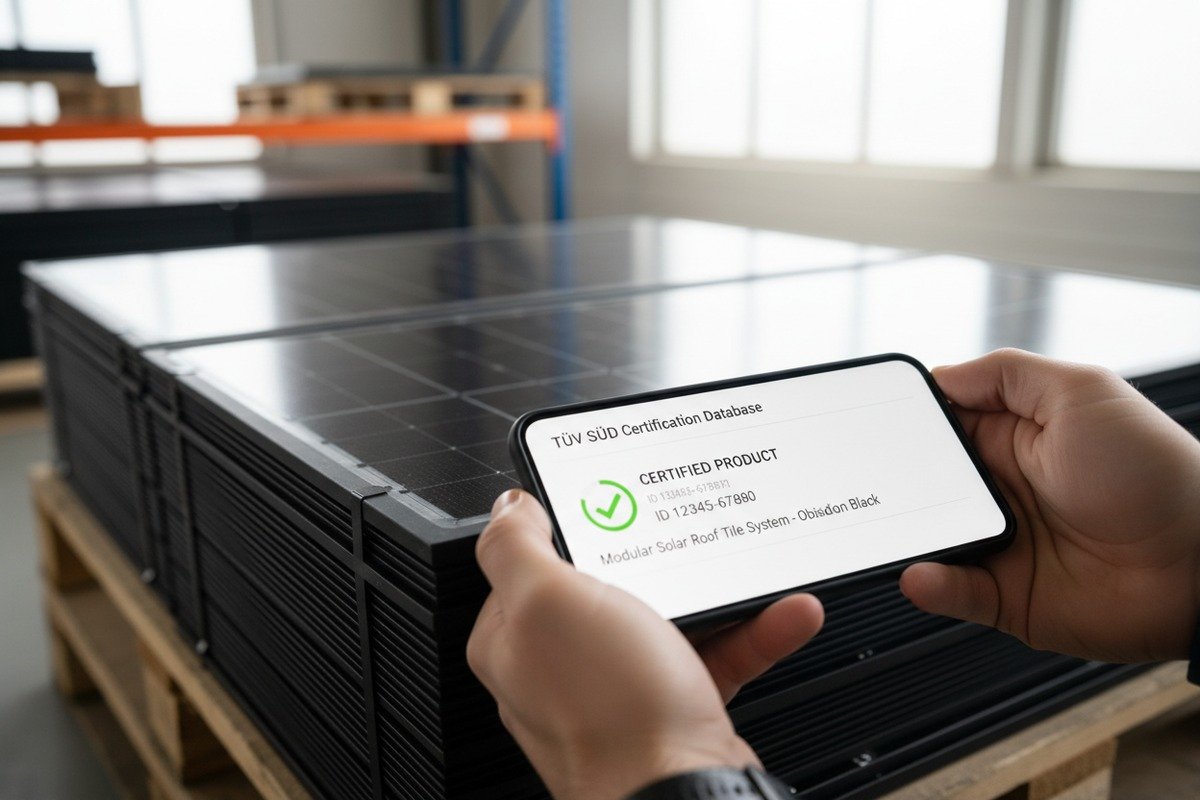
To verify TUV certification includes PID resistance, request the full test report and check if IEC 62804 is listed in the scope. Look for specific mention of "PID test" under the climate chamber protocols, and confirm the certificate number directly with the TUV database online.
Why a Generic TUV Certificate Is Not Enough
Many buyers assume that if a product carries a TUV mark, it has passed every relevant test. That is not true. TUV certifies modules under different IEC standards. A product might pass IEC 61215 3 (design qualification) and IEC 61730 (safety) without ever being tested for PID under IEC 62804. These are separate test scopes.
When our engineering team submits products for TUV testing, we specifically request IEC 62804 to be included. This adds time and cost to the certification process, but it gives our European partners the proof they need.
How to Read the TUV Certificate
Here is what to look for on the certificate itself:
| Item to Check | What It Should Say | Red Flag |
|---|---|---|
| Test Standard Listed | IEC 62804-1 (crystalline silicon) | Only IEC 61215 or IEC 61730 listed |
| Test Conditions | 85°C / 85% RH / ±1000V / 96 hours | No mention of voltage bias or climate chamber |
| Degradation Result | Power loss < 5% | No quantified result or "pass" without data |
| Certificate Scope | "PID Resistance" explicitly named | Vague language like "environmental durability" |
| Verification | Certificate number searchable on TUV online database | No traceable certificate number |
Cross-Check with the TUV Online Database
Every legitimate TUV certificate has a unique ID. Go to the TUV Rheinland 4 or TUV SÜD online portal and enter the certificate number. The database will show the exact standards covered. If IEC 62804 is missing, the product was not PID tested — regardless of what the supplier claims.
Ask for the Full Test Report, Not Just the Certificate
The certificate is a summary. The full test report contains the raw data: power output before and after the PID stress test, EL (electroluminescence) images showing cell degradation, and the exact conditions used. Our team always provides this report to distributors who ask. If a manufacturer hesitates to share it, that is a warning sign.
In our experience shipping to France, Germany, and the Netherlands, building inspectors and project engineers increasingly ask for this level of documentation. Having it ready speeds up project approvals.
What technical parameters should I check to ensure my solar roof tiles won't suffer from PID in damp European climates?
Our production team spent two years optimizing encapsulant materials and cell coatings specifically because European coastal and northern climates push solar shingles to their humidity limits — and PID thrives in those conditions.
Check five key parameters: encapsulant type (POE or EPE preferred over standard EVA), cell anti-reflection coating resistivity, system voltage rating (1000V or 1500V), glass surface resistivity, and the manufacturer's "double 85" test results showing less than 5% degradation after 96 hours.
The "Double 85" Condition Explained
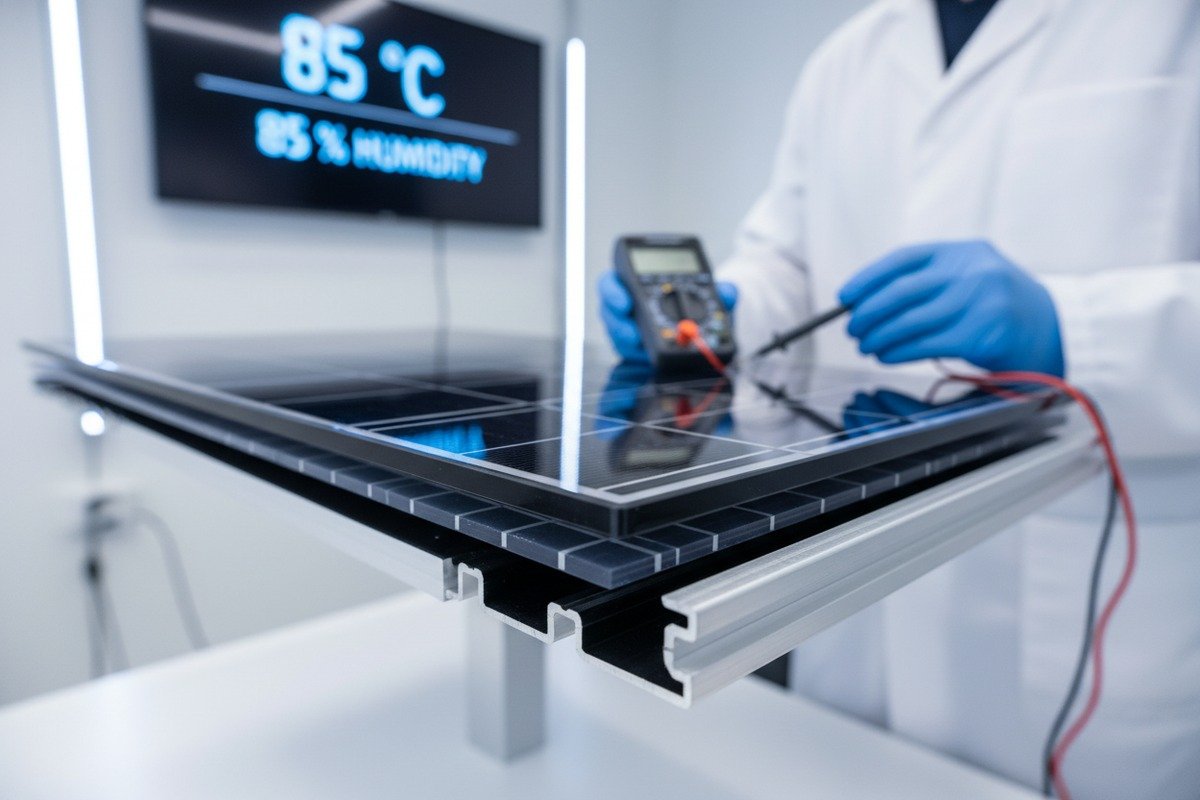
"Double 85" means 85°C temperature and 85% relative humidity. This simulates the worst-case scenario for moisture ingress into a solar module. Under IEC 62804, modules are exposed to these conditions while a high voltage bias (typically -1000V or -1500V) is applied between the cells and the frame for 96 hours. If power loss stays below 5%, the module passes.
In places like the Netherlands, Belgium, coastal France, and northern Germany, real-world humidity regularly exceeds 80%. Roof-integrated shingles face even higher localized temperatures because they lack the ventilation gap that rack-mounted panels enjoy. This makes PID resistance even more critical for BIPV products.
Key Material Choices That Determine PID Resistance
| Parameter | PID-Resistant Choice | PID-Vulnerable Choice | Why It Matters |
|---|---|---|---|
| Encapsulant Material | POE (Polyolefin Elastomer) 5 or EPE | Standard EVA | POE has 10x higher volume resistivity, blocking leakage currents |
| Cell ARC (Anti-Reflection Coating) | SiNx with optimized refractive index | Low-quality SiNx or uncoated | High-resistivity ARC prevents ion migration at the cell surface |
| Backsheet / Back Glass | Glass-glass or fluoropolymer backsheet | Standard PET backsheet | Better moisture barrier reduces humidity-driven PID |
| Frame Grounding | Proper grounding design | Floating or poorly grounded | Correct grounding minimizes voltage potential between cells and frame |
| System Voltage | Tested at 1500V for future-proofing | Only tested at 600V | Higher voltage systems amplify PID risk; testing at 1500V proves robustness |
Why Encapsulant Selection Is the Single Biggest Factor
When we switched part of our production line from standard EVA to POE encapsulant, the PID test results improved dramatically. Standard EVA has a volume resistivity around 10^12 to 10^13 Ω·cm. POE achieves 10^14 to 10^15 Ω·cm. That difference of one to two orders of magnitude means far less leakage current can flow through the encapsulant under high voltage and humidity.
For European buyers, always ask the supplier what encapsulant they use. If the answer is "EVA," ask whether it is a high-volume-resistivity formulation specifically designed for PID resistance. Generic EVA is a cost-saving measure that can lead to field failures within 5–10 years in damp climates.
Shingled Cell Architecture Offers Built-In Advantages
Solar roof shingles often use shingled cell technology 6, where cells overlap like roof tiles. This design eliminates busbars and ribbon interconnections, which reduces the pathways for leakage current. Our R&D team has observed that shingled modules consistently show lower PID susceptibility compared to traditional half-cut or full-cell designs under identical test conditions.
However, shingled cell design alone is not a guarantee. The encapsulant, glass, and manufacturing quality must all align. Think of PID resistance as a system-level property, not a single-component fix.
How will PID resistance impact the 25-year power output warranty I offer to my local construction clients?
One of the toughest conversations we have with our European roofing company partners is about warranty liability — because when a solar roof shingle loses 20–30% of its power output in year 8, the warranty claim lands on the distributor's desk first.
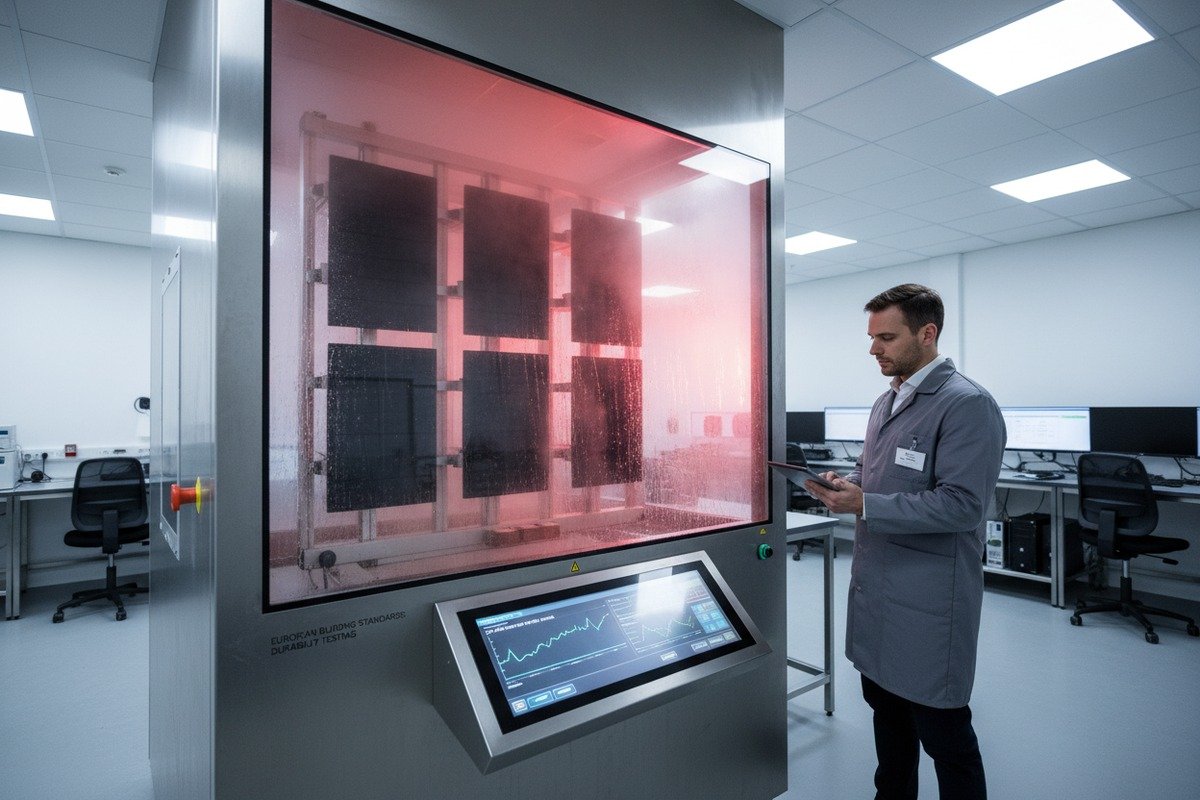
PID resistance directly determines whether your 25-year warranty holds or becomes a financial liability. Modules failing PID tests can lose 20–30% output within 5–10 years, triggering warranty claims. Products passing IEC 62804 with less than 5% degradation protect your margin and your reputation with construction clients.
The Real Cost of PID-Related Warranty Claims
European construction clients expect solar roof systems to deliver consistent power for 25 years. Most warranties promise no more than 2–3% degradation in year one and 0.5–0.7% per year after that. PID can blow through those numbers in just a few years.
Consider a typical scenario: a roofing company installs 500 homes with solar shingles. If even 10% of those installations suffer PID-related output drops, that is 50 warranty claims. Each claim involves site inspection, power measurement, potential module replacement, and labor — all at European rates.
Warranty Risk Breakdown by PID Performance Level
| PID Test Result | Likely Field Outcome (25 years) | Warranty Risk Level | Financial Impact per Installation |
|---|---|---|---|
| < 2% degradation (excellent) | Minimal PID-related loss; within warranty spec | Very Low | Near zero additional cost |
| 2–5% degradation (acceptable) | Minor PID contribution; manageable with monitoring | Low | €200–500 in monitoring/adjustment |
| 5–15% degradation (marginal) | Noticeable output drop by year 10–15 | Medium | €1,000–3,000 per claim (inspection + partial replacement) |
| > 15% degradation (fail) | Severe power loss by year 5–8 | Very High | €5,000–10,000+ per claim (full replacement + labor) |
How We Structure Our Warranty to Protect Partners
At our facility, every batch of solar roof shingles undergoes in-line PID screening before shipment. We provide batch-level test data alongside our 25-year power output warranty. This means our distributors can show their construction clients not just a warranty document, but actual test evidence.
We also maintain a dedicated after-sales team available 24/7. If a PID issue is suspected in the field, we can analyze performance data remotely and ship replacement shingles via our DDP logistics service. This approach has helped our partners in France and Germany maintain strong relationships with builders and developers.
The EPBD Factor: Why PID Matters More Now
Under the EU's Energy Performance of Buildings Directive 7, new commercial and public buildings must integrate solar from 2026, and residential buildings from 2029. This means millions of new rooftops will need solar shingles. If those shingles suffer PID, the scale of warranty exposure is enormous.
For a distributor offering 25-year warranties, choosing PID-resistant shingles is not optional — it is the foundation of your business model. A single batch of PID-vulnerable products can damage your brand for a decade.
How do I evaluate a manufacturer's PID test results to ensure they meet European long-term reliability standards?
When we share PID test reports with prospective European partners, many tell us they are not sure what numbers to focus on — and that confusion is exactly what less transparent suppliers rely on.
Evaluate PID test results by confirming the test follows IEC 62804 protocols (96 hours, 85°C, 85% RH, ≥1000V bias), checking that power degradation is below 5%, reviewing electroluminescence images for cell-level damage, and verifying results come from an accredited third-party lab like TUV, SGS, or Bureau Veritas.
Step 1: Confirm the Test Protocol Matches IEC 62804
The first thing to check is whether the test was actually conducted according to IEC 62804. Some manufacturers run shorter tests (48 hours instead of 96) or use lower voltage (600V instead of 1000V). These shortened protocols do not represent real European field conditions.
Ask for the full test report. It should clearly state:
- Test duration: 96 hours minimum
- Temperature: 85°C
- Relative humidity: 85%
- Voltage bias: -1000V or -1500V (negative polarity is more stressful)
- Number of samples tested (minimum 2 modules per IEC standard)
Step 2: Read the Power Degradation Numbers
The headline number is power loss as a percentage of initial rated power. IEC 62804 requires less than 5% degradation for a pass. But a "pass" at 4.8% is very different from a pass at 1.2%.
Our modules typically show less than 2% degradation. This extra margin matters because lab conditions, while severe, do not perfectly replicate 25 years of European weather. A tighter result gives you more confidence.
Step 3: Review Electroluminescence (EL) Images
EL imaging uses infrared photography to reveal inactive cell areas. A PID-affected module will show dark spots or fully dark cells in EL images taken after the stress test. Even if the power number looks acceptable, EL images can reveal localized damage that may worsen over time.
Request both pre-test and post-test EL images. Compare them side by side. Uniform brightness across all cells after the test is the ideal outcome.
Step 4: Verify the Lab Is Accredited and Independent
In-house test results carry limited credibility. Always insist on third-party lab reports 8 from accredited institutions. Here are the most recognized labs for European market access:
| Lab / Institution | Accreditation | Credibility Level | Common in EU Market |
|---|---|---|---|
| TUV Rheinland | ISO 17025 9, IEC 62804 | Very High | Yes — industry standard |
| TUV SÜD | ISO 17025, IEC 62804 | Very High | Yes — widely recognized |
| SGS | ISO 17025 | High | Yes — accepted across EU |
| Bureau Veritas | ISO 17025 | High | Yes — growing in solar |
| Manufacturer In-House Lab | Varies; often not accredited | Low to Medium | Not sufficient alone |
Step 5: Ask About Recovery Testing
IEC 62804 also includes an optional recovery phase. After the 96-hour stress test, some modules can partially recover their power output when the voltage bias is removed and they are exposed to light. While recovery sounds positive, it can mask underlying damage.
Ask the manufacturer whether their reported degradation number is pre-recovery or post-recovery. The more conservative (and honest) approach is to report pre-recovery numbers. Our team reports both figures for full transparency.
Step 6: Cross-Reference with Field Performance Data
Lab tests are essential, but field data adds another layer of confidence. Ask the manufacturer for monitoring data from existing European installations. How do their shingles perform after 3, 5, or 10 years in real conditions? We have installations across multiple European countries that we monitor continuously, and we share anonymized performance summaries with serious buyers.
If a manufacturer has no field data from European climates, proceed with caution. Lab results alone, while necessary, are not sufficient to guarantee 25-year reliability under the variable conditions of a real European roof.
Conclusion
PID resistance is not a checkbox — it is the backbone of reliable solar roof shingles in European climates. Verify IEC 62804 certification, demand third-party test data, and choose materials proven under double 85 conditions.
Footnotes
1. Explains the phenomenon of PID in crystalline photovoltaic modules and its causes. ↩︎
2. Defines procedures to evaluate durability of PV modules to potential-induced degradation. ↩︎
3. Lays down requirements for design qualification and type approval of terrestrial photovoltaic modules. ↩︎
4. Official website of TÜV Rheinland, a leading provider of technical services and certifications. ↩︎
5. Describes POE encapsulant as a specialized material for PV solar panels, offering enhanced durability. ↩︎
6. Explains the technique of overlapping solar cells to maximize photoactive area and minimize power loss. ↩︎
7. Official directive promoting the improvement of energy performance in buildings within the European Union. ↩︎
8. Replaced with a link to UL Solutions, a globally recognized third-party certification provider for solar energy products. ↩︎
9. International standard specifying general requirements for the competence of testing and calibration laboratories. ↩︎
10. Details the 85°C temperature and 85% relative humidity test for product reliability. ↩︎