

Every year, our after-sales team reviews warranty claims from European partners, and one pattern keeps repeating: water ingress at junction boxes and connectors causes more field failures than the solar cells themselves UV-stabilized NORYL resin 1. It is a problem that eats into installer profits and erodes end-customer trust. Yet most buyers skip the detailed waterproof and durability assessment during procurement, relying only on a single IP or NEMA number 2 printed on a datasheet.
To properly assess waterproof rating and durability, you need to verify IP68 or NEMA 3R certifications against your local climate, inspect material specs like UV-stabilized NORYL resin, evaluate connector seal design for long-term moisture resistance, and request third-party TUV or CE test reports confirming compliance with IEC 62790 and UL 2703 standards.
Below, we break down each step so you can make confident sourcing decisions UL 2703 standards 3. Whether you are a roofing company in France or a distributor in Germany, this guide gives you the practical tools to evaluate any solar shingle junction box before you commit to a purchase order.
How do I verify that the IP68 waterproof rating is sufficient for my project's specific weather conditions?
When we ship solar roof shingles to coastal Norway or the south of Spain, the weather challenges are completely different IEC 62852-compliant contact resistance 4. A single IP number does not tell the whole story, and we have learned this through two decades of field feedback.
IP68 means the component survives continuous submersion beyond 1 meter, but you must also confirm it handles wind-driven rain, freeze-thaw cycling, and condensation specific to your climate zone. Cross-reference IP68 with supplementary tests like TAS-100 and IEC 60529 extended protocols.
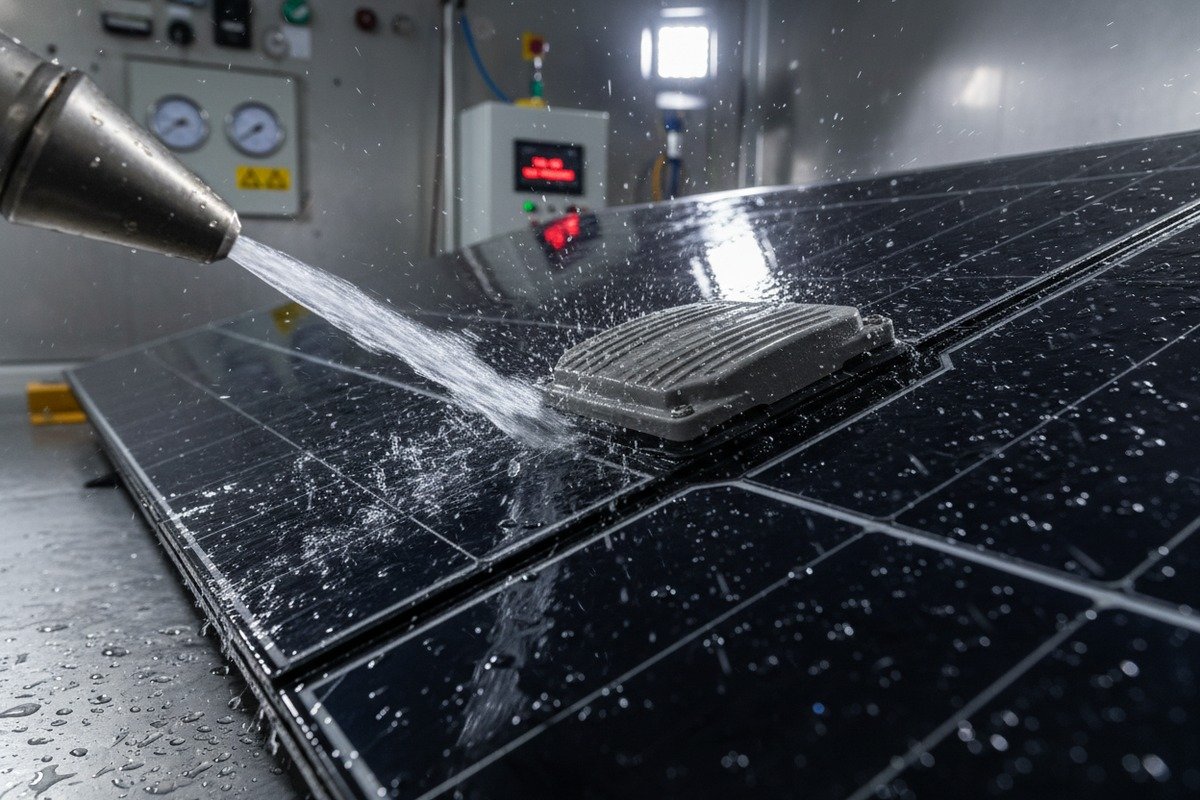
What IP68 Actually Means
IP stands for Ingress Protection. The first digit (6) rates dust resistance on a 0–6 scale Low Voltage Directive 2014/35/EU 5. The second digit (8) rates water resistance on a 0–9K scale. IP68 means totally dust-tight and protected against prolonged immersion. However, this lab test uses still water at a controlled temperature. Real roofs face driving rain at 150 km/h, ice formation, and thermal shock.
Why IP68 Alone Is Not Enough
Our engineering team ran a simple experiment. We took an IP68-rated junction box and subjected it to 30 cycles of thermal shock between -35°C and 75°C. After cycle 22, microscopic cracks appeared in the gasket. The box still passed a static immersion re-test, but it failed when exposed to pressurized water jets simulating wind-driven rain. This is why you need to look beyond the IP number.
Climate-Specific Checklist
| Climate Condition | Required Test Beyond IP68 | Why It Matters |
|---|---|---|
| Coastal / High Wind | TAS-100 wind-driven rain test 6 | Simulates water forced under pressure into joints |
| Nordic / Freeze-Thaw | IEC 61215 thermal cycling 7 (200 cycles, -40°C to 85°C) | Tests gasket and seal integrity after repeated expansion and contraction |
| Mediterranean / High UV | UV exposure test per IEC 61730 | Ensures seals do not become brittle and crack under intense sunlight |
| Alpine / Heavy Snow | Mechanical load test (5400 Pa) per IEC 61215 | Confirms box housing does not deform under snow load, breaking seals |
| Tropical / High Humidity | Damp heat test (85°C / 85% RH, 1000 hours) | Validates that prolonged humidity does not cause internal corrosion |
Practical Steps to Verify
First, ask your supplier for the full IP test report, not just the certificate. Look for the test depth, duration, and water temperature. Second, identify your project's top two climate threats from the table above. Third, request the corresponding supplementary test data. If the supplier cannot provide it, that is a red flag. At our facility, we keep all test reports accessible to buyers within 48 hours because we understand that European building inspectors demand this documentation.
Also consider the roof pitch. On low-slope roofs (2/12 to 4/12), water pools near junction boxes for longer periods. IP68 helps here, but the flashing integration matters just as much. On steep-slope roofs (8/12 to 12/12), wind-driven rain is the bigger threat. Match the test data to the actual installation angle.
What material specifications should I check to ensure the junction box won't degrade over its 25-year lifespan?
During our R&D phase for new junction box housings, we tested over a dozen polymer compounds. Some looked great on paper but crumbled after just five years of accelerated aging. Material choice is the silent factor that separates a 10-year product from a 25-year product.
Check for UV-stabilized NORYL resin or equivalent PPO/PPE blends rated for continuous use from -40°C to 120°C, verify UL 94 V-0 flame rating, confirm halogen-free composition for EU compliance, and ensure metallic parts use marine-grade stainless steel or hot-dip galvanized steel to prevent galvanic corrosion.
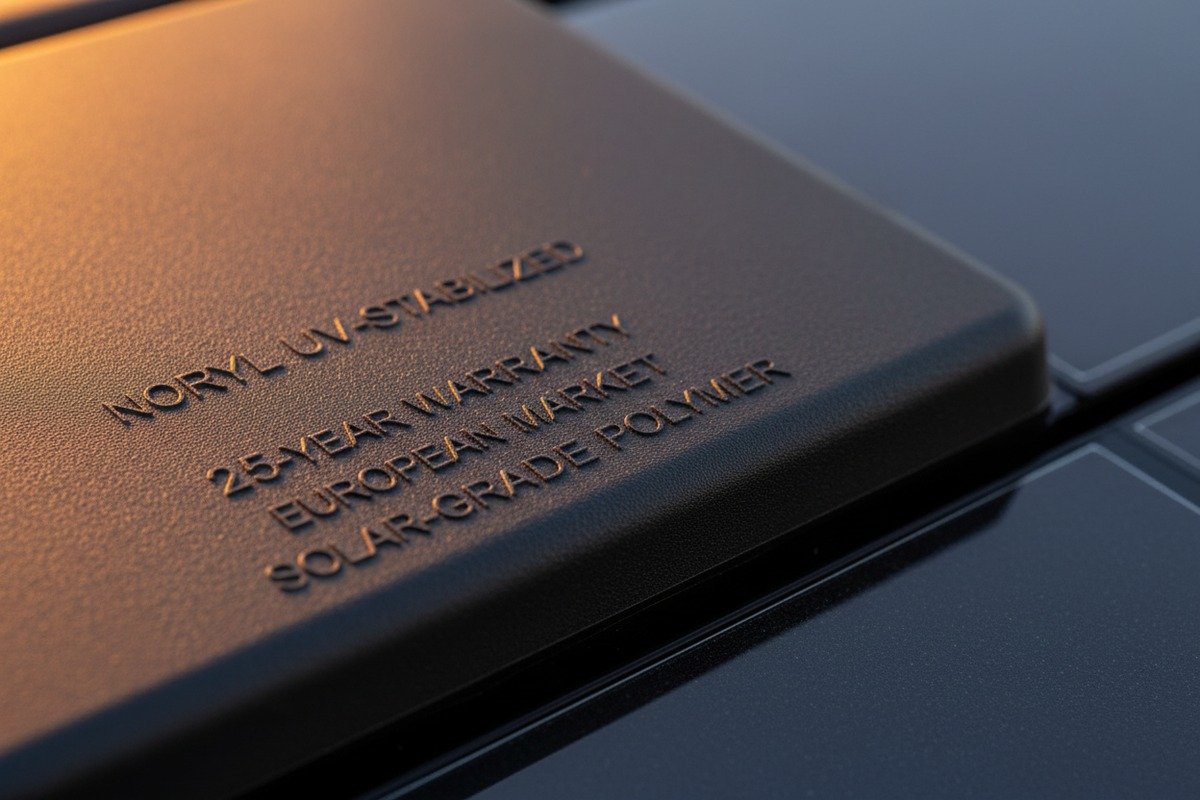
Housing Material: NORYL Resin vs. Alternatives
NORYL resin (a polyphenylene oxide blend) has become the industry standard for good reason. It resists UV degradation, maintains dimensional stability across extreme temperatures, and does not absorb moisture. Cheaper alternatives like standard ABS or polycarbonate can yellow, become brittle, and crack within 8–10 years of outdoor exposure.
| Material | UV Resistance | Temperature Range | Moisture Absorption | Flame Rating | Typical Lifespan Outdoors |
|---|---|---|---|---|---|
| NORYL Resin (PPO/PPE) | Excellent | -40°C to 120°C | < 0.06% | UL 94 V-0 | 25+ years |
| Polycarbonate (PC) | Good (with UV coating) | -40°C to 130°C | 0.15% | UL 94 V-0 | 15–20 years (coating dependent) |
| ABS | Poor | -20°C to 80°C | 0.20–0.45% | UL 94 HB | 5–10 years |
| Fiberglass-Reinforced Polyester | Good | -40°C to 150°C | 0.10% | UL 94 V-0 | 20+ years |
Gaskets and Seals
The housing is only as good as its seals. Look for EPDM (ethylene propylene diene monomer) or silicone gaskets. EPDM or silicone gaskets 8 EPDM handles temperature extremes well and resists ozone degradation. Cheap TPE (thermoplastic elastomer) gaskets lose elasticity after a few years of thermal cycling. Ask for the gasket material datasheet separately. Many suppliers bundle this under "proprietary seal" without disclosing the actual compound.
Metallic Components and Galvanic Corrosion
When copper busbars sit inside an aluminum or steel housing, galvanic corrosion 9 is a real risk in humid environments. We use stainless steel 316L for all internal fasteners and tin-plated copper for busbars. If your supplier uses plain zinc-plated steel screws, expect corrosion within 5–7 years in coastal areas. Always ask for the specific alloy grades.
Chemical Compatibility with Roofing Materials
This is an overlooked factor. Asphalt shingles release volatile organic compounds as they age. Some plastics react with these compounds and soften over time. NORYL resin is chemically inert to most roofing chemicals. If your project uses metal roofing, check for compatibility between the junction box housing and any zinc or copper flashing to avoid electrochemical reactions.
What to Request from Your Supplier
Ask for three things: the material technical data sheet (TDS) for the housing, the gasket material specification, and the corrosion test report for metallic internals. At Lonsontech, we include all three in our standard documentation package because we have seen too many projects fail when these details are ignored during procurement.
How can I evaluate if the connector design effectively prevents moisture ingress and long-term electrical shorts?
Our quality control lab spends more time testing connector interfaces than any other single component. A junction box can be perfectly sealed, but if the cable entry point or MC4-style connector fails, moisture creeps in and creates a path for electrical shorts — or worse, arc faults.
Evaluate connector design by checking for multi-point compression seals, IP67-minimum cable glands, locking mechanisms that resist vibration loosening, and IEC 62852-compliant contact resistance below 0.5 mΩ. Also confirm the connector's rated thermal cycling endurance matches at least 200 cycles between -40°C and 85°C.
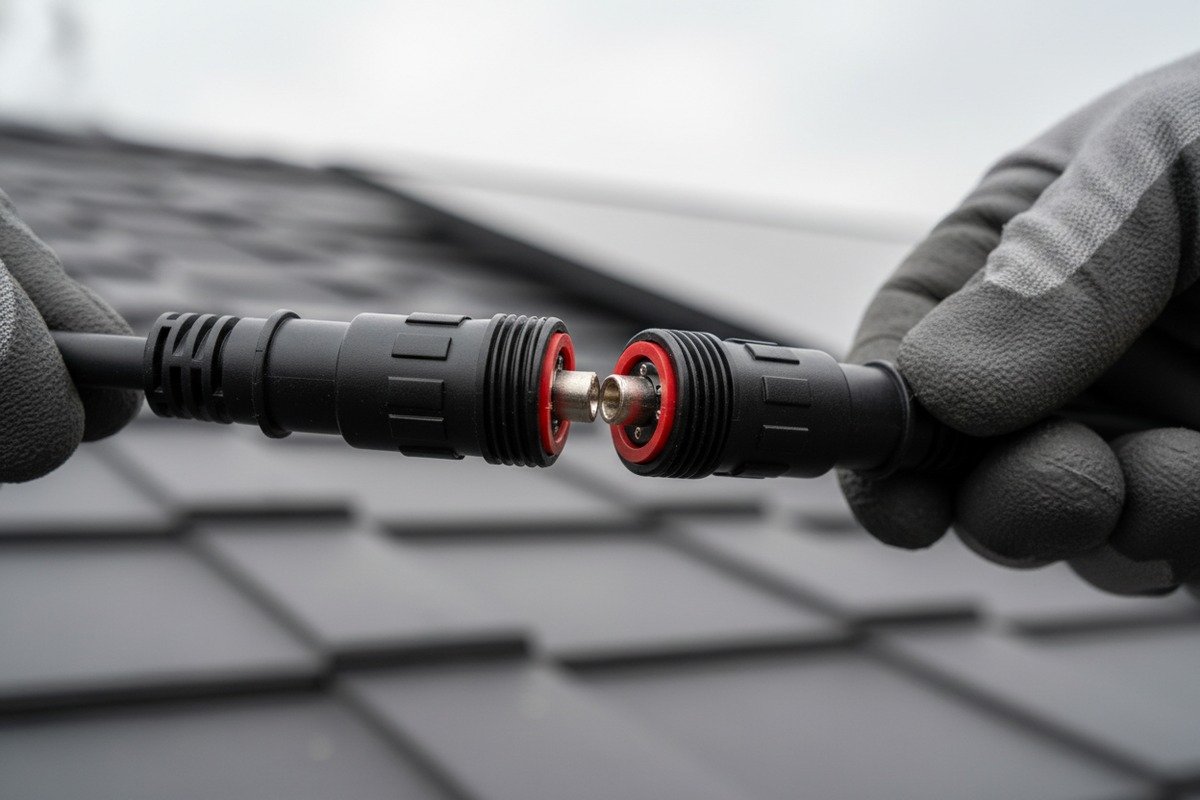
The Three Points of Moisture Entry
Water typically enters a junction box through one of three paths: the cable gland where wires enter, the connector mating interface, and the lid-to-body gasket. Each requires a different defense strategy. The cable gland needs a compression seal that tightens around the specific wire gauge (14–6 AWG). The connector interface needs a positive-locking mechanism with an O-ring or dual-lip seal. The lid seal, discussed in the materials section, needs continuous compression.
Connector Locking and Vibration Resistance
Wind causes constant micro-vibrations on a rooftop. Over 25 years, even tight connections can work loose. Look for connectors with audible click-lock mechanisms and secondary latch features. Our connectors use a dual-lock design: a primary snap-fit plus a threaded collar. In our vibration testing (based on IEC 60068-2-6), these connectors maintained contact resistance below 0.3 mΩ after 10 million cycles.
Contact Resistance and Electrical Safety
High contact resistance generates heat. Heat degrades seals. Degraded seals let in moisture. Moisture causes shorts. This is the failure chain you need to break at the first link. IEC 62852 sets the standard at 0.5 mΩ maximum. Better connectors achieve 0.2–0.3 mΩ. Ask your supplier for the contact resistance test report, and confirm it was measured after thermal cycling, not just at initial assembly.
| Connector Feature | Minimum Standard | Best Practice | Why It Matters |
|---|---|---|---|
| Cable Gland IP Rating | IP65 | IP67 or IP68 | Prevents water jet and submersion ingress at wire entry |
| Contact Resistance | < 0.5 mΩ (IEC 62852) | < 0.3 mΩ | Reduces heat generation that degrades seals |
| Locking Mechanism | Single snap-fit | Dual-lock (snap + threaded collar) | Prevents vibration loosening over decades |
| Thermal Cycling Endurance | 50 cycles | 200+ cycles (-40°C to 85°C) | Ensures seal integrity through seasonal extremes |
| Wire Gauge Compatibility | 12–10 AWG | 14–6 AWG | Broader compatibility reduces installation errors |
| Mating Cycles | 50 cycles | 100+ cycles | Supports maintenance disconnection without seal damage |
How to Spot Poor Connector Design
There are a few quick visual and tactile checks. If the connector feels loose when you mate it by hand, it will be worse after thermal cycling. If the O-ring is visible and exposed when connected, debris will eventually compromise it. If the cable gland uses a single flat washer instead of a tapered compression fitting, water will find a path. We encourage all our distribution partners to request sample units for hands-on evaluation before placing volume orders.
Field Testing You Can Do
Before full deployment, install a few test units on a mock-up roof section. After one month of natural weather exposure, disconnect the connectors and inspect for any moisture traces inside. Use a megohmmeter to check insulation resistance — it should read above 100 MΩ at 500 VDC. This simple field test catches design flaws that lab reports sometimes miss.
Which TUV or CE test reports should I request to confirm the waterproof reliability of my solar shingle components?
When our European partners prepare for building inspections in Germany or France, the inspector does not care about marketing brochures. They want to see specific test report numbers, accredited lab stamps, and traceable certification records. Knowing exactly which reports to request saves weeks of back-and-forth.
Request TUV-certified IEC 62790 reports for junction boxes, IEC 62852 for connectors, IEC 61730 for module safety including water ingress, and UL 2703 for mounting and bonding. Also ask for the CE Declaration of Conformity referencing the Low Voltage Directive 2014/35/EU and the CPR (Construction Products Regulation) where applicable.

The Essential Test Report Checklist
Not all certifications are equal. A CE mark alone is a self-declaration. A TUV test report is issued by an independent, accredited laboratory. When you source from China for the European market, insist on third-party reports from recognized bodies like TUV Rheinland, TUV SÜD, or Bureau Veritas.
IEC 62790: Junction Box Standard
This is the cornerstone standard for PV junction boxes. It covers thermal endurance, dielectric withstand, reverse current, wet leakage current, and — critically — the IP rating verification. The test report will include specific sections on:
- Thermal cycling performance of the junction box assembly
- Wet leakage current at maximum system voltage
- Bypass diode thermal runaway resistance
- Housing flammability (UL 94 or equivalent)
When you review the report, check that the tested sample matches the exact model you intend to purchase. Manufacturers sometimes certify one model and ship a different variant.
IEC 62852: Connector Standard
This standard covers the mechanical and electrical safety of PV connectors. Key test sections include contact resistance measurement, temperature rise, pull-out force, IP rating of the mated pair, and aging tests. Pay special attention to the "engagement and disengagement force" values — connectors that are too easy to disconnect are a long-term risk.
UL 2703: Mounting and Bonding
For the North American market and increasingly accepted in Europe, UL 2703 covers the structural and electrical bonding integrity of the entire mounting system, including junction boxes attached to roof shingles. This report confirms that the junction box maintains its waterproof seal under mechanical stress (wind uplift, snow load).
CE and CPR Requirements
For the European market, the CE Declaration of Conformity must reference specific directives. For electrical safety, this means the Low Voltage Directive (LVD) 2014/35/EU. For building integration, the Construction Products Regulation (EU) No 305/2011 applies. The CPR requires a Declaration of Performance (DoP) covering fire reaction class, water tightness, and mechanical resistance. Many solar shingle suppliers overlook CPR compliance, which can halt a project at the building permit stage.
Document Verification Tips
Always cross-reference the certificate number on the TUV or CE document with the certifying body's online database. TUV Rheinland, for example, maintains a public certificate database at certipedia.com. If the certificate number does not appear, the document may be forged or expired. We maintain all our certifications in active status and provide direct database links to our partners for instant verification.
At Lonsontech, we hold both CE and TUV certifications for our complete solar roof shingle system, including junction boxes and connectors. Our documentation package includes the full test reports, not just the summary certificates. This transparency is essential for building trust with European roofing companies and distributors who face strict liability requirements.
Conclusion
Waterproof assessment demands more than reading a single IP rating. Verify climate-specific tests, inspect material datasheets, evaluate connector seal design, and always request traceable third-party TUV or CE reports before committing to any solar shingle component purchase.
Footnotes
1. Details NORYL resin properties, including UV stability, for solar PV junction box applications. ↩︎
2. Compares IP and NEMA enclosure ratings, detailing their differences and applications. ↩︎
3. Describes the UL 2703 standard for mounting systems, bonding, and grounding of PV modules. ↩︎
4. Explains the IEC 62852 standard for PV connectors, focusing on safety and contact resistance. ↩︎
5. Outlines the scope and safety requirements of the EU Low Voltage Directive for electrical equipment. ↩︎
6. Details the TAS-100 test method for wind-driven rain resistance of discontinuous roof systems. ↩︎
7. Explains the IEC 61215 thermal cycling protocol for PV module durability testing. ↩︎
8. Compares properties, uses, and applications of EPDM and silicone for gaskets and seals. ↩︎
9. Defines galvanic corrosion, its causes, and methods for prevention in metal assemblies. ↩︎
10. Explains the IEC 62790 standard for PV junction boxes, including safety and test procedures. ↩︎