

Every week, our engineering team fields calls from European distributors asking the same question: will these solar shingles actually work with the inverters and batteries already popular across the continent short-circuit current (Isc) 1? After 20 years on the production line, we know the answer is nuanced.
To evaluate solar roof shingle compatibility with European inverters and storage systems, you must match the shingles’ electrical output (Voc, Isc, wattage) to the inverter’s MPPT range, confirm CE/IEC/VDE certifications for grid compliance, verify AC or DC coupling suitability for your chosen battery, and simulate performance using European irradiance data before installation.
This guide breaks down each step so you can confidently pair BIPV shingles with string inverters, hybrid systems, and battery storage across the European market. Let’s walk through it section by section.
How do I verify that the electrical output of solar shingles is compatible with my European string inverter?
When we calibrate our solar shingle modules before shipment, the electrical specs printed on each unit are the starting point for every compatibility check. Getting this wrong means wasted hardware and frustrated installers.
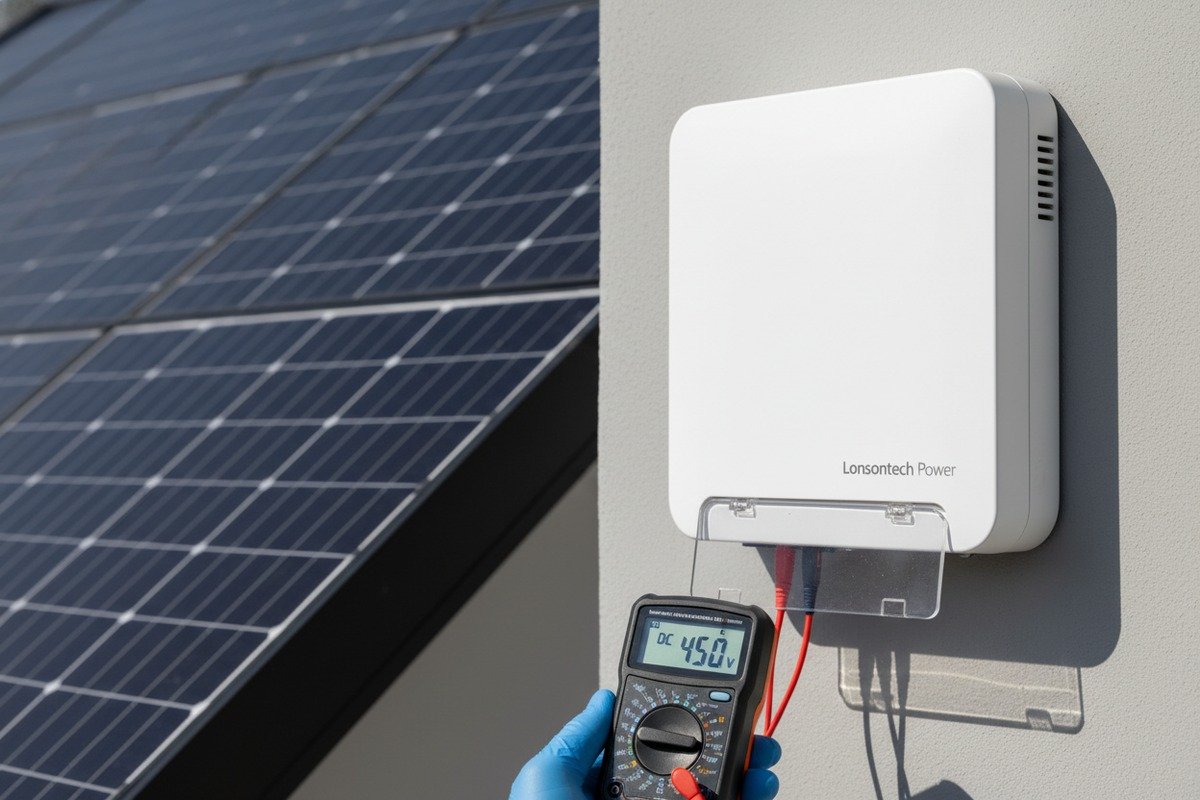
To verify compatibility, compare each solar shingle's open-circuit voltage (Voc) and short-circuit current (Isc) against your string inverter's MPPT input range. The total string voltage must fall within the inverter's operating window—typically 80–600V for models like the Fronius Primo or SMA Sunny Boy—under both cold and hot temperature extremes.
Understanding the Key Electrical Parameters
Solar roof shingles produce DC electricity. Each shingle has a rated power output, an open-circuit voltage (Voc) 2, a short-circuit current (Isc), and a maximum power point voltage (Vmpp). When you wire shingles in series to form a string, the voltages add up. When you wire strings in parallel, the currents add up.
A European string inverter has one or more MPPT (Maximum Power Point Tracking) 3 inputs. Each MPPT channel accepts a specific voltage range and a maximum current. If the total string voltage at the coldest expected temperature exceeds the inverter's maximum input voltage, you risk equipment damage. If it drops below the minimum start-up voltage at the hottest expected temperature, the inverter won't activate.
Step-by-Step Voltage Matching
Here is how we recommend our B2B partners approach it:
- Get the shingle datasheet. Note the Voc, Vmpp, Isc, and temperature coefficients.
- Determine the number of shingles per string.
- Calculate the maximum string Voc at the lowest winter temperature in your region (e.g., -10°C in Germany).
- Calculate the minimum string Vmpp at the highest summer temperature (e.g., 70°C cell temperature).
- Confirm both values fall within the inverter's MPPT range.
Common European String Inverters and Their Input Ranges
| Inverter Model | MPPT Voltage Range | Max Input Voltage | Max Input Current per MPPT | Typical Use Case |
|---|---|---|---|---|
| Fronius Primo 3.0-6.0 | 80–600 V | 600 V | 12 A | Residential single-phase |
| SMA Sunny Boy 3.0–6.0 | 80–600 V | 600 V | 15 A | Residential single-phase |
| Kostal Plenticore Plus | 80–1000 V | 1000 V | 15 A | Residential hybrid |
| SMA Sunny Tripower 8–10 | 150–1000 V | 1000 V | 33 A | Commercial three-phase |
Why Temperature Coefficients Matter
Our production team tests every batch of shingles under Standard Test Conditions (STC) 4: 25°C, 1000 W/m² irradiance. But rooftops in Finland in January or Spain in August don't match STC. The temperature coefficient of Voc—usually around -0.3% per °C—tells you how much voltage shifts with temperature. In cold weather, Voc rises. In hot weather, it drops. Ignoring this is the most common cause of string-inverter mismatch we see among European installers.
Also note that solar shingles are roof-integrated. Unlike racked panels, they lack an air gap beneath them. This means cell temperatures can run 5–10°C higher than conventional panels. Factor this into your Vmpp calculations for summer.
Frequency and Phase Considerations
European grids run at 50 Hz, single-phase (230V) or three-phase (400V). Some US-designed solar shingles are pre-wired or marketed for 60 Hz systems. The shingles themselves produce DC, so frequency is not a shingle-side issue. However, if a shingle system ships with a bundled inverter (as some US brands do), that inverter may not be 50 Hz compatible. Always confirm that the inverter—not just the shingle—is rated for 50 Hz, 230/400V output.
Which certifications should I look for to ensure my solar roof tiles meet European grid-tie and storage standards?
Our quality assurance lab runs every new shingle design through a gauntlet of tests before we ship a single container to Europe. We learned early that passing one certification but missing another can halt an entire project at customs or during building inspection.
For European markets, solar roof tiles must carry CE marking, IEC 61215 (module performance) and IEC 61730 (module safety) certifications, plus grid-tie compliance per EN 50549 or country-specific codes like Germany's VDE-AR-N 4105. Building-integration also requires CPR (Construction Products Regulation) compliance for fire, wind, and water resistance.

The Dual Certification Challenge
This is one of the biggest pain points we hear from our European distribution partners. Solar shingles are both an electrical product and a building material. They need to satisfy two separate regulatory frameworks simultaneously. A product that passes photovoltaic testing but fails building material standards cannot legally be installed as roofing in most EU countries.
Essential Certifications at a Glance
| Certification / Standard | What It Covers | Why It Matters |
|---|---|---|
| CE Marking 5 | General EU product safety | Legally required for market access in the EEA |
| IEC 61215 6 | PV module design qualification and performance | Proves the module can withstand environmental stress (humidity, UV, thermal cycling) |
| IEC 61730 7 | PV module safety qualification | Ensures electrical insulation, fire resistance, and mechanical safety |
| EN 50549 8 (Parts 1 & 2) | Grid connection requirements for generators | Mandatory for grid-tied systems across Europe |
| VDE-AR-N 4105 | German low-voltage grid connection standard | Required for any system feeding into the German grid |
| IEC 62109-1/2 | Inverter safety | Ensures the paired inverter meets safety requirements |
| CPR (EU 305/2011) 9 | Construction product performance | Covers fire class, structural load, water tightness for building-integrated products |
| Low Voltage Directive 2014/35/EU | Electrical safety for products 50–1000V AC / 75–1500V DC | Applies to the overall electrical system |
Country-Specific Requirements
Not every EU country applies the same grid codes. France has its own NF C 15-100 requirements and mandates local testing for certain BIPV products. Italy requires CEI 0-21 compliance for low-voltage grid connections. The Netherlands follows NEN-EN 50549 but has additional utility-specific requirements from grid operators like Enexis or Liander. When we prepare shipments for different markets, we always confirm the specific country code requirements with our distribution partner.
Fire Ratings and Building Codes
European buildings have strict fire classifications. Solar tiles used as roofing must meet Euroclass fire ratings (A1 to F) depending on the building type and national code. In Germany, for example, roofing products generally need at least a Broof(t1) classification. Our shingles are designed with tempered glass and fire-resistant backing to meet these thresholds. If a product only has IEC 61730 fire classification but lacks a Euroclass rating, it may still be rejected by building inspectors.
The TUV Advantage
While not legally required beyond CE, TUV certification (from TÜV Rheinland or TÜV SÜD) is widely respected across Europe. It tells your customers that an independent German testing body has verified the product. In our experience, having TUV on the datasheet shortens sales cycles by weeks because it removes a layer of doubt for risk-averse European buyers.
Wind and Snow Load Ratings
European roofs face diverse mechanical loads. Alpine regions need shingles rated for heavy snow (5400 Pa or higher). Coastal areas demand high wind resistance (2400 Pa minimum). Our shingles are tested to withstand 35mm hail and Grade 15 wind loads. Always cross-reference the shingle's IEC 61215 mechanical load test results with the specific wind and snow zone requirements of the installation site per Eurocode 1.
Can I integrate these BIPV shingles with popular European hybrid battery systems like Huawei or Fronius?
Our R&D department has spent the past three years testing our shingles against the most popular European hybrid inverter-battery ecosystems. The good news is that integration is very achievable. The challenge lies in choosing the right coupling method.
Yes, BIPV shingles can integrate with European hybrid battery systems from Huawei, Fronius, SMA, and others. AC coupling connects shingles through a standard inverter to a separate battery inverter, while DC coupling routes shingle output directly into a hybrid inverter's battery input. Both methods work, but DC coupling requires precise voltage matching with the battery system.
AC Coupling vs. DC Coupling
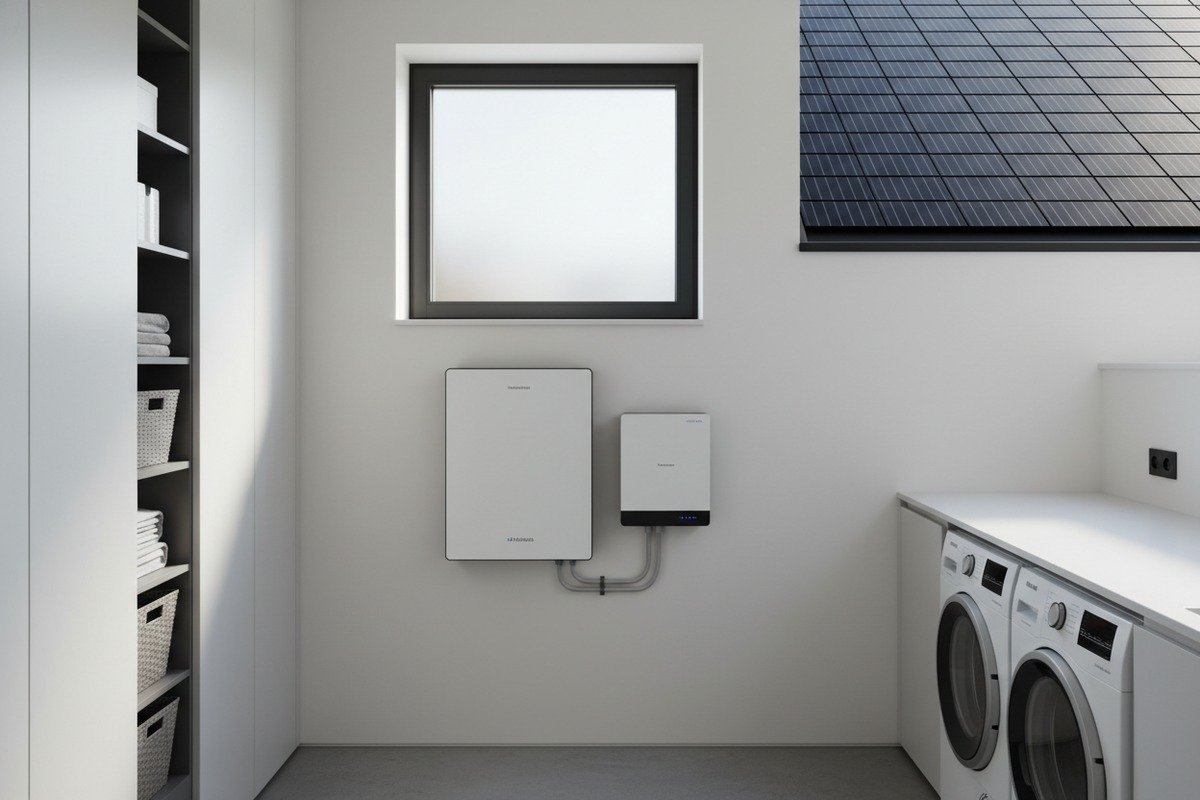
AC coupling 10 is the simpler path. Your solar shingles connect to a standard grid-tie inverter that converts DC to AC. A separate battery inverter (or an AC-coupled battery like the Sonnen or Tesla Powerwall) sits on the AC side. The two systems communicate but operate independently. This is ideal for retrofits or when you want to mix and match brands.
DC coupling is more efficient. Your shingles feed DC directly into a hybrid inverter that manages both grid export and battery charging. This avoids the double conversion loss (DC→AC→DC) that AC coupling suffers. However, the shingle string voltage must align with the hybrid inverter's battery-side MPPT and the battery's voltage range.
Popular European Hybrid Systems and Compatibility
| Hybrid System | Coupling Type | Battery Voltage Range | PV Input Range | Notes |
|---|---|---|---|---|
| Huawei LUNA2000 + SUN2000 | DC-coupled | 90–560 V (HV battery) | 140–1100 V MPPT | Widely deployed; excellent monitoring app |
| Fronius Symo GEN24 Plus | DC-coupled (BYD HVS/HVM) | 160–750 V | 80–1000 V MPPT | Supports emergency power backup |
| SMA Sunny Boy Storage | AC-coupled | 80–500 V (with BYD) | N/A (separate PV inverter) | Flexible; pairs with any grid-tie inverter |
| Sonnen Batterie | AC-coupled | Internal 48V system | N/A (separate PV inverter) | Plug-and-play; strong in Germany |
| Enphase IQ Battery | AC-coupled (microinverter) | Internal management | N/A (Enphase IQ microinverters) | Module-level optimization included |
Practical Integration Steps
When our partners plan a hybrid installation, we recommend this workflow:
- Select the shingle configuration and calculate the total string voltage and current.
- Choose the hybrid inverter first if DC coupling is desired. The inverter dictates the voltage window.
- Verify the battery's high-voltage or low-voltage architecture matches the inverter.
- Run a simulation in PV*SOL or PVsyst using local irradiance data (900–1200 kWh/kWp/year in central Europe).
- Confirm all components share compatible communication protocols (e.g., Modbus, CAN bus).
- Install and commission with a certified electrician who can verify grid export settings per local codes.
The Efficiency Trade-Off
DC coupling typically saves 3–5% in round-trip efficiency compared to AC coupling. But AC coupling offers more flexibility—you can add storage later without rewiring the PV side. For new installations where the budget allows a full hybrid inverter, DC coupling is usually the better choice. For retrofits or projects where the inverter brand is already locked in, AC coupling keeps things simple.
Monitoring and Cybersecurity
Modern hybrid systems from Huawei, Fronius, and SMA all offer cloud-based monitoring. With increasing connectivity, cybersecurity has become a genuine concern. The EU's Network and Information Security Directive (NIS2) is pushing stricter requirements for connected energy devices. When evaluating a hybrid system, check whether the inverter manufacturer provides regular firmware updates and encrypted data transmission. This is especially important in distributed energy systems where hundreds of homes feed into the same grid segment.
How do I determine if my specific roof layout requires micro-inverters or power optimizers for my solar shingles?
When we design shingle layouts for complex European rooftops—think multi-gabled Dutch townhouses or French mansard roofs—the question of micro-inverters versus power optimizers comes up in almost every project meeting. The roof's geometry directly determines the answer.
Your roof layout requires micro-inverters or power optimizers if it has multiple orientations, significant shading from dormers or chimneys, varying pitch angles, or if local regulations require module-level monitoring. For simple south-facing roofs with uniform exposure, a standard string inverter is usually sufficient and more cost-effective.
When String Inverters Work Fine
A string inverter works best when all shingles in a string receive roughly the same amount of sunlight throughout the day. This means:
- The roof faces one direction (ideally south or southeast in Europe).
- The pitch is consistent across the installation area.
- There are no obstructions casting shadows on parts of the array.
- The roof area is large enough to form full strings within the inverter's voltage window.
In these conditions, a string inverter from Fronius, SMA, or Kostal offers the lowest cost per watt and the simplest installation. About 40% of European residential roofs fit this profile.
When You Need Module-Level Power Electronics
The remaining 60% of roofs have complications. Here is when micro-inverters or power optimizers become necessary:
Micro-inverters (e.g., Enphase IQ8) convert DC to AC at each shingle or small group of shingles. They eliminate string-level mismatch entirely. If one shingle is shaded, only that shingle's output drops. The rest continue at full power. Micro-inverters also provide module-level monitoring, which simplifies troubleshooting.
Power optimizers (e.g., SolarEdge, Tigo) keep the system DC-coupled but optimize the voltage and current at each module before sending power to a central inverter. They offer most of the benefits of micro-inverters at a slightly lower cost.
Decision Matrix for Roof Layouts
| Roof Characteristic | String Inverter | Power Optimizer | Micro-Inverter |
|---|---|---|---|
| Single orientation, no shading | ✔ Best choice | Works, but overkill | Works, but overkill |
| Two orientations (e.g., east/west) | Possible with dual MPPT | ✔ Good choice | ✔ Good choice |
| Multiple gables or dormers | Not recommended | ✔ Good choice | ✔ Best choice |
| Partial shading (trees, chimneys) | Not recommended | ✔ Good choice | ✔ Best choice |
| Very small roof areas (<2 kW per face) | String may not reach min voltage | Possible | ✔ Best choice |
| Fire code requires rapid shutdown | Requires add-on | ✔ Built-in | ✔ Built-in |
| Budget priority | ✔ Lowest cost | Mid-range | Highest cost |
Performance Impact of Shading on Solar Shingles
Solar shingles are particularly sensitive to partial shading because of how they are wired internally. A single shaded cell in a string can drag down the entire string's output. In our testing, a chimney shadow covering just 10% of a shingle array reduced string-inverter output by up to 25%. With power optimizers, the same shadow reduced output by only 8–10%. With micro-inverters, the loss was limited to roughly the area actually shaded—about 10%.
The Airflow Factor
Remember that solar shingles sit flush against the roof deck. There is minimal airflow underneath. This raises cell temperatures and slightly reduces efficiency—typically a 10–15% underperformance compared to racked panels in low-light conditions common across northern Europe. Micro-inverters and optimizers can partially compensate for this by keeping each module at its optimal power point regardless of temperature variations across the roof surface.
Cost Considerations for European Projects
Micro-inverters add approximately €0.15–0.25 per watt to the system cost. Power optimizers add about €0.08–0.15 per watt. For a 5 kW system, that translates to an additional €400–1,250 for optimizers or €750–1,250 for micro-inverters. However, on complex roofs, the energy gain from eliminating mismatch losses can improve annual yield by 15–25%, which often pays back the extra hardware cost within 3–4 years at European electricity rates.
Future-Proofing with Module-Level Electronics
The European energy landscape is shifting rapidly. The EPBD (Energy Performance of Buildings Directive) recast pushes for zero-energy buildings by 2030. Bidirectional inverters for Vehicle-to-Grid (V2G) integration are emerging. Module-level electronics make it easier to expand, reconfigure, or upgrade your system as these technologies mature. If you are installing shingles today on a roof you expect to last 25 years, investing in micro-inverters or optimizers provides a future-proof foundation.
Conclusion
Evaluating solar shingle compatibility with European inverters and storage systems comes down to matching electrical specs, verifying certifications, choosing the right coupling method, and accounting for your specific roof layout. Work with certified installers, simulate before you build, and always check country-specific grid codes.
Footnotes
1. Defines a critical electrical characteristic of solar shingles. ↩︎
2. Replaced with a Wikipedia link for authoritative definition. ↩︎
3. Comprehensive overview of MPPT technology and its application in PV systems. ↩︎
4. Replaced with a Wikipedia link, which is an authoritative source and explains STC within the context of photovoltaics. ↩︎
5. Official information from the European Commission on CE marking requirements. ↩︎
6. Official IEC standard page detailing requirements for PV module design qualification. ↩︎
7. Official IEC standard page outlining safety requirements for PV modules. ↩︎
8. Replaced with a link to iTeh Standards, an authoritative source for European standards, detailing EN 50549-1:2019. ↩︎
9. Official European Union legislation text for the Construction Products Regulation. ↩︎
10. Explains AC coupling in home energy management and storage systems. ↩︎