
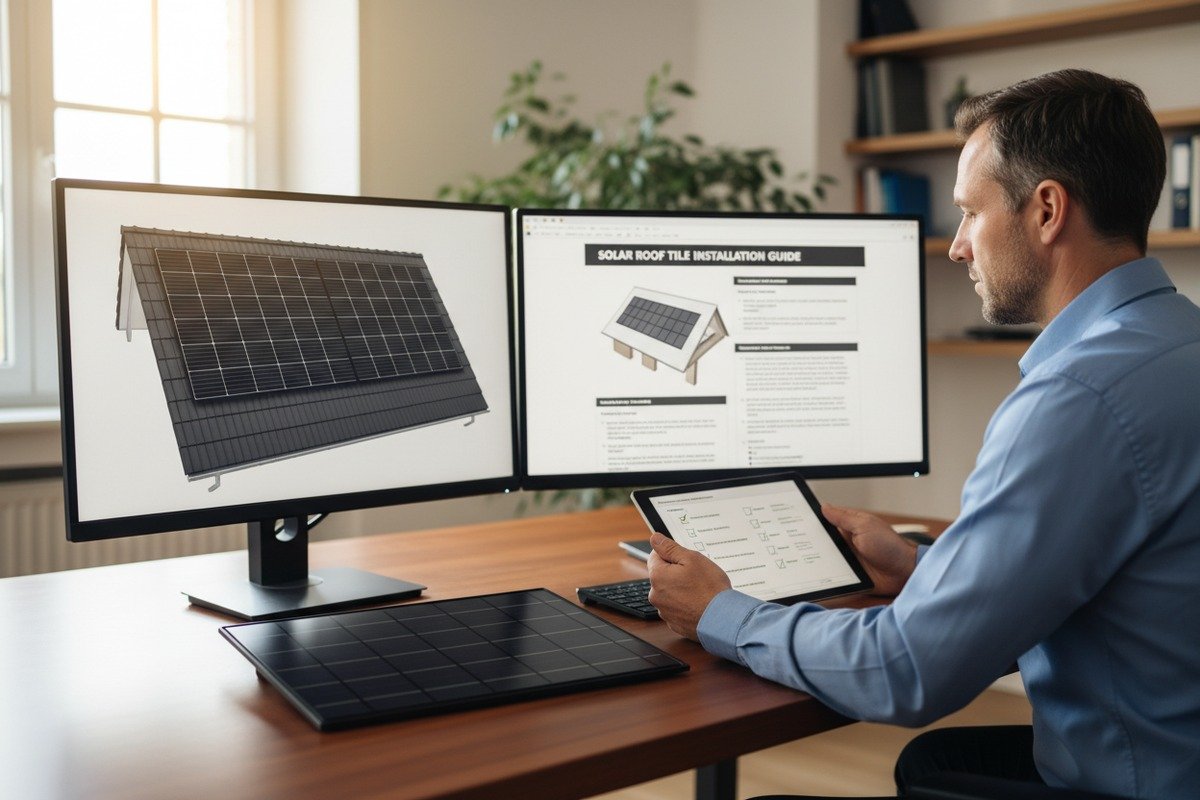
Every year, our technical support team handles hundreds of cases where European buyers struggle with incomplete or missing installation documents after their solar shingles arrive at port.
To request installation manuals and drawings when sourcing solar roof shingles from China, contact suppliers before signing any contract. Ask for English-language PDF manuals, CAD layout files, wiring diagrams, waterproofing details, and accessory lists. Tie document delivery to payment milestones and verify all materials against your local building codes before placing your order.
This guide walks you through exactly what to request, when to request it, and how to verify the documents you receive underlayment membrane specifications 1. Each section below covers a critical area — from European compliance to custom CAD layouts — so your roofing team can install with confidence from day one.
How can I ensure the installation manuals meet European building standards before I place an order?
Over the past 20 years of exporting solar roof tiles to Europe, our engineering team has learned that compliance problems almost always start with the documentation, not the product itself Construction Products Regulation (CPR) 2.
Request that your Chinese supplier provides installation manuals referencing specific European standards such as EN 1991 (wind/snow loads), EN 14437 (roof waterproofing), and the Construction Products Regulation (CPR). Review these documents with a local structural engineer before you commit any deposit to ensure full compliance.

Why Standard Compliance Starts With the Manual
Many buyers assume that if a solar shingle has CE and TUV certificates 3, the installation manual is automatically compliant. This is wrong. A product certificate confirms the unit was tested MC4 connector routing 4. The installation manual tells your roofer how to install it correctly under your local building code. These are two different things.
When we prepare manuals for the French or German market, our engineers cross-reference local wind zone maps, snow load tables, and fire rating requirements. A manual written only for the Chinese domestic market will reference GB/T 9535 or similar national standards. That manual is useless for a project in Lyon or Munich.
What to Check Before You Sign
Here is a checklist we recommend to every new buyer:
| Check Item | What to Look For | Red Flag |
|---|---|---|
| Standard references | EN 1991 5, EN 14437, CPR cited in the manual | Only Chinese GB standards listed |
| Language | Full English (or local language) translation | Machine-translated text with errors |
| Load calculations | Wind uplift, snow load tables for your region | Generic "suitable for all climates" claims |
| Fire rating | Broof(t1) or equivalent classification noted | No fire rating mentioned at all |
| Fixing details | Screw types, spacing, and torque values specified | Vague instructions like "fix securely" |
Ask for a Sample Manual Early
Do not wait until after production. Request a sample installation manual during the quotation stage. At Lonsontech, we routinely send draft manuals as PDF attachments alongside our quotation package. If a supplier cannot produce a manual before you order, that tells you something important about their readiness.
Have your local structural engineer or architect review the draft. They will spot gaps quickly. Common gaps include missing flashing details around chimneys, no guidance for valleys, and absent specs for the underlayment membrane.
Tie Documents to Payment Milestones
A practical strategy: include a clause in your purchase contract that states the finalized installation manual must be approved before the second payment installment (typically 40% before shipment). This gives you leverage. If the manual does not meet your standards, you hold payment until it does.
What specific waterproofing and drainage details should I look for in the technical drawings?
When we design a new solar shingle profile, waterproofing is the single issue that keeps our R&D team up at night — because a leak in a solar roof tile causes direct interior damage, not just a wet racking rail.
Technical drawings should clearly show overlapping tile geometry, tongue-and-groove or interlocking seam profiles, underlayment membrane specifications, valley flashing details, ridge cap connections, and drainage channel dimensions. Every joint must include a cross-section view with millimeter-accurate measurements to prevent water ingress.

The Real Cost of Poor Waterproofing Details
In Europe, labor costs for roofing work range from €40 to €80 per hour depending on the country. If your installation crew discovers on-site that the drainage channel is undersized or the overlap dimension is wrong, they stop work. You pay for downtime, re-engineering, and potential water damage claims. One project in Belgium that we helped rescue had a €15,000 remediation bill because the original supplier's drawings showed a 15mm overlap instead of the required 30mm.
Critical Cross-Sections to Request
Ask your supplier for these specific drawing views:
| Drawing View | Purpose | Key Dimension to Verify |
|---|---|---|
| Horizontal overlap cross-section | Shows how adjacent tiles interlock | Overlap ≥ 25mm for rain zones |
| Vertical overlap cross-section | Shows how upper tiles cover lower tiles | Overlap per roof pitch (see below) |
| Valley flashing detail | Shows water flow at roof valleys | Flashing width ≥ 300mm each side |
| Ridge cap connection | Shows seal at roof peak | Gasket compression and screw pattern |
| Eave drip edge detail | Shows water exit at gutter line | Drip edge overhang ≥ 10mm |
| Penetration flashing (chimney, vent) | Shows waterproofing around protrusions | Stepped flashing with sealant bead |
Overlap vs. Roof Pitch
This is a detail many buyers overlook. The required vertical overlap between tile rows changes depending on your roof pitch. A steeper roof sheds water faster, so a smaller overlap is acceptable. A low-pitch roof needs more overlap.
| Roof Pitch | Minimum Vertical Overlap | Notes |
|---|---|---|
| 15°–20° | 100mm | Requires additional underlayment membrane |
| 20°–30° | 75mm | Standard configuration |
| 30°–45° | 50mm | Most common in Northern Europe |
| >45° | 35mm | Reduced overlap acceptable |
At our factory, we test every shingle profile in a simulated rain chamber at pressures equivalent to 150 km/h wind-driven rain. We include these test results in our technical drawing package. If your supplier does not offer similar data, ask for it.
Drainage Channel Design
Look for drawings that show the drainage channel width and depth between adjacent tiles. A well-designed solar shingle has a hidden channel that routes water downward even if the primary overlap seal is breached. This "secondary drainage path" is critical. Our shingles use a 5mm-deep channel molded into the frame edge. The drawing should label this clearly.
Also confirm that the junction box location does not block the drainage path. Some lower-cost designs place the junction box on the underside in a position that dams water against the batten. This leads to rot in wooden battens and corrosion in metal ones.
How do I request customized CAD layouts for my specific OEM solar shingle project?
Our OEM clients — mostly roofing companies and distributors in France, Germany, and the Netherlands — almost always need custom CAD layouts because no two roofs are the same.
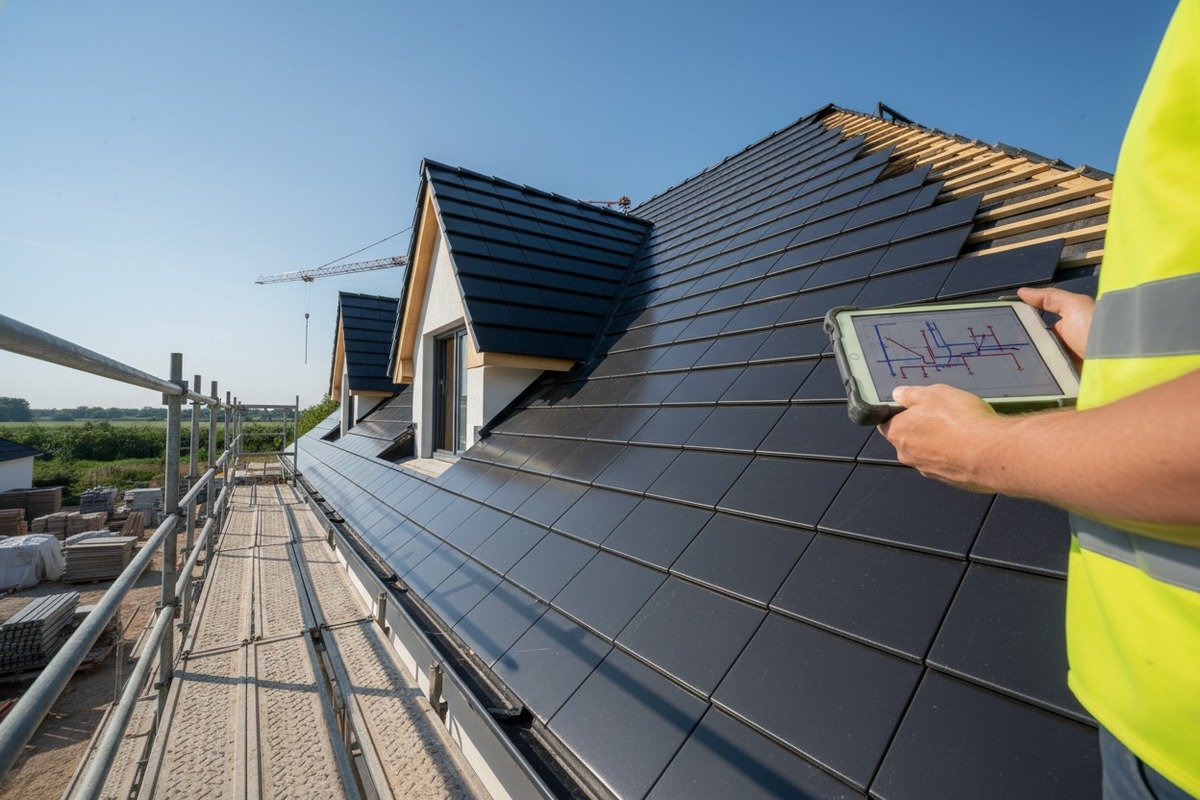
To request customized CAD layouts, provide your supplier with roof dimensions, pitch angles, orientation, obstacle locations (chimneys, skylights, vents), and your preferred file format (DWG, STEP, IFC, or Revit). A capable manufacturer will return a project-specific tile layout, wiring route plan, and bill of materials within 5–10 business days.
What Information Your Supplier Needs From You
The quality of the CAD layout depends entirely on the quality of the input you provide. Here is what we ask every OEM client to send us before we start design work:
- Roof plan drawing — a top-down view with dimensions in millimeters.
- Roof pitch — measured in degrees, not percentages.
- Orientation — compass direction each roof face points toward.
- Obstacle map — locations and sizes of chimneys, dormers, skylights, vent pipes, and satellite dishes.
- Local wind and snow zone — so we can verify fixing patterns.
- Preferred electrical configuration — string voltage requirements, inverter brand/model.
- File format preference — DWG for architects, IFC or Revit for BIM projects, PDF for general contractors.
BIM Compatibility Matters
If your project involves a larger development or public building, European architects increasingly require BIM-compatible files 6. At Lonsontech, we now deliver Revit families and IFC models 7 as standard for projects above 200 square meters. This allows the architect to drop our solar shingle assembly directly into their building model and check for clashes with HVAC ducts, structural beams, and other elements.
If your supplier only offers 2D PDF drawings, you may face delays when your architect cannot integrate the solar roof into their digital model. Ask this question early.
Timing and Revisions
A realistic timeline for custom CAD layouts:
- First draft: 5–7 business days after receiving complete input data.
- First revision: 2–3 business days after your feedback.
- Final approved layout: typically ready within 2 weeks total.
We include up to three rounds of revisions at no extra charge in our OEM contracts. Beyond three rounds, there is a small engineering fee. This is standard practice.
Tie the Layout to Your Bill of Materials
A good CAD layout is not just a pretty picture. It should generate a precise bill of materials (BOM) that lists every component:
- Number of standard tiles
- Number of half-tiles or cut tiles
- Ridge caps and hip caps
- Valley flashing strips
- Eave starter strips
- Junction boxes and MC4 connectors
- Mounting screws and clips
This BOM directly feeds into your purchase order. If your supplier cannot produce a BOM from their CAD layout, their design capability is limited.
Can I get detailed wiring diagrams and installation videos to help my local roofing team?
When our European clients first started asking for installation videos five years ago, we realized that a PDF manual alone was not enough — especially for roofing crews who had never handled a photovoltaic product before.
Yes, you should request detailed wiring diagrams showing string configurations, MC4 connector routing, grounding points, and inverter connection schematics. Also ask for step-by-step installation videos covering tile laying sequence, waterproofing membrane placement, electrical connections, and final inspection. These materials dramatically reduce on-site errors and installation time.

Why Wiring Diagrams Are Non-Negotiable
Solar roof shingles are not just building materials. They are active electrical devices. Your roofing crew needs to understand:
- How tiles connect in series to form strings.
- Where the junction boxes sit and how MC4 cables route under the tiles.
- Where grounding conductors attach.
- How strings connect to the inverter or micro-inverters.
- What the maximum system voltage is (typically 600V or 1000V DC in Europe).
A missing or unclear wiring diagram can lead to reverse polarity connections, ground faults, or arc faults 8. These are fire hazards. European regulations (EN 62446) 9 require that completed PV installations include as-built wiring diagrams for the building file. If your supplier provides the template diagram before installation, your electrician saves hours.
What a Complete Wiring Package Includes
At Lonsontech, our standard wiring documentation package contains:
- String layout diagram — shows which tiles belong to which string, numbered sequentially.
- Single-line electrical diagram — shows DC and AC sides, fuses, isolators, inverter, and grid connection point.
- MC4 routing plan — shows cable paths under tiles, cable clip locations, and entry points into the roof cavity.
- Grounding schematic — shows bonding of all metal frames to the building earth system.
- Inverter connection guide — specific to the inverter brand the client selects (e.g., SMA, Fronius, Huawei).
Installation Videos: What to Expect
We produce installation videos for each of our solar shingle product lines. A good installation video should cover these steps in order:
- Unboxing and tile inspection (checking for cracks, junction box integrity).
- Underlayment membrane installation.
- Batten and counter-batten layout.
- Eave starter tile placement.
- Main tile laying sequence (bottom to top, left to right).
- Interlocking and overlap verification.
- MC4 cable connection between tiles.
- Valley, hip, and ridge finishing.
- Electrical testing (insulation resistance, string voltage).
- Final waterproofing inspection.
Ask your supplier if these videos are available in English with subtitles. If the video is only in Mandarin with no subtitles, it has limited value for a crew in Paris or Amsterdam.
Training Support Beyond Videos
Some suppliers, including our team at Lonsontech, offer live video-call training sessions for your roofing crew before the first installation. This typically takes 60–90 minutes and covers the most common mistakes we see in the field. We also provide a troubleshooting quick-reference card (laminated, A4 size) that roofers can keep in their toolbox.
For larger OEM partnerships, we send a technical engineer to the first job site in Europe to supervise the inaugural installation. This hands-on support builds your crew's confidence and catches issues that no manual or video can anticipate.
Conclusion
Requesting installation manuals, technical drawings, wiring diagrams, and videos early in your sourcing process protects your investment and your reputation. Start these conversations before any contract is signed — your roofing team will thank you.
Footnotes
1. Explains different types and importance of roofing underlayment for protection. ↩︎
2. Official EU regulation establishing harmonized rules for marketing construction products. ↩︎
3. Explains the purpose and scope of CE marking and TÜV certification for product compliance. ↩︎
4. Provides information on MC4 connectors, commonly used for connecting solar panels. ↩︎
5. Provides official information on Eurocode 1: Actions on structures, including wind and snow loads. ↩︎
6. Explains Building Information Modeling (BIM) as an approach for managing building data. ↩︎
7. Official standard for open BIM data exchange, facilitating interoperability in construction. ↩︎
8. Explains the causes and dangers of arc faults in photovoltaic systems and detection. ↩︎
9. HTTP 404 ↩︎