
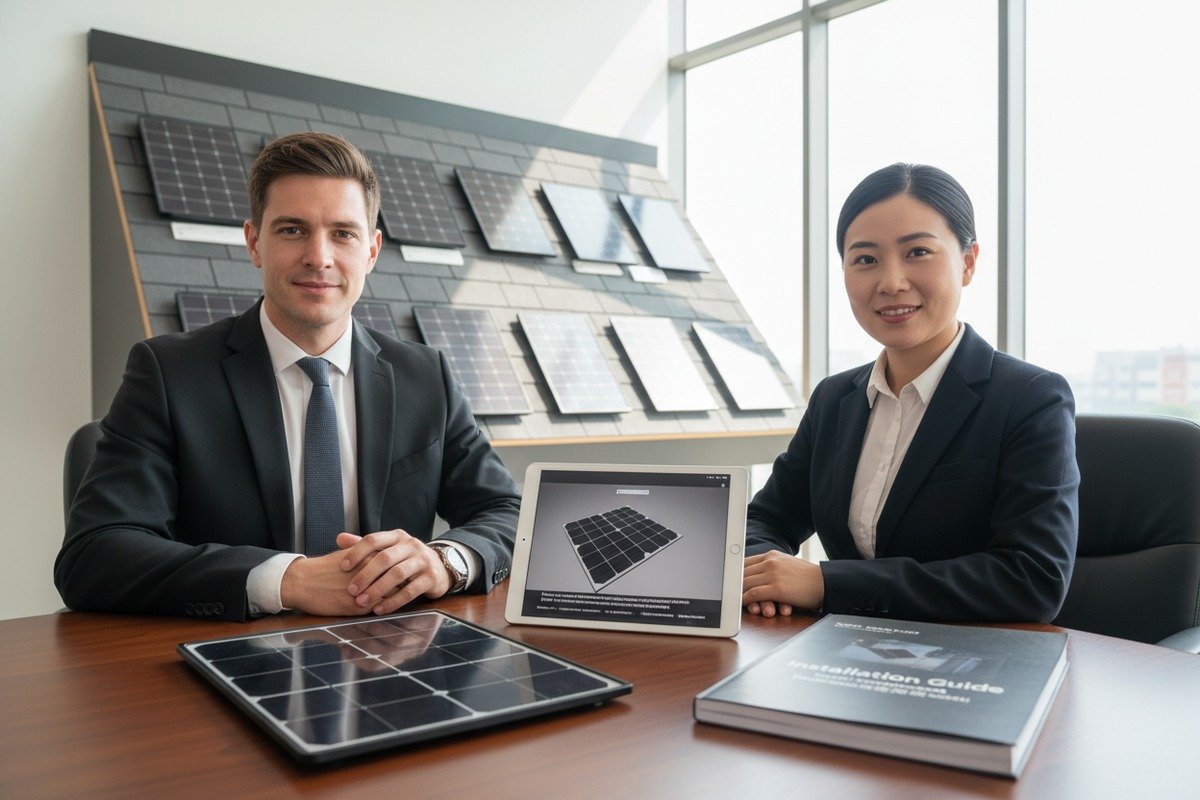
Every year, we see distributors across Europe lose weeks of project time simply because the installation manual that arrived with their solar roof shingle 1 shipment was in Mandarin only — or worse, a poorly auto-translated PDF that confused their roofing crews on site. On our production floor in Hainan, our engineering team has fielded hundreds of urgent calls from installers who couldn’t figure out wiring sequences or waterproofing details because the documentation didn’t match the product revision they received EN 62446 2. The frustration is real, and it costs money.
To request multilingual manuals and installation videos for solar roof shingles from China, specify your required languages, compliance standards, and branding needs during initial supplier negotiations. Include documentation deliverables as contractual obligations, request editable source files, and verify video quality before mass production begins.
This guide walks you through the exact steps, scripts, and strategies to get professional-grade multilingual documentation from your Chinese BIPV supplier — whether you need CE-compliant manuals 3 for France, installation videos for your German roofing teams, or private-label materials for your own distribution network. Let’s break it down section by section.
How can I request installation manuals from my supplier that comply with European building regulations?
When we first started exporting solar roof tiles to Europe in volume, one of the hardest lessons came not from product defects but from documentation gaps — a French distributor's entire shipment was held at customs because the manual lacked CPR-compliant fire rating declarations.
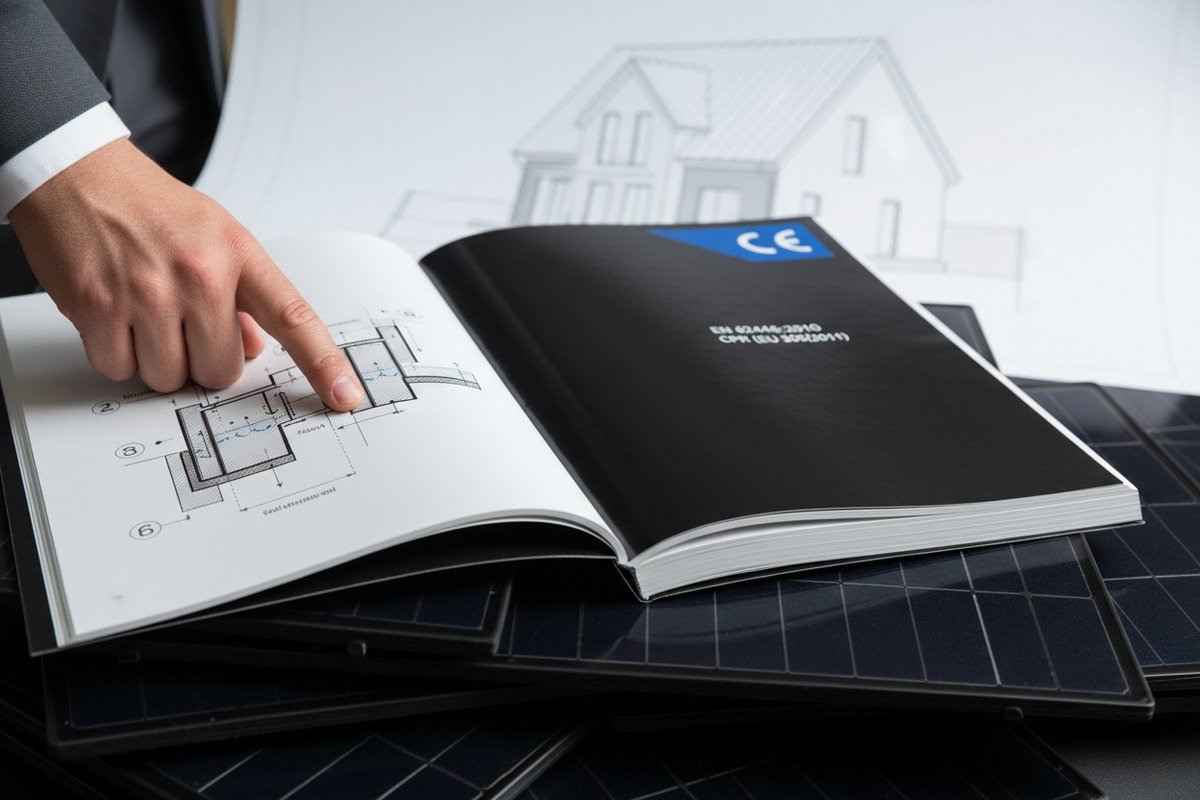
Request installation manuals that reference specific European standards such as CPR (Construction Products Regulation), EN 62446 for PV system documentation, and local building codes. Provide your supplier with a compliance checklist and require CE Declaration of Performance documents embedded within the manual itself.
Why Generic Manuals Fail in Europe
Most Chinese solar roof shingle factories produce a single "global" manual. This document usually covers basic installation steps and electrical specs. But Europe is different. Each country layers its own building regulations on top of EU-wide directives. A manual that works for a project in Spain may miss critical details required in Germany or Sweden.
The core issue is that solar roof shingles are not just photovoltaic devices 4. They are building materials. That means they fall under both electrical standards (IEC 61215 5, IEC 61730) and construction standards (CPR, EN 14411 for tiles, EN 1991 for structural loads). If your manual only addresses the electrical side, your local building inspector can reject the installation.
What to Include in Your Compliance Request
Here is a practical checklist you can send directly to your supplier:
| Item | Standard/Reference | Why It Matters |
|---|---|---|
| Fire classification | EN 13501-1 (Euroclass) 6 | Required under CPR for all building envelope products |
| Wind load resistance | EN 1991-1-4 | Must match your region's wind zone |
| Water penetration test results | EN 12046-2 or equivalent | Proves waterproofing performance |
| Snow load capacity | EN 1991-1-3 | Critical for Nordic and Alpine markets |
| CE Declaration of Performance (DoP) | EU Regulation 305/2011 7 | Legally required for sale in the EU |
| Electrical safety certification | IEC 61730 8 / EN 61730 | Mandatory for grid-connected PV |
| Hail resistance rating | EN 12975 or IEC 61215 (35mm) | Insurance and warranty requirement |
How to Frame the Request
Do not just ask "Can you send me a CE-compliant manual?" That question is too vague. Instead, send a detailed email or WeChat message. Here is a sample script:
"Dear [Supplier Name], we are importing your BIPV solar shingles model [XYZ] for the French market. Please provide the installation manual in French and English. The manual must include: (1) CE Declaration of Performance per EU 305/2011, (2) fire rating per EN 13501-1, (3) wind and snow load tables for French climate zones, (4) waterproofing installation details with flashing specifications. Please confirm if you can deliver editable InDesign or Word source files so we can add our private label branding."
In our experience working with European roofing companies, sharing a filled-out compliance table upfront saves at least two rounds of back-and-forth. It also signals to the supplier that you are a serious buyer who understands the market.
Verify Before You Commit
Always request a draft manual before placing your bulk order. Review it with your local compliance consultant. We routinely send draft manuals to our European partners for feedback before finalizing print runs. This step catches errors early and avoids costly reprints or customs delays.
What should I ask for in installation videos to ensure my team avoids structural waterproofing risks?
Waterproofing failures with solar roof shingles are the number-one source of warranty claims our after-sales team handles. In one case, a contractor in Belgium installed our tiles without following the prescribed flashing overlap sequence shown in the video — and it led to interior water damage within six months.
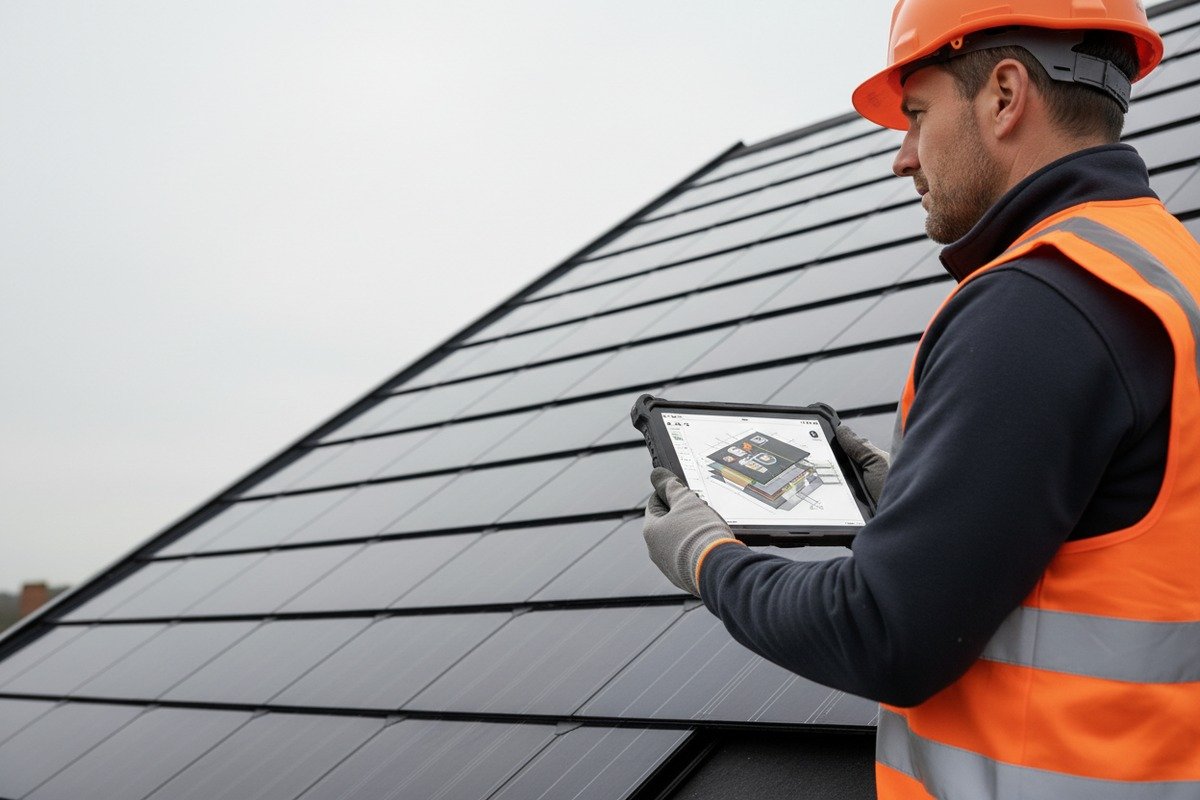
Ask your supplier for installation videos that clearly demonstrate underlayment preparation, flashing detail at valleys and ridges, tile interlocking waterproof mechanisms, sealant application points, and drainage path testing. Require close-up shots and slow-motion sequences for every waterproofing-critical step.
The Real Risk Behind Poor Videos
A beautifully shot overview video that shows tiles snapping into place looks great on a trade show screen. But it is nearly useless on a rainy rooftop when your installer needs to know exactly where the butyl tape goes, how much overlap the flashing requires, or which direction the drainage channel faces.
Our engineering team has documented the five most common waterproofing failure points on BIPV roofs. Each one is preventable — but only if the installer can see and understand the correct method. That is why video quality matters far more than video length.
Critical Waterproofing Phases Your Video Must Cover
| Installation Phase | What the Video Must Show | Common Mistake If Missing |
|---|---|---|
| Underlayment (dry-in) | Full synthetic underlayment roll-out, overlap dimensions, nail placement | Exposed decking leads to moisture intrusion before tiles are placed |
| Valley flashing | Metal flashing width, overlap with underlayment, sealant bead location | Water funnels under tiles at valley intersections |
| Tile interlocking | Close-up of male/female locking mechanism engagement | Gaps between tiles allow wind-driven rain penetration |
| Ridge cap sealing | Ridge vent integration, foam closure strips, fastener spacing | Ridge becomes primary leak point under heavy rain |
| Wire routing and penetration sealing | Cable exit points sealed with EPDM grommets 10, conduit boots | Electrical penetrations become water entry points |
How to Structure Your Video Request
When you contact your supplier, be specific about video deliverables. Here is what we recommend requesting:
Resolution and format: Minimum 1080p MP4. Many suppliers still deliver 720p or compressed files. Insist on full HD so your installers can see small details on tablets on-site.
Narration and subtitles: Request a video with no burned-in text narration. Instead, ask for separate subtitle files (.SRT) in your target languages. This way you can update translations without re-editing the entire video.
Close-up shots: Require at least 30% of video runtime to be close-up or macro shots of connection points, sealant application, and locking mechanisms. Wide-angle overview shots are supplementary, not primary.
Chapter markers: Ask for the video to be segmented into clear chapters — underlayment, starter strip, field tile placement, flashing, wiring, ridge cap. This lets installers jump to the section they need without scrubbing through a 40-minute file.
A Practical Email Script
"We need installation videos that focus heavily on waterproofing. Please include: (1) close-up of tile interlock engagement, (2) valley and ridge flashing sequences, (3) sealant and butyl tape application points, (4) drainage path test with water pour demonstration. Provide raw footage plus edited version with chapter markers. Subtitle files in English and French separately."
Our production team now films every new product revision on a full-scale test roof inside our facility. We pour water at every joint to demonstrate leak-proof performance on camera. If your supplier does not do this, ask them to. It is the single most convincing proof point for your installation crews.
How do I get my Chinese manufacturer to provide multilingual manuals under my own private label?
Three years ago, one of our French distribution partners asked us to produce manuals with their logo, their brand colors, and their technical hotline number — in French, German, and Dutch. That single request transformed their market presence because their customers saw a polished, local brand, not a Chinese import.
To get private-label multilingual manuals, provide your manufacturer with your brand guidelines (logo files, color codes, fonts), specify target languages, and negotiate editable source file delivery. Include private-label documentation as a line item in your OEM/ODM contract with clear revision and approval workflows.

Why Private Label Documentation Matters
Your end customers — whether they are homeowners, architects, or roofing contractors — judge product quality partly by the documentation. A manual with your brand, your language, and your local support contact builds trust instantly. A manual with a Chinese factory's logo and broken English does the opposite.
Private labeling is standard practice in the BIPV industry. Most mid-to-high-end manufacturers, including our team at Lonsontech, already have workflows for this. But you need to structure your request correctly to avoid delays and quality problems.
Step-by-Step Process
Step 1: Prepare your brand assets. Send your supplier a brand kit that includes vector logo files (AI or EPS), Pantone or CMYK color codes, approved fonts, and your company's legal name and address as it should appear on the manual cover.
Step 2: Define your language list. Start with one or two languages for the first batch. Our recommendation is to begin with English plus your primary market language. Once you validate the workflow, expand to additional languages.
Step 3: Request editable source files. This is the most important point. If your supplier only gives you a finished PDF, you cannot make corrections or add languages later without starting from scratch. Ask for InDesign, Word, or at minimum, layered PDF files.
Step 4: Agree on a review cycle. Build two rounds of revision into your timeline. The first draft will almost always have terminology issues or layout problems. Budget two to three weeks for this process.
Step 5: Include it in the contract. Make private-label documentation a formal deliverable in your purchase agreement. Specify the number of languages, file formats, delivery timeline, and who bears the cost of professional translation.
Cost Considerations
| Service | Typical Cost Range | Who Usually Pays |
|---|---|---|
| Manual layout and design (per language) | $300–$800 | Supplier (if MOQ met) or buyer |
| Professional translation (per 10,000 words) | $500–$1,200 | Buyer or split |
| Editable source file delivery | Often free with OEM orders | Supplier |
| Video rebranding (logo swap, subtitle) | $200–$500 per language | Buyer |
| Print run (per 500 copies) | $400–$1,000 | Buyer |
At Lonsontech, we bundle manual design and layout costs into orders above our standard MOQ. For smaller orders, we provide the English master file and let the buyer handle local translations. This keeps the process efficient for both sides.
Common Pitfalls to Avoid
Do not rely on machine translation for technical manuals. Google Translate handles conversational language well, but it consistently fails on technical roofing and electrical terms. A mistranslated wiring instruction can create a safety hazard. Always use a human translator with experience in construction or solar vocabulary.
Also, do not assume your supplier's "English manual" is ready for your market. Review it carefully. We have seen competitors' manuals reference Chinese electrical codes (GB/T 9535) without any mention of IEC or EN equivalents. Your European customers will notice.
Provide your supplier or translator with a glossary of key terms. Words like "flashing," "underlayment," "junction box," and "bypass diode" must be translated consistently throughout the entire manual and video set. We maintain a 200-term glossary in six languages for exactly this purpose.
Can I request customized technical support videos to help my distributors handle complex on-site wiring?
On-site wiring is where most solar roof shingle installations go wrong — not because the electricians are unskilled, but because BIPV wiring is fundamentally different from standard rooftop panel wiring. Our technical support team in Hainan handles more wiring-related calls than any other category.
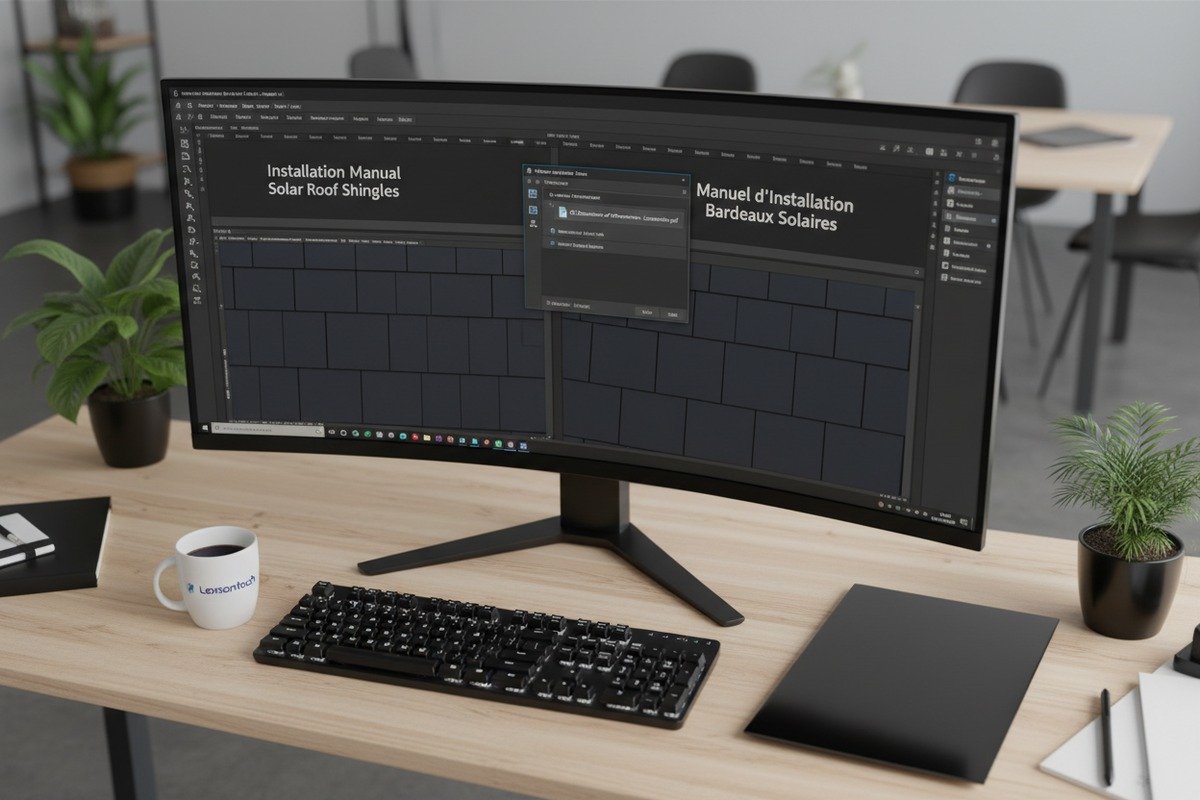
Yes, you can and should request customized wiring support videos from your Chinese manufacturer. Specify your local electrical codes (e.g., NF C 15-100 for France, VDE for Germany), inverter compatibility requirements, and common on-site scenarios like string configuration, grounding, and rapid shutdown compliance.
Why Wiring Videos Need to Be Customized
A generic wiring video shows cables connecting to an inverter. That is not enough. European markets have strict rapid shutdown requirements, arc fault detection mandates, and grounding standards that vary by country. Your installers need to see wiring done according to their specific local codes — not a universal diagram.
Additionally, solar roof shingles have a unique wiring topology. Unlike traditional panels that wire in straightforward series strings, BIPV shingles often use a zigzag wiring pattern across the roof surface. Each shingle connects to the next through integrated MC4-compatible connectors hidden beneath the overlap. If the installer misses one connection or routes a cable incorrectly, the entire string underperforms or trips the inverter's fault detection.
What to Specify in Your Custom Video Request
Local code references: Tell your supplier which national electrical installation code applies. For example, NF C 15-100 in France, BS 7671 in the UK, or VDE 0100 in Germany. The video should reference these by name and show compliant practices.
Inverter pairing: Specify which inverters your installers commonly use — Enphase microinverters, SMA string inverters, Huawei optimizers, etc. The video should demonstrate the exact connection process with that hardware.
String layout scenarios: Request videos showing wiring for common roof shapes — simple gable, hip roof, L-shaped roof, and dormer integration. Each shape creates different string lengths and cable routing challenges.
Troubleshooting segments: Ask for a dedicated troubleshooting section covering the top five wiring problems: low string voltage, ground fault alarms, arc fault triggers, shading mismatch, and connector seating failures.
Sample Request Format
Here is a structured brief you can send to your supplier:
"Please produce a technical support video for on-site wiring of your [Model] solar roof shingles. Requirements:
- Show wiring for a 30-tile array on a simple gable roof with Enphase IQ8 microinverters
- Reference NF C 15-100 grounding requirements
- Demonstrate MC4 connector seating verification
- Include rapid shutdown device installation per EN 50549-1
- Show troubleshooting for ground fault and low voltage scenarios
- Deliver in 1080p with separate English and French .SRT subtitle files
- Provide raw footage for our team to create additional language versions"
Delivery Format Comparison
| Format Option | Pros | Cons | Best For |
|---|---|---|---|
| Edited video with burned-in subtitles | Ready to use immediately | Cannot change language without re-edit | Single-market distributors |
| Edited video with separate .SRT files | Easy to add languages | Requires video player that supports subtitles | Multi-market distributors |
| Raw footage + script document | Maximum flexibility for rebranding | Requires post-production capability | Large distributors with marketing teams |
| Interactive chapter-marked video | Installers jump to relevant section | Higher production cost | Field training programs |
Our engineering team films custom wiring videos on request for orders above our standard project threshold. We use a full-scale test roof with actual inverters and monitoring software running live, so the video shows real voltage readings and system commissioning — not just cable routing.
Co-Creation Works Best
The most effective approach we have seen is co-creation. Your technical team joins a video call with our engineers during filming. They can request specific angles, ask for repeated demonstrations, and flag any steps that differ from local practice. We then edit the footage and send it for your review. This collaborative method produces videos that your installers actually trust and use daily.
If your supplier is reluctant to produce custom videos, offer to share the production cost. A well-made technical video costs between $1,000 and $3,000 to produce but saves tens of thousands in avoided installation errors, warranty claims, and repeat site visits. The return on investment is immediate.
Conclusion
Getting multilingual manuals and installation videos right is not optional — it is the foundation of a successful BIPV distribution business in Europe. Treat documentation as a core product deliverable, not an afterthought.
Footnotes
1. Defines solar shingles as photovoltaic modules integrated into roofing. ↩︎
2. Found an authoritative page describing the EN 62446-1 standard for PV systems. ↩︎
3. Explains CE marking requirements and how to obtain it for products in the EU. ↩︎
4. Explains how photovoltaic devices convert sunlight into electricity using semiconductors. ↩︎
5. Lays down requirements for design qualification and type approval of terrestrial PV modules. ↩︎
6. Explains the Euroclass system for fire classification of building products, including EN 13501-1. ↩︎
7. Found the official EU Regulation 305/2011 (Construction Products Regulation) on EUR-Lex, the official journal of the European Union. ↩︎
8. Specifies fundamental construction requirements for PV modules to ensure safe electrical and mechanical operation. ↩︎
9. Explains the EU Construction Products Regulation and its obligations for manufacturers. ↩︎
10. Describes EPDM grommets, their applications, and characteristics for protection and sealing. ↩︎