

Every year, we see buyers receive thousands of solar roof shingles 1 only to discover hidden micro-cracks after installation. The damage is done. Warranties get disputed. Projects stall. The root cause? Skipping piece-by-piece EL testing before shipment.
To request piece-by-piece EL testing from a Chinese solar shingle manufacturer, you must include explicit testing clauses in your purchase contract, specify acceptable defect thresholds, require individually labeled EL images for every shingle, and arrange independent third-party verification before shipment.
This guide walks you through the exact steps to protect your investment Electroluminescence imaging 2. We cover contract language, report verification, defect identification, and the practical challenges of working with Chinese suppliers on this critical quality step.
How can I specify piece-by-piece EL testing requirements in my purchase contract?
We have worked with distributors in France and Germany who lost tens of thousands of euros because their contracts only mentioned "quality inspection" without defining what that meant. Vague language is the enemy of good quality control.
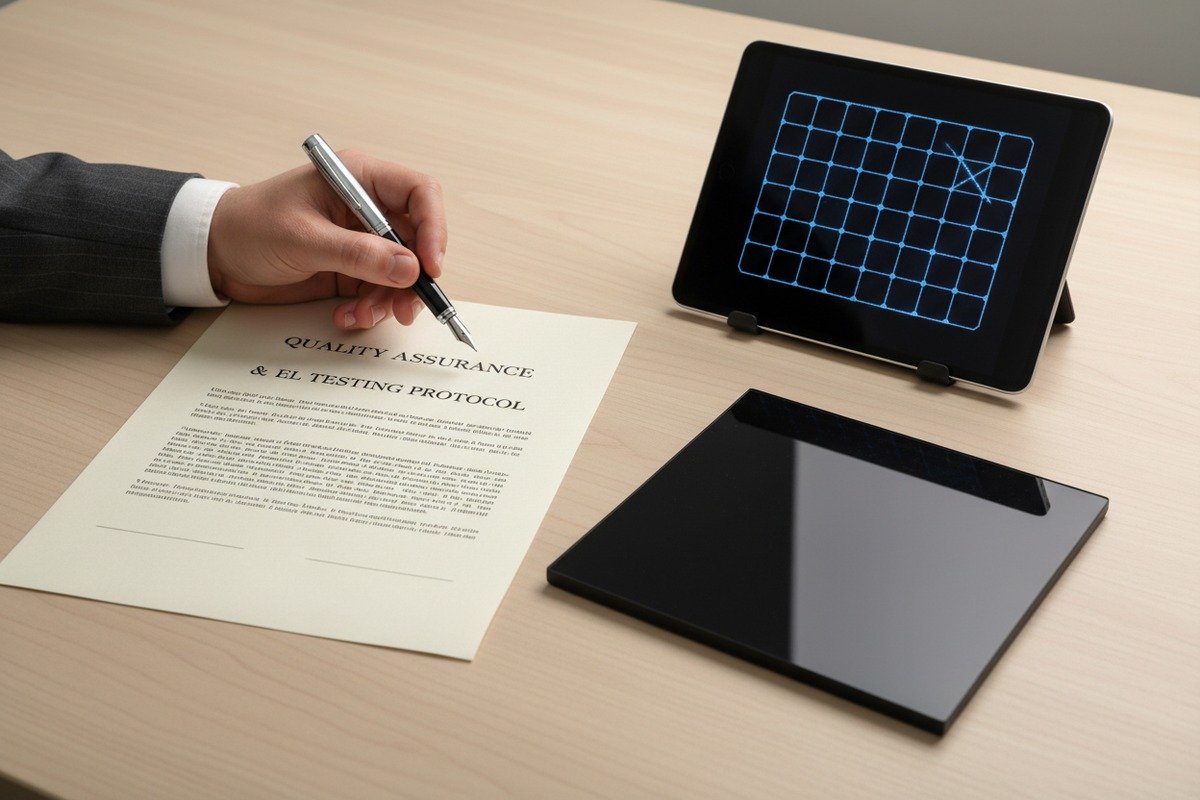
Your purchase contract should include a dedicated EL testing clause that mandates 100% piece-by-piece Electroluminescence imaging, defines pass/fail criteria with specific defect classifications, requires individually traceable EL images per shingle, and outlines rejection and replacement procedures for non-conforming units.
Why Generic Quality Clauses Fail
Most buyers add a line like "products must pass quality inspection" to their contracts. This is almost meaningless. It gives the manufacturer full discretion over what "pass" means. In our production facility, we have seen how different interpretations of quality standards can lead to disputes months after delivery.
A proper EL testing clause must be specific. It should name the testing method, the equipment standard, the acceptable defect levels, and the documentation format.
Key Elements of an EL Testing Contract Clause
Here is what your contract clause should cover:
| Contract Element | What to Specify | Why It Matters |
|---|---|---|
| Testing Method | Electroluminescence (EL) imaging per IEC 62446-3 3 or equivalent | Ensures a recognized standard is used |
| Testing Scope | 100% of units (piece-by-piece), not sampling | Eliminates batch-level loopholes |
| Image Resolution | Minimum resolution (e.g., 1 megapixel per cell) | Prevents low-quality images that hide defects |
| Labeling | Each EL image linked to a unique shingle serial number | Ensures traceability from factory to rooftop |
| Defect Thresholds | Maximum allowable crack length, dark area percentage | Creates objective pass/fail criteria |
| Reporting Format | Digital files (TIFF or PNG), delivered before shipment | Allows buyer review before goods leave the factory |
| Non-Conformance | Replacement or credit for failed units, at manufacturer cost | Protects buyer financially |
| Third-Party Witness | Right to have independent inspector present during testing | Adds verification layer |
How to Frame the Request to Your Supplier
When we discuss EL testing with our overseas partners, we always recommend framing it as a shared quality goal rather than an accusation of poor workmanship. Chinese manufacturers respond better when the request is positioned as a market requirement. For example, you can say: "Our European clients require individual EL traceability for each shingle installed. This is a market standard we both need to meet."
This approach reduces friction. It also opens the door to negotiating the cost of testing. Piece-by-piece EL testing does add time and expense to production. Expect a cost premium of roughly 2–5% depending on the order volume. Factor this into your pricing negotiations upfront rather than treating it as an afterthought.
Protecting Yourself With a Trial Order
Before committing to a large order, place a trial order of 50–100 shingles with full EL testing. Review the images, check labeling consistency, and verify that the defect criteria in your contract are being applied correctly. This small investment can save you from a catastrophic quality failure later.
Why is individual EL reporting critical for my solar roof shingle warranty and project safety?
On our production line, we run EL scans on every single shingle before it leaves the facility. We do this because we have seen firsthand what happens when a cracked cell goes undetected — it degrades faster, drags down the string performance, and eventually causes a warranty claim that costs everyone time and money.
Individual EL reporting is critical because solar roof shingles serve a dual structural and electrical function. A hidden defect does not just reduce energy output — it can compromise waterproofing integrity, create fire risks from hot spots, and void both product and installation warranties if undocumented.

The Dual Risk of Solar Roof Shingles
Standard solar panels sit on a rack above your roof. If a panel fails, you replace it. The roof underneath is fine. Solar roof shingles are the roof. If a shingle fails electrically and structurally, you face both an energy loss and a potential leak. This dual risk makes individual quality documentation far more important than it is for conventional panels.
How EL Reports Support Warranty Claims
When a performance issue arises three or five years after installation, the first question any warranty team asks is: "What did the shingle look like at the time of delivery?" warranty claims 4 Without a piece-by-piece EL image from before installation, you have no baseline. You cannot prove whether a defect was pre-existing or caused by installation or weather.
Individual EL reports create a factory-condition record for each shingle. This record is your strongest tool in any warranty dispute.
Safety Implications of Undetected Defects
Micro-cracks 5 in solar cells can lead to hot spots. Hot spots generate localized heat that, in extreme cases, can cause thermal damage to surrounding materials. Since solar roof shingles are integrated directly into the building envelope, this heat is in contact with roofing membranes, wood decking, and insulation. The fire risk is real.
| Risk Type | With EL Testing | Without EL Testing |
|---|---|---|
| Micro-crack detection | Identified and rejected before shipment | Goes undetected; degrades over time |
| Hot spot prevention | Defective cells removed from supply | Hot spots 6 develop after 2–5 years |
| Warranty baseline | Clear photographic evidence per shingle | No evidence; disputes favor manufacturer |
| Waterproofing integrity | Structurally sound shingles confirmed | Cracked shingles may warp or delaminate |
| Insurance compliance | Documentation supports building code filings | Missing records may void building insurance |
The European Regulatory Angle
In Europe, the Construction Products Regulation (CPR) 7 requires building materials to meet fire safety, structural, and environmental standards. Solar roof shingles fall under both photovoltaic and building material regulations. Individual EL testing documentation strengthens your CPR compliance file. It demonstrates due diligence in product selection and quality verification — something that building inspectors and insurance underwriters increasingly expect.
When we ship to our European partners, we include EL reports as part of a complete compliance package alongside CE certificates, TUV reports, fire rating documentation, and wind load test results. This package protects both us and the buyer.
How do I verify that the EL test images provided by my manufacturer are authentic and accurate?
Our engineering team has reviewed EL reports from dozens of suppliers across China — not just our own. We have seen duplicate images relabeled with different serial numbers, stock images from testing equipment catalogs, and reports with resolution so low that defects were invisible. The problem is more common than most buyers realize.
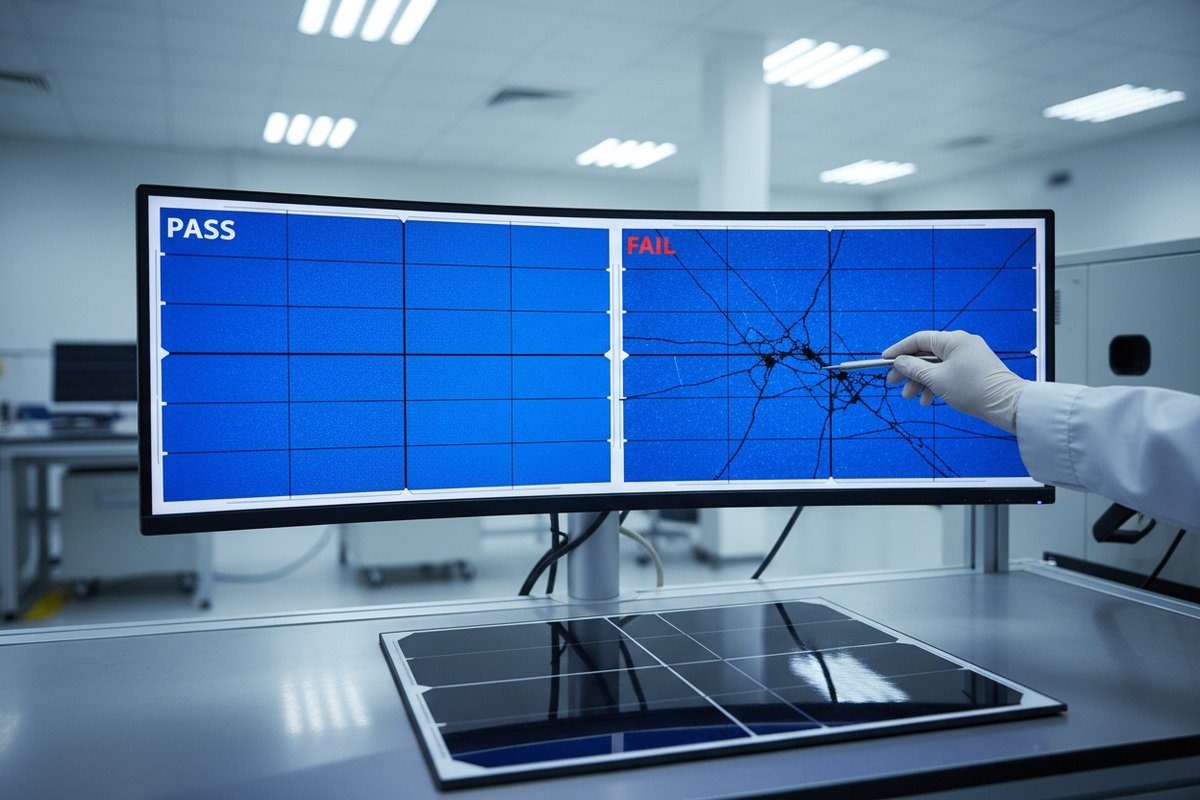
To verify EL image authenticity, cross-check each image's embedded metadata (timestamp, camera model, resolution) against production records, require unique serial number watermarks on every image, request random re-testing by an independent third-party inspector, and verify report numbers directly with the issuing laboratory.
The Counterfeit Documentation Problem
The solar supply chain has a known issue with fraudulent test reports. Some suppliers purchase certificates or fabricate test images to meet buyer requirements without actually performing the tests. This is not unique to solar shingles — it occurs across the broader solar and electronics industries. But the consequences for solar roof shingles are especially severe because of the dual structural-electrical function.
Step-by-Step Verification Process
Here is a practical checklist for verifying EL images:
Step 1: Check EXIF metadata. Every digital image contains metadata showing when it was taken, with what device, and at what resolution. EXIF metadata 8 If all images share identical timestamps or show a consumer camera model instead of an industrial EL camera, that is a red flag.
Step 2: Require serial number watermarks. Each EL image should display the shingle's unique serial number either burned into the image or physically visible on a label in the frame. This prevents image reuse.
Step 3: Request video documentation. Ask the manufacturer to provide a short video of the EL testing process for a randomly selected batch. The video should show the shingle being connected, the current applied, and the EL image captured.
Step 4: Hire an independent inspector. Companies like Bureau Veritas, SGS, and TUV Rheinland offer pre-shipment inspection services in China. They can witness EL testing on-site and verify that images match the actual shingles being tested. This is the strongest verification method available.
Step 5: Verify with the laboratory. If the manufacturer uses a third-party lab for EL testing, contact the lab directly with the report number. Confirm that the report was actually issued by that lab and matches the product specifications in your order.
AI-Powered Image Analysis
A growing number of quality assurance firms now use AI software to analyze EL images automatically. These tools can detect duplicated images across a batch, identify resolution inconsistencies, and flag anomalies faster than manual review. If you are ordering tens of thousands of shingles, investing in AI-assisted EL analysis can save significant time and improve detection accuracy.
Cost of Verification vs. Cost of Failure
Many buyers hesitate to spend on independent verification. Consider this: a third-party inspector for a pre-shipment EL check costs roughly €1,500–€3,000 per visit. A single container of defective solar roof shingles that fails on a European rooftop can cost €50,000–€200,000 in replacement labor, material, and legal fees. The math is clear.
What specific defects should I look for in my EL reports to avoid future performance issues?
When our quality control team reviews EL images on the production floor, they follow a strict defect classification system. Not every dark spot means a shingle should be rejected. But certain patterns — especially those that cross busbars or appear near cell edges — are clear indicators of future failure.
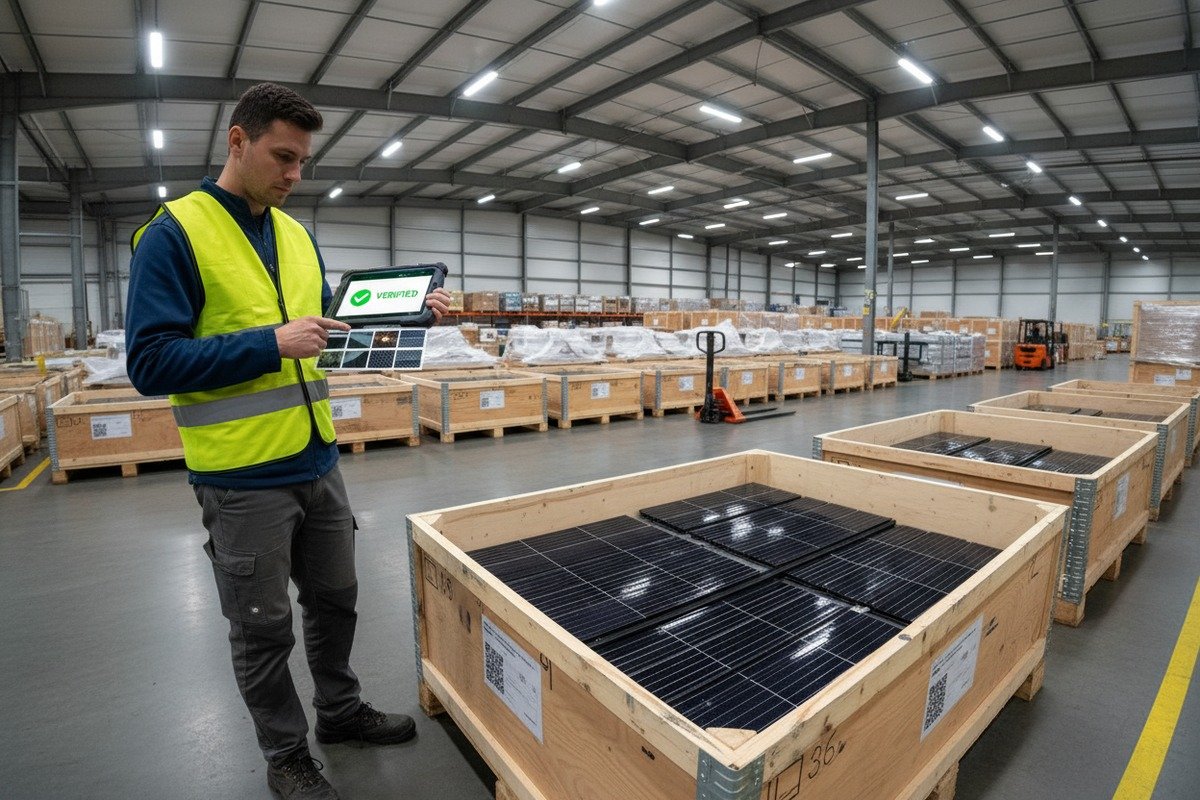
In EL reports, look for micro-cracks crossing busbars or cell interconnects, large dark areas indicating inactive cell regions, dendritic cracks that branch outward suggesting mechanical stress, edge darkening from poor soldering, and snail trail precursors that appear as faint linear shadows — all of which accelerate degradation under thermal cycling and wind loads.
Understanding What EL Images Show
An EL image is essentially a brightness map of a solar cell under forward bias. Bright areas indicate healthy, active silicon. Dark areas indicate regions where current is not flowing properly. The darker the area, the more severe the defect.
But not all dark areas are equal. A small dark spot at the center of a cell may be cosmetic. A crack running from edge to busbar can propagate under thermal cycling 9 and eventually cause the cell to split, creating a hot spot.
Common Defect Types and Their Impact
| Defect Type | Appearance in EL Image | Severity | Long-Term Impact |
|---|---|---|---|
| Micro-crack (isolated) | Thin dark line within a cell | Low to Medium | May propagate under thermal stress |
| Micro-crack (crossing busbar) | Dark line crossing a bright vertical strip | High | Likely to cause cell segment isolation |
| Inactive cell region | Large dark patch covering >10% of cell area | High | Permanent power loss; hot spot risk |
| Edge darkening | Dark border along one or more cell edges | Medium | Indicates poor soldering; may worsen |
| Dendritic crack | Branching dark lines like tree roots | High | Rapid propagation under load/wind |
| Snail trail precursor | Faint linear shadow, often wavy | Medium | Evolves into visible snail trails within 1–3 years |
| Uniform dimness | Entire cell appears darker than neighbors | Medium | Possible low-grade cell; reduces string output |
How to Set Defect Acceptance Criteria
You should define acceptance criteria in your contract based on a severity classification system. A common approach uses three levels:
Class A (No defects): The EL image shows uniform brightness across all cells. No visible cracks, dark areas, or edge effects. This is the ideal standard for premium installations.
Class B (Minor defects allowed): Small isolated micro-cracks that do not cross busbars. Minor edge darkening affecting less than 5% of cell area. Acceptable for standard residential projects.
Class C (Reject): Any crack crossing a busbar. Any inactive region exceeding 10% of a single cell. Any dendritic cracking pattern. Any shingle in this category should be rejected and replaced.
The Thermal Cycling Factor
Solar roof shingles on a European rooftop experience daily temperature swings of 30–50°C. Over 25 years, that adds up to thousands of thermal cycles. A micro-crack that looks minor in a factory EL image will grow under these conditions. This is why our engineers err on the side of caution — we reject shingles at Class B level for clients who specify premium installations.
Correlating EL Defects With Flash Test Data
EL testing tells you where defects are. Flash testing 10 tells you how much power the shingle produces. The two should be reviewed together. If a shingle passes flash testing at rated power but shows a significant dark area in its EL image, the defect may not yet affect output — but it will. A shingle that looks fine electrically today can lose 5–15% of its output within 3–5 years if underlying cracks propagate.
Always request both EL and flash test reports. Compare them side by side. If they contradict each other, investigate further before accepting the shipment.
Conclusion
Piece-by-piece EL testing is not optional for solar roof shingles — it is essential. Protect your projects with clear contracts, authentic reports, and rigorous defect standards. Your rooftop depends on it.
Footnotes
1. Explains Building-Integrated Photovoltaics (BIPV), a category that includes solar roof shingles. ↩︎
2. Provides a comprehensive overview of electroluminescence testing for solar panels. ↩︎
3. Official source defining the international standard for outdoor thermographic inspection of PV modules. ↩︎
4. Provides information on common reasons solar panel warranties can be voided. ↩︎
5. Details causes, impacts, and prevention of micro-cracks in solar panels, a critical defect. ↩︎
6. Explains hot spots as a fire risk in solar systems and prevention measures. ↩︎
7. Explains the updated European Construction Products Regulation and its implications for manufacturers. ↩︎
8. Provides an online tool and explanation for viewing and verifying EXIF metadata in images. ↩︎
9. Explains thermal cycling as a cause of solar panel degradation and micro-cracks. ↩︎
10. Describes flash testing as a method to assess solar panel electrical performance. ↩︎