

Every year, our technical team fields dozens of calls from European distributors dealing with leaking solar roofs—costly failures that could have been prevented with proper upfront verification.
To verify if solar roof shingles meet European waterproofing standards, check for CE marking, European Technical Assessment (ETA) certificates, compliance with EN 13956 or ETAG 005, and independent test reports from accredited bodies like TÜV Rheinland. Also confirm fire classification, wind load ratings, and that warranties explicitly cover structural water penetration—not just electrical output.
This guide walks you through the exact certifications, test reports, design checks, and warranty terms you need to confirm before committing to any solar shingle product for the European market thermal cycling reports 1. Let’s break it down step by step.
Which specific European building certifications should I check to confirm a solar shingle's waterproofing performance?
When we ship solar roof shingles to partners in France, Germany, or Belgium, the first question is always the same: "Which certifications do I actually need to show my building inspector?"
You should check for CE marking under the Construction Products Regulation (CPR), a valid European Technical Assessment (ETA), compliance with EN 13956 for flexible waterproofing sheets, fire classification per EN 13501-5, and IEC 61215/61730 for PV performance and safety. These certifications together confirm both building and electrical compliance.
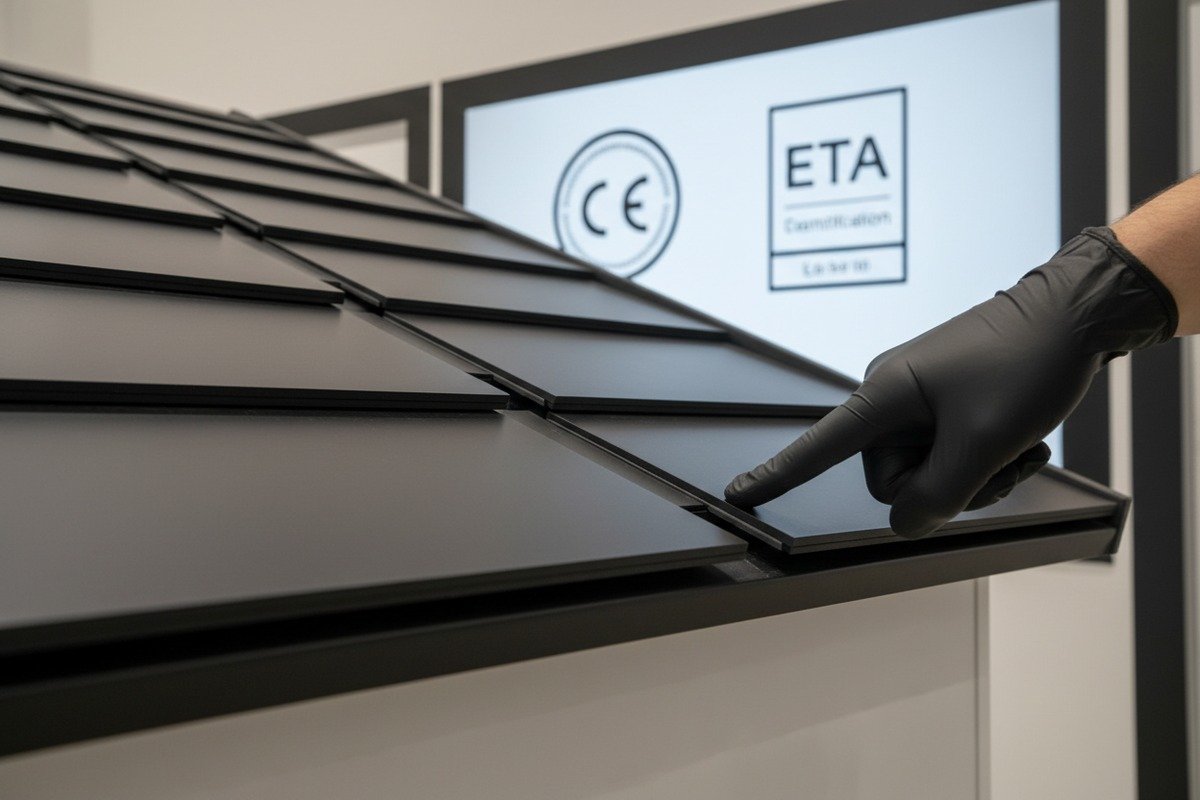
CE Marking Is Your Entry Ticket
CE marking 2 is non-negotiable for any construction product sold in the EU. It signals that the product meets essential health, safety, and environmental requirements. For solar roof shingles, CE marking must cover both the photovoltaic function and the building material function. A product with only an electrical CE mark but no construction CE mark is incomplete and may be rejected by local building authorities.
Our production line carries CE certification covering both aspects. This dual compliance is what separates legitimate BIPV products from standard solar panels bolted onto a roof.
ETA and ETAG 005: The Waterproofing Gold Standard
The European Technical Assessment 3 (ETA) is issued by authorized bodies under EOTA (European Organisation for Technical Approvals). For liquid-applied and flexible waterproofing systems, ETAG 005 4 is the relevant guideline. If your solar shingle integrates a membrane or liquid waterproofing layer, the supplier should hold an ETA based on ETAG 005.
However, not all solar shingles use liquid-applied membranes. Many rely on overlapping shingle design with underlayment. In those cases, EN 13956 5 (for flexible sheets in waterproofing) or national building codes may apply instead.
Key Certifications at a Glance
| Certification / Standard | What It Covers | Why It Matters |
|---|---|---|
| CE Marking (CPR) | Construction product compliance | Legal market entry in the EU |
| ETA (via ETAG 005) | Liquid-applied waterproofing kits | Validates waterproof membrane performance |
| EN 13956 | Flexible sheets for roof waterproofing | Covers sheet-based waterproofing layers |
| EN 13501-5 6 | External fire performance (Broof) | Fire safety classification for roofs |
| IEC 61215 7 | PV module design qualification | Confirms electrical performance standards |
| IEC 61730 | PV module safety qualification | Ensures electrical safety under fault conditions |
| EN 1090 | Structural steel/aluminum execution | Validates mounting system structural integrity |
Don't Overlook National Variations
One important nuance: EU standards set the baseline, but countries like France, Belgium, and Germany add their own requirements. In France, Avis Technique (ATec) or Document Technique d'Application (DTA) may be required. In Germany, DIN norms supplement EN standards. Always ask your supplier if they have country-specific approvals for your target market.
We have worked with distributors in both France and Belgium who were initially confident their CE-marked product was sufficient—only to face delays when local inspectors requested additional national documentation. It is far cheaper to verify this upfront.
The Waterproofing vs. Water-Shedding Debate
There is a critical distinction that many buyers miss. Steep-slope roofs with shingles primarily rely on water-shedding, not full waterproofing. Water runs off overlapping tiles, aided by underlayment. True waterproofing (impervious barrier) is mainly required for flat or very low-slope roofs (≤2% gradient). If your project is steep-slope, the shingle's overlap design and underlayment quality matter more than a liquid membrane certification. If it is low-slope, demand ETAG 005 or equivalent.
How can I evaluate if the interlocking drainage design of these tiles is sufficient for heavy rain and Grade 15 winds?
During our R&D process for interlocking solar shingles, we tested dozens of drainage channel profiles before settling on one that handles extreme European weather conditions reliably.
Evaluate the interlocking drainage design by reviewing wind uplift test data per Eurocode 1 (EN 1991-1-4), checking overlap dimensions against national minimum lap requirements, confirming EPDM or silicone gasket integration at joints, and verifying that the tile profile includes dedicated drainage channels designed to redirect water away from fastener points even under wind-driven rain.
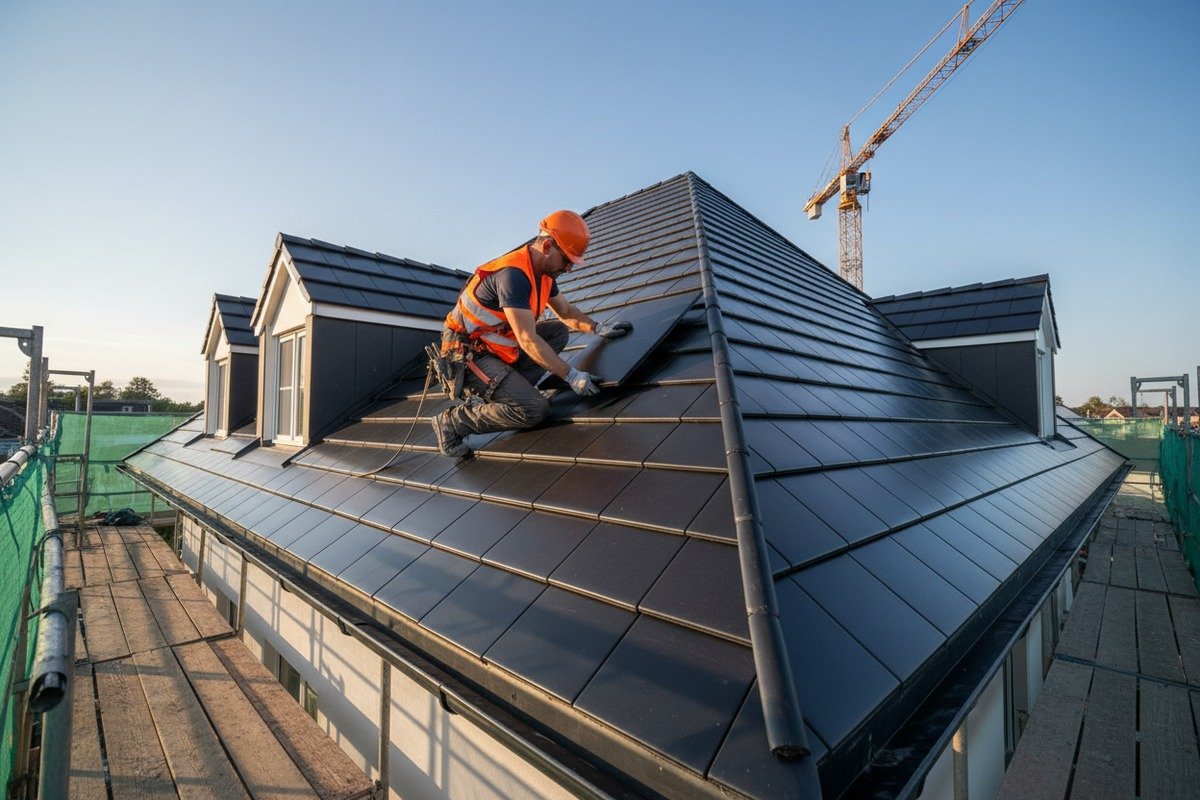
Understanding Wind-Driven Rain
Normal rain falls vertically. Wind-driven rain 9 does not. At Grade 15 wind speeds, water can be pushed horizontally and even upward through tile overlaps. This is why simple overlap is not enough. The interlocking mechanism must include labyrinth-style channels that force water to change direction multiple times before it could reach any vulnerable point.
Our tiles feature a triple-channel interlock design. Each joint has a primary drainage groove, a secondary capillary break, and a final barrier channel. This means even if wind pushes water past the first channel, the second and third layers catch it.
Key Design Metrics to Check
| Design Feature | Minimum Recommended Spec | What to Ask Your Supplier |
|---|---|---|
| Head lap (top-bottom overlap) | ≥75 mm for moderate exposure | "What is the minimum head lap for your tile?" |
| Side lap (left-right interlock) | ≥30 mm with drainage channel | "Does the side interlock include a water channel?" |
| Gasket material | EPDM or silicone (UV-resistant) | "What seal material is used, and what is its lifespan?" |
| Wind uplift resistance | Tested per EN 1991-1-4 (Eurocode 1 10) | "Provide wind tunnel or mechanical uplift test data." |
| Fastener sealing | EPDM washer or hidden fixing | "Are screw penetrations sealed or fully concealed?" |
| Drainage channel depth | ≥5 mm | "What is the depth of the drainage groove at the interlock?" |
Non-Drilling Fixings Preserve Integrity
One of the biggest risks to waterproofing on any roof is drilling holes through the weatherproofing layer. Traditional solar panel mounting requires rafter hooks or bracket screws that penetrate tiles. Our approach uses concealed hook systems made from A2/A4 stainless steel that grip rafter structures without penetrating the tile surface. Each hook is rated for >1.5 kN tensile load per EN 1090, with 30–60 mm vertical adjustment to accommodate rafter irregularities.
When screws are necessary, they should use 8–10 mm wood screws torqued to 15–20 Nm, with EPDM washers providing a compression seal. Over-torquing crushes the washer and breaks the seal. Under-torquing leaves a gap. Ask your supplier for the exact torque specification.
Structural Load Compliance Under Eurocode
Eurocode 1 (EN 1991-1-4 for wind loads, EN 1991-1-3 for snow loads) governs structural requirements across Europe. The mounting rails—typically 40×40 mm aluminum profiles—should span no more than 1.2 m between supports to handle combined wind, snow, and self-weight loads. Request your supplier's structural calculation report showing compliance with the Eurocode load combinations relevant to your project location.
For coastal or high-altitude installations, exposure factors increase significantly. A tile system that passes in Paris may fail in Brest or in the Alps. Always specify your project's wind zone and snow zone when requesting test data.
Real-World Failure Patterns
From warranty claim data we have reviewed over 20 years, the most common leak points are not the tile faces—they are the overlaps and flashings. Specifically:
- Side interlocks where the gasket has degraded due to UV exposure.
- Head laps where debris accumulation creates a dam effect.
- Penetration points where screws were over-torqued or under-sealed.
These failures are preventable with proper design and installation training. We provide detailed installation manuals and on-site training for our distribution partners to minimize these risks.
What technical test reports should I request from my supplier to verify the product's resistance to water penetration?
Our quality assurance team runs every batch through a rigorous testing protocol before shipment, but we always encourage buyers to independently verify by requesting the right documentation.
Request these technical reports: water penetration test results per EN 13956 or ETAG 005, hail impact resistance data (35 mm steel ball at terminal velocity), thermal cycling reports (-40°C to +85°C for 200 cycles), damp heat exposure (85°C/85% RH for 1000 hours per IEC 61215), wind uplift test certificates per EN 1991-1-4, and artificial aging test results showing seal integrity after simulated 25-year exposure.
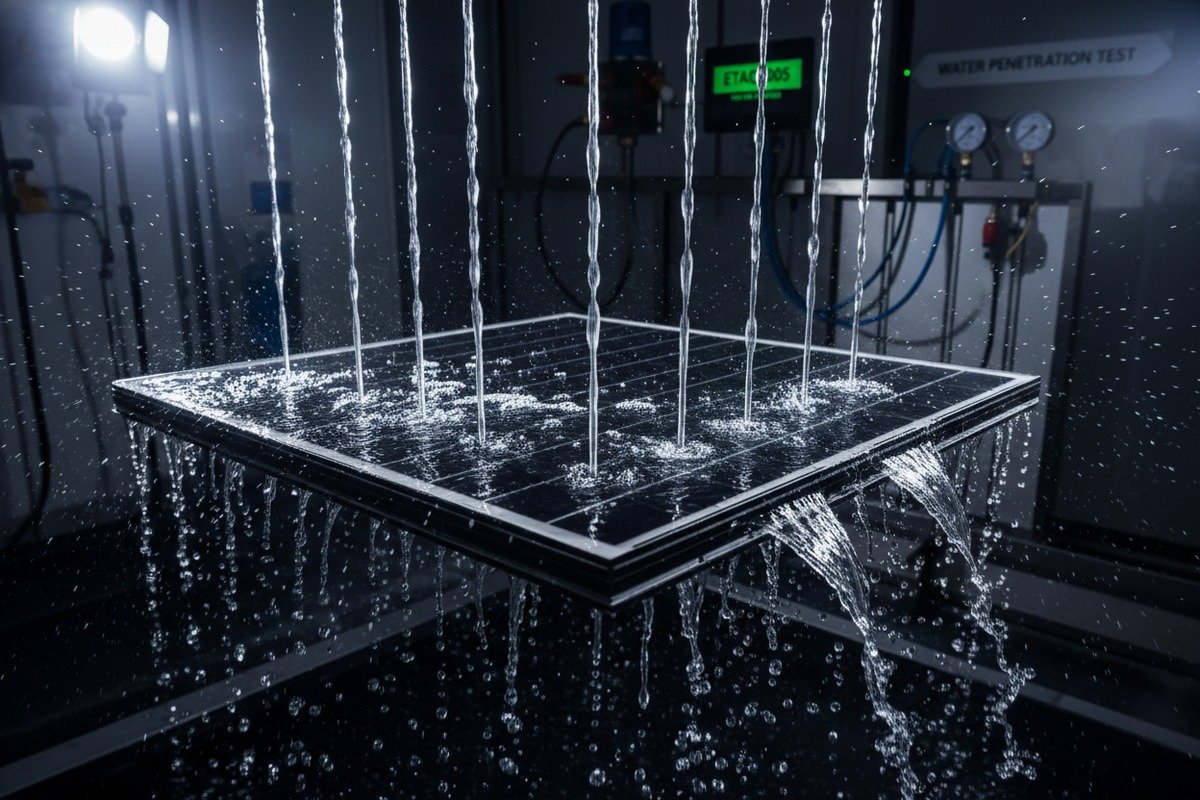
The Essential Test Report Checklist
Not all test reports are equal. Some suppliers provide generic PV module test certificates and claim waterproofing compliance by association. That is not sufficient. Here is what you need:
| Test / Report | Standard | What It Proves |
|---|---|---|
| Water penetration resistance | EN 13956 / ETAG 005 | Direct measurement of water ingress through the product |
| Hail impact resistance | EN 12049 / IEC 61215 (Module) | Structural integrity after impact (35 mm hail at our spec) |
| Thermal cycling | IEC 61215 (-40°C to +85°C, 200 cycles) | No delamination, seal failure, or cracking after thermal stress |
| Damp heat | IEC 61215 (85°C/85% RH, 1000 hrs) | Moisture resistance of encapsulation and seals |
| Wind uplift / mechanical load | EN 1991-1-4 / IEC 61215 (5400 Pa) | Tile stays secure and sealed under extreme wind suction |
| Artificial aging (UV exposure) | EN 13956 / ISO 4892 | Seal and surface material durability after UV degradation |
| Fire classification | EN 13501-5 (Broof) | External fire performance rating |
| Salt mist corrosion | IEC 61701 | Suitability for coastal installations |
| Tensile load on fixings | EN 1090 (>1.5 kN per hook) | Mounting hardware structural safety |
Insist on Third-Party Accreditation
Test reports should come from accredited, independent laboratories. Look for Notified Bodies recognized under the CPR, or well-known institutions like TÜV Rheinland, Fraunhofer Institute, or CSTB (Centre Scientifique et Technique du Bâtiment) in France. A report generated by the manufacturer's own internal lab, while useful for quality control, does not carry the same weight with building inspectors or insurance companies.
Our products are tested by TÜV-accredited labs, and we provide full third-party certificates with every shipment. If a supplier hesitates to share these documents, treat that as a red flag.
Beyond Initial Certification: Long-Term Degradation
One of the most overlooked aspects is what happens after year 10 or year 15. Initial test reports confirm the product works when new. But EPDM gaskets degrade under UV. Polymer-modified bitumen underlayments can become brittle. Thermal cycling fatigues adhesive bonds.
Ask your supplier for accelerated aging test data. These tests simulate decades of exposure in a compressed timeframe. For bitumen-based systems, independent evaluations suggest an expected service life (ESL) of 20–40+ years depending on protection layers. For EPDM seals, look for data showing retention of elasticity after UV aging equivalent to 25 years.
Flood Testing: Know Its Limits
Some buyers ask about flood testing (ponding water on the tile surface). This is relevant for flat roofs with ≤2% slope. For steep-slope installations, flood testing is not the right metric. Instead, focus on wind-driven rain simulation tests and overlap integrity under dynamic pressure. If your project involves low-slope sections, however, flood testing per ETAG 005 methodology becomes essential.
We have seen cases where a solar shingle passed a static water ponding test but failed under wind-driven rain because the interlock channels were too shallow. Always match the test method to the actual roof conditions.
How do I ensure the 25-year warranty actually covers structural leakage and not just electrical output?
We designed our warranty terms specifically to address the number one fear our European partners have: "If this roof leaks in year 8, who pays for the interior damage?"
To ensure your 25-year warranty covers structural leakage, read the warranty document line by line for explicit mentions of "water penetration," "structural integrity," and "roofing function." Confirm it is not limited to power output degradation. Verify the warranty is backed by insurance or escrow, includes labor costs for remediation, and specifies a clear claims process with defined response times.
The Two-Warranty Trap
Most solar products come with two separate warranties: a product warranty (covering material defects, typically 10–15 years) and a performance warranty (covering power output degradation, typically 25–30 years). The performance warranty almost never covers waterproofing. If your supplier only provides a "25-year warranty" without specifying what it covers, you may discover during a leak claim that only electrical output is guaranteed.
Our warranty explicitly separates and covers three domains: electrical performance (25-year linear degradation guarantee), structural/material defects (25-year coverage including waterproofing function), and aesthetic consistency (color stability guarantee). Each domain has its own claims process.
What to Look For in the Warranty Text
Read the fine print carefully. Here are specific phrases and clauses to look for—or demand if absent:
- "Water penetration through the tile body or interlocking joints" — This phrase must appear. Without it, the manufacturer can argue leaks are an installation issue, not a product issue.
- "Including reasonable labor costs for repair or replacement" — In Europe, labor is the largest cost component of any roof repair. A warranty that covers only replacement tiles but not labor is nearly worthless.
- "Transferable to subsequent property owners" — Real estate changes hands. A non-transferable warranty reduces property value.
- "Backed by third-party insurance or escrow arrangement" — This is the ultimate safeguard against supplier disappearance. If the manufacturer goes out of business, the insurance still covers claims.
Supplier Stability and the "Disappearance Risk"
A 25-year warranty is only as strong as the company behind it. This is a legitimate concern, especially when sourcing from overseas. We address this in three ways:
- Financial transparency — We share audited financial statements with key accounts upon request.
- Third-party warranty insurance — Available for large orders, providing an independent guarantee.
- Local stock and support — We maintain relationships with European warehousing and service partners to ensure continuity.
Ask your supplier directly: "If your company ceases operations in year 12, who honors this warranty?" If they cannot answer clearly, reconsider.
Compare Warranty Structures
Here is a comparison framework to evaluate different suppliers' warranty offerings:
| Warranty Element | Strong Warranty | Weak Warranty |
|---|---|---|
| Waterproofing coverage | Explicitly stated for 25 years | Silent on waterproofing or limited to 5 years |
| Labor cost inclusion | Covers reasonable repair labor | Material replacement only |
| Claims response time | Defined (e.g., 48-hour acknowledgment) | No timeline specified |
| Transferability | Fully transferable to new owners | Non-transferable |
| Financial backing | Third-party insurance or escrow | Manufacturer self-guarantee only |
| Exclusions | Clearly listed and reasonable | Vague language allowing broad denial |
| Geographic scope | Covers all EU installation countries | Limited to country of purchase |
Practical Steps Before Signing
Before you sign a purchase agreement, take these steps:
- Request the full warranty document in English and your local language.
- Have a local construction lawyer review the waterproofing clauses.
- Ask for references from existing European customers who have filed warranty claims.
- Confirm the warranty is registered with a third-party administrator if available.
- Document your installation with photos and torque records—most warranties require proof of correct installation.
We provide our partners with a detailed installation checklist that, when completed and submitted, automatically activates the full warranty including structural waterproofing coverage. This protects both parties.
Conclusion
Verifying European waterproofing compliance for solar roof shingles requires checking certifications, evaluating drainage design, demanding accredited test reports, and scrutinizing warranty terms—every step protects your investment and your reputation.
Footnotes
1. Detailed explanation of thermal cycling tests for solar modules, referencing IEC 61215. ↩︎
2. Wikipedia page explaining CE marking within the Construction Products Regulation. ↩︎
3. Official EOTA website explaining the European Technical Assessment (ETA) process. ↩︎
4. Authoritative source (EOTA) explaining the archive of European Technical Approval Guidelines (ETAGs), including ETAG 005, and their transition to European Assessment Documents (EADs). ↩︎
5. Details of the European standard EN 13956 for flexible sheets for roof waterproofing. ↩︎
6. Explanation of the European standard EN 13501-5 for fire classification of roof coverings. ↩︎
7. Official IEC standard page for design qualification of terrestrial photovoltaic modules. ↩︎
8. Wikipedia page detailing the EU’s Construction Products Regulation (CPR). ↩︎
9. Provides a clear definition and explanation of wind-driven rain and its impact, which is relevant to the article’s context, in an accessible HTML format. ↩︎
10. Authoritative Wikipedia page offering a comprehensive overview of Eurocode 1: Actions on structures, including its various parts and specific mention of wind actions (EN 1991-1-4). ↩︎